Kirjojen hintavertailu. Mukana 12 595 353 kirjaa ja 12 kauppaa.

Kirjailija

Ion Boldea

Kirjat ja teokset yhdessä paikassa: 22 kirjaa, julkaisuja vuosilta 2015-2025, suosituimpien joukossa Reluctance Electric Machines. Vertaile teosten hintoja ja tarkista saatavuus suomalaisista kirjakaupoista.

22 kirjaa

Kirjojen julkaisuhaarukka 2015-2025.

Electric Drives

Electric Drives

Ion Boldea

TAYLOR FRANCIS LTD
2025
sidottu
Electric Drives, now in its fourth edition, provides a practical guide in understanding the fundamental principles and recent new knowledge of electric motion (in motoring) and electric energy flow (in generating) digital control via power electronics for energy savings and increased productivity in practically all industries, from intelligent watches and phones to robots, electric transport, industrial processes, and modern distributed electric power systems with ever more renewable energy penetration.Every proposition, number, figure, and reference has been revisited to bring necessary changes, with new references to key recent knowledge trends, to reflect the present state of the art.The book has been restructured, with a few chapters combined and one chapter (on rectifier d.c. brush motor drives) removed, new introductory paragraphs in most chapters (many as inspiring case studies), and brand-new chapters on flux-modulation machine drives (Chapter 8) and predictive control of a.c. drives (Chapter 15), reflecting this updating effort. The large number of new case studies complements the large number of worked numerical examples and the 10 user-friendly MATLAB® Simulink® programs that remain available online.Although, inevitably, the math is intensive and intended to be directly usable, the book, mainly intended for senior undergraduate and graduate students and engineers in research and development in industry, is a practical, easy-to-assimilate, and an up-to-date synthesis of basic and advanced power electronics (variable speed) electric motor-generator drives needed in all industries in which electric energy flow-wise, mainly digitally intelligent, control is paramount.
Linear Electric Machines, Drives, and MAGLEVs Handbook
Linear motion is richly present in various industries, from direct electric propulsion in urban and interurban people movers on wheels or on magnetic “cushions” (MAGLEVs) to indoor transport of goods (conveyors, etc.), through plunger solenoids (to open hotel doors and as electromagnetic power switches), to compressor drives by linear oscillatory permanent magnet (PM) motors, smart phones integrated microphone and loudspeakers, and controlled vehicles’ suspension, etc. Besides the traditional rotary motor drives with mechanical transmissions, which mean friction limitations (weather dependent) in traction (heavy vehicles), more losses, positioning errors (backlash) in the process, and higher maintenance costs to handle them, linear motion in industry by direct electromagnetic forces is free of friction limitations for traction, free of mechanical transmission, and thus more efficient, with less maintenance cost and fewer positioning errors (backlash). This explains why they are used in so many applications already since the dramatic advancement of power electronics and digital control in the last four decades.Modeling, performance, design, control, and testing of linear electric machines (LEMs) show notable differences with respect to rotary electric motor drives, which warrant a dedicated treatment of these aspects.The Second Edition (First Edition: 2013) concentrates on the above technical aspects of various types of LEMs in close relationship with specific applications via numerical examples of modeling, design, control, and testing, with ample representative results from literature, industry and some of the author’s contributions, such as: Technical field and circuit modeling of linear induction motors in flat configurations for low and high speeds (with and without dynamic end effects) and in tubular configurations short travel design, control and testing Linear synchronous motor (LSM) drives in dc-excited, homopolar, reluctance and superconducting excitation configurations for urban and interurban high-speed vehicles propulsion and integrated propulsion and levitation (in MAGLEVs) modeling, design and control with full-scale numerical examples, with emphasis on lower KWh/passenger/Km at high speeds Flat and tubular linear permanent magnet (PM) synchronous motors (L-PMSMs), mainly destined to industrial indoor transport for automation at high efficiency in clean rooms Linear “flux-modulation” motors— new breed, suitable for very low-speed applications due to higher thrust density Plunger solenoids in various applications including new valve PM actuators with millisecond response time Linear resonant PM oscillatory motors design, control and testing mainly destined to compressors for higher efficiency in compact drives Attraction and repulsive force suspension (levitation) systems for MAGLEVs Active and passive guideway MAGLEVs in urban and superhigh-speed interurban transport at lower Kwh per passenger/km (in lighter vehicles without wheels) The numerous numerical design and control examples (with practical specifications) throughout the 23 chapters of the book allow the reader deep and fast access to a practical but thorough unitary (good for comparisons) methodology in designing and controlling LEMs for various applications.
Electric Machines

Electric Machines

Ion Boldea; Lucian N. Tutelea

TAYLOR FRANCIS LTD
2024
muu
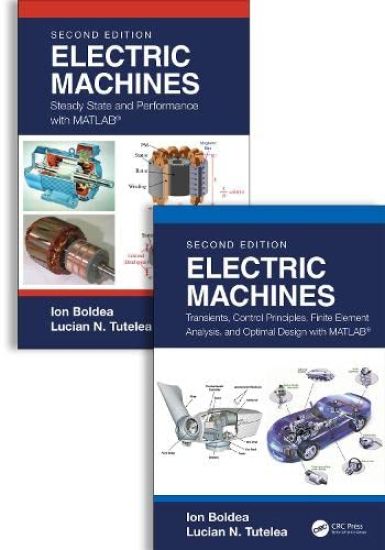
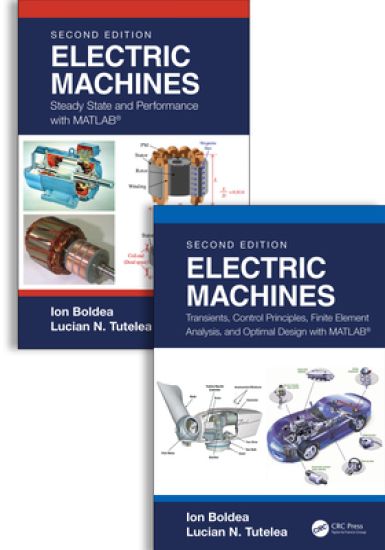
With its comprehensive coverage of the state of the art, this second edition of the book introduces the basic types of transformers and electric machines and also discusses advanced subjects in electric machines, starting from principles, to applications and case studies with ample graphical results. The first volume, Electric Machines: Steady State Performance with MATLAB® covers circuit modeling characteristics and performance characteristics under steady state, testing techniques and preliminary electromagnetic-thermic dimensioning. This book is intended for first semester course, treating electric transformers, rotary and linear machines steady state modeling and performance computation, preliminary dimensioning and testing standardized and innovative techniques. The second volume, Electric Machines: Transients, Control Principles, Finite Element Analysis and Optimal Design with MATLAB® is intended for second (and third) semester course, treating topics such as modeling of transients, control principles, electromagnetic and thermal finite element Analysis and optimal design (dimensioning). Notable recent knowledge with strong industrialization potential has been added to this edition, such as, orthogonal models of multiphase A.C. machines, thermal finite element analysis of (FEA) electric machines, and FEA– based–only optimal design of a PM motor case study. Both the volumes include numerical examples and case studies, and numerous computer simulation programs in MATLAB and Simulink® are also available online that illustrate performance characteristics present in the chapters.
Induction Machines Handbook

Induction Machines Handbook

Ion Boldea

TAYLOR FRANCIS LTD
2024
nidottu
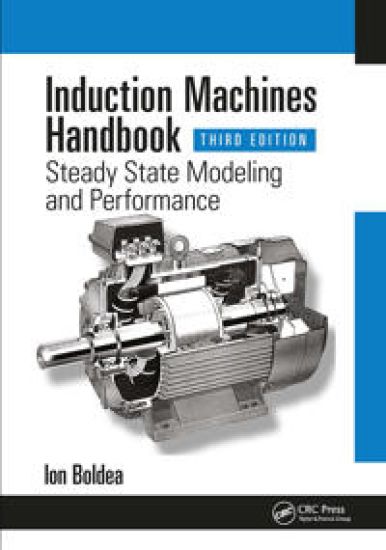
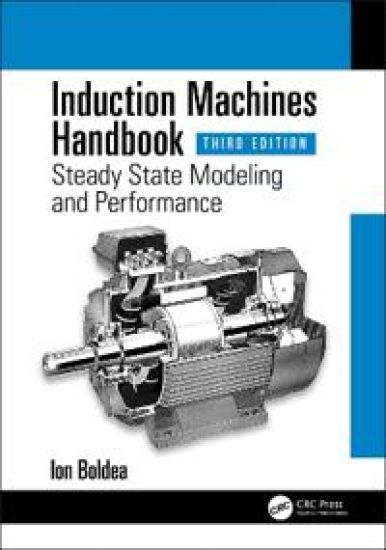
Induction Machines Handbook: Steady State Modeling and Performance offers a thorough treatment of steady-state induction machines (IM), the most used electric motor (generator) in rather constant or variable speed drives, forever lower energy consumption and higher productivity in basically all industries, from home appliances, through robotics to e-transport and wind energy conversion.Chapter 1 offers a detailed introduction from fundamental principles to topological classifications and most important applications and power ranges from tens of W to tens of MW.Then individual Chapters 2 and 4 deal in detail with specific issues, such as Magnetic, electric, and insulation materials Electric windings and their mmf Magnetization curve and inductance Leakage inductances and resistances Steady-state equivalent circuit and performance Starting and speed control methods Skin and on-load saturation effects Field harmonics, parasitic torques, radial forces, noise Losses Thermal modeling Single-phase induction machine basics Single-phase induction motors: steady-state modeling and performanceFully revised and updated to reflect the last decade’s progress in the field, this third edition adds new sections, such as Multiphase and multilayer tooth-wound coil windings The brushless doubly fed induction machine (BDFIM) Equivalent circuits for BDFIM Control principles for doubly fed IM Magnetic saturation effects on current and torque versus slip curves Rotor leakage reactance saturation Closed-slot IM saturation The origin of electromagnetic vibration by practical experience PM-assisted split-phase cage-rotor IM’s steady stateThe promise of renewable (hydro and wind) energy via cage-rotor and doubly fed variable speed generators e-transport propulsion and i-home appliances makes this third edition a state-of-the-art tool, conceived with numerous case studies and timely for both academia and industry.
Induction Machines Handbook

Induction Machines Handbook

Ion Boldea

TAYLOR FRANCIS LTD
2024
nidottu
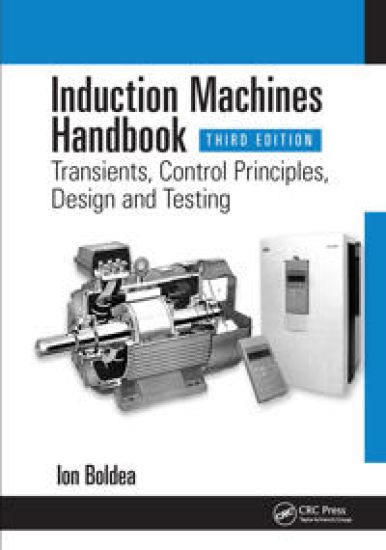
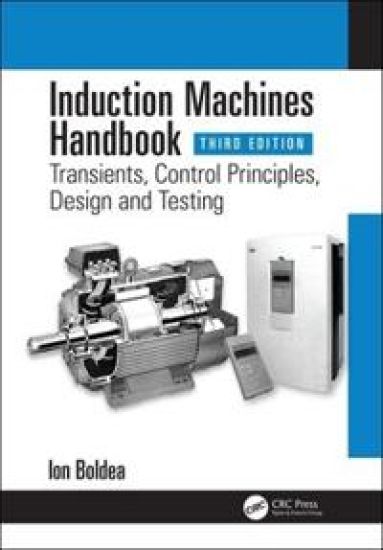
Induction Machines Handbook: Transients, Control Principles, Design and Testing presents a practical up-to-date treatment of intricate issues with induction machines (IM) required for design and testing in both rather constant- and variable-speed (with power electronics) drives. It contains ready-to-use industrial design and testing knowledge, with numerous case studies to facilitate a thorough assimilation of new knowledge.Individual Chapters 1 through 14 discuss in detail the following: Three- and multiphase IM transients Single-phase source IM transients Super-high-frequency models and behavior of IM Motor specifications and design principles IM design below 100 kW and constant V1 and f1 IM design above 100 kW and constant V1 and f1 IM design principles for variable speed Optimization design Single-phase IM design Three-phase IM generators Single-phase IM generators Linear induction motors Testing of three-phase IMs Single-phase IM testingFully revised and amply updated to add the new knowledge of the last decade, this third edition includes special sections on Multiphase IM models for transients Doubly fed IMs models for transients Cage-rotor synchronized reluctance motors Cage-rotor PM synchronous motor Transient operation of self-excited induction generator Brushless doubly fed induction motor/generators Doubly fed induction generators with D.C. output Linear induction motor control with end effect Recent trends in IM testing with power electronics Cage-PM rotor line-start IM testing Linear induction motor (LIM) testingThis up-to-date book discusses in detail the transients, control principles, and design and testing of various IMs for line-start and variable-speed applications in various topologies, with numerous case studies. It will be of direct assistance to academia and industry in conceiving, designing, fabricating, and testing IMs (for the future) of various industries, from home appliances, through robotics, e-transport, and renewable energy conversion.
Electric Machines

Electric Machines

Ion Boldea; Lucian N. Tutelea

TAYLOR FRANCIS LTD
2024
nidottu
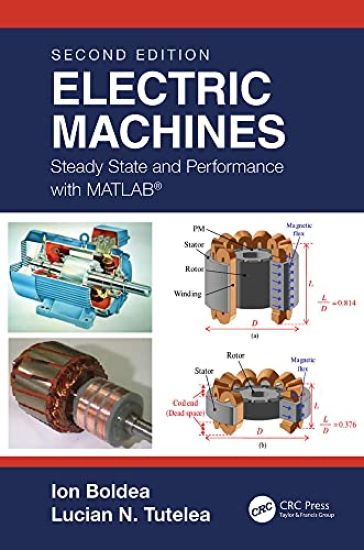
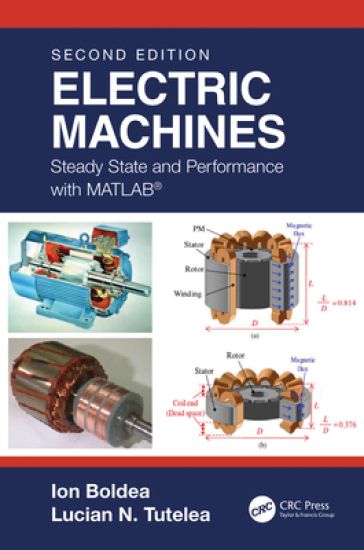
With its comprehensive coverage of the state of the art, this Second Edition introduces basic types of transformers and electric machines. Classifications and characterization—modeling and performance—of power electric transformers (single and multiphase), motors and generators, commercial machines (dc brush, induction dc excited synchronous, PM synchronous, reluctance synchronous) and some new ones (multiphase ac machines, switched reluctance machines) with great potential for industry with rotary or linear motion are all treated in the book. The book covers, in detail, circuit modeling characteristics and performance characteristics under steady state, testing techniques and preliminary electromagnetic-thermic dimensioning with lots of solved numerical examples and special cases to illustrate new electric machines with strong industrialization potential. All formulae used to characterize parameters and performance may be safely used in industry for preliminary designs and have been applied in the book through numerical solved examples of industrial interest. Numerous computer simulation programs in MATLAB® and Simulink® that illustrate performance characteristics present in the chapters are included and many be used as homework to facilitate a deeper understanding of fundamental issues. This book is intended for a first-semester course covering electric transformers, rotary and linear machines, steady-state modeling and performance computation, preliminary dimensioning, and testing standardized and innovative techniques. The textbook may be used by R&D engineers in industry as all machine parameters and characteristics are calculated by ready-to-use industrial design mathematical expressions.
Electric Machines

Electric Machines

Ion Boldea; Lucian N. Tutelea

TAYLOR FRANCIS LTD
2024
nidottu
This Second Edition extensively covers advanced issues/subjects in electric machines, starting from principles, to applications and case studies with ample graphical (numerical) results. This textbook is intended for second (and third) semester courses covering topics such as modeling of transients, control principles, electromagnetic and thermal finite element analysis, and optimal design (dimensioning). Notable recent knowledge with strong industrialization potential has been added to this edition, such as: Orthogonal models of multiphase a.c. machines Thermal Finite Element Analysis of (FEA) electric machines FEA–based–only optimal design of a PM motor case study Line start synchronizing premium efficiency PM induction machines Induction machines (three and single phase), synchronous machines with DC excitation, with PM-excitation, and with magnetically salient rotor and a linear Pm oscillatory motor are all investigated in terms of transients, electromagnetic FEM analysis and control principles. Case studies, numerical examples, and lots of discussion of FEM results for PMSM and IM are included throughout the book.The optimal design is treated in detail using Hooke–Jeeves and GA algorithms with case comparison studies in dedicated chapters for IM and PMSM. Numerous computer simulation programs in MATLAB® and Simulink® are available online that illustrate performance characteristics present in the chapters, and the FEM and optimal design case studies (and codes) may be used as homework to facilitate a deeper understanding of fundamental issues.
Linear Electric Machines, Drives, and MAGLEVs Handbook
Linear motion is richly present in various industries, from direct electric propulsion in urban and interurban people movers on wheels or on magnetic “cushions” (MAGLEVs) to indoor transport of goods (conveyors, etc.), through plunger solenoids (to open hotel doors and as electromagnetic power switches), to compressor drives by linear oscillatory permanent magnet (PM) motors, smart phones integrated microphone and loudspeakers, and controlled vehicles’ suspension, etc. Besides the traditional rotary motor drives with mechanical transmissions, which mean friction limitations (weather dependent) in traction (heavy vehicles), more losses, positioning errors (backlash) in the process, and higher maintenance costs to handle them, linear motion in industry by direct electromagnetic forces is free of friction limitations for traction, free of mechanical transmission, and thus more efficient, with less maintenance cost and fewer positioning errors (backlash). This explains why they are used in so many applications already since the dramatic advancement of power electronics and digital control in the last four decades.Modeling, performance, design, control, and testing of linear electric machines (LEMs) show notable differences with respect to rotary electric motor drives, which warrant a dedicated treatment of these aspects.The Second Edition (first edition: 2013) concentrates on the above technical aspects of various types of LEMs in close relationship with specific applications via numerical examples of modeling, design, control, and testing, with ample representative results from literature, industry and some of the author’s contributions, such as: Technical field and circuit modeling of linear induction motors in flat configurations for low and high speeds (with and without dynamic end effects) and in tubular configurations short travel design, control and testing Linear synchronous motor (LSM) drives in dc-excited, homopolar, reluctance and superconducting excitation configurations for urban and interurban high-speed vehicles propulsion and integrated propulsion and levitation (in MAGLEVs) modeling, design and control with full-scale numerical examples, with emphasis on lower KWh/passenger/Km at high speeds Flat and tubular linear permanent magnet (PM) synchronous motors (L-PMSMs), mainly destined to industrial indoor transport for automation at high efficiency in clean rooms Linear “flux-modulation” motors— new breed, suitable for very low-speed applications due to higher thrust density Plunger solenoids in various applications including new valve PM actuators with millisecond response time Linear resonant PM oscillatory motors design, control and testing mainly destined to compressors for higher efficiency in compact drives Attraction and repulsive force suspension (levitation) systems for MAGLEVs Active and passive guideway MAGLEVs in urban and superhigh-speed interurban transport at lower Kwh per passenger/km (in lighter vehicles without wheels) The numerous numerical design and control examples (with practical specifications) throughout the 23 chapters of the book allow the reader deep and fast access to a practical but thorough unitary (good for comparisons) methodology in designing and controlling LEMs for various applications.
Induction Machines Handbook

Induction Machines Handbook

Ion Boldea

TAYLOR FRANCIS LTD
2023
muu
The third edition of Induction Machines Handbook comprises two volumes, Induction Machines Handbook: Steady State Modeling and Performance and Induction Machines Handbook: Transients, Control Principles, Design and Testing. The promise of renewable (hydro and wind) energy via cage-rotor and doubly fed variable speed generators e-transport propulsion, i-home appliances makes this third edition state of the art tool, conceived with numerous case studies, timely for both Academia and Industry.The first volume offers a thorough treatment of steady state modeling and performance of induction machines, the most used electric motors (generators) in rather constant or variable speed drives for even lower energy consumption and higher productivity in basically all industries, from home appliances, through robotics to e-transport and wind energy conversion.The second volume presents a practical up to date treatment of intricate issues with induction machine (IM) required for design and testing both in rather constant and variable speed (with power electronics) drives. It contains ready to use in industrial design and testing knowledge with numerous case studies to facilitate thorough assimilation of new knowledge.
Electric Drives

Electric Drives

Ion Boldea; Syed A. Nasar

TAYLOR FRANCIS LTD
2022
nidottu
Electric Drives provides a practical understanding of the subtleties involved in the operation of modern electric drives. The Third Edition of this bestselling textbook has been fully updated and greatly expanded to incorporate the latest technologies used to save energy and increase productivity, stability, and reliability. Every phrase, equation, number, and reference in the text has been revisited, with the necessary changes made throughout. In addition, new references to key research and development activities have been included to accurately reflect the current state of the art. Nearly 120 new pages covering recent advances, such as those made in the sensorless control of A.C. motor drives, have been added; as have two new chapters on advanced scalar control and multiphase electric machine drives. All solved numerical examples have been retained, and the 10 MATLAB®–Simulink® programs remain online. Thus, Electric Drives, Third Edition offers an up-to-date synthesis of the basic and advanced control of electric drives, with ample material for a two-semester course at the university level.
Electric Machines

Electric Machines

Ion Boldea; Lucian N. Tutelea

CRC Press
2021
sidottu
This Second Edition extensively covers advanced issues/subjects in electric machines, starting from principles, to applications and case studies with ample graphical (numerical) results. This textbook is intended for second (and third) semester courses covering topics such as modeling of transients, control principles, electromagnetic and thermal finite element analysis, and optimal design (dimensioning). Notable recent knowledge with strong industrialization potential has been added to this edition, such as: Orthogonal models of multiphase a.c. machines Thermal Finite Element Analysis of (FEA) electric machines FEA–based–only optimal design of a PM motor case study Line start synchronizing premium efficiency PM induction machines Induction machines (three and single phase), synchronous machines with DC excitation, with PM-excitation, and with magnetically salient rotor and a linear Pm oscillatory motor are all investigated in terms of transients, electromagnetic FEM analysis and control principles. Case studies, numerical examples, and lots of discussion of FEM results for PMSM and IM are included throughout the book.The optimal design is treated in detail using Hooke–Jeeves and GA algorithms with case comparison studies in dedicated chapters for IM and PMSM. Numerous computer simulation programs in MATLAB® and Simulink® are available online that illustrate performance characteristics present in the chapters, and the FEM and optimal design case studies (and codes) may be used as homework to facilitate a deeper understanding of fundamental issues.
Electric Machines

Electric Machines

Ion Boldea; Lucian N. Tutelea

CRC Press
2021
sidottu
With its comprehensive coverage of the state of the art, this Second Edition introduces basic types of transformers and electric machines. Classifications and characterization—modeling and performance—of power electric transformers (single and multiphase), motors and generators, commercial machines (dc brush, induction dc excited synchronous, PM synchronous, reluctance synchronous) and some new ones (multiphase ac machines, switched reluctance machines) with great potential for industry with rotary or linear motion are all treated in the book. The book covers, in detail, circuit modeling characteristics and performance characteristics under steady state, testing techniques and preliminary electromagnetic-thermic dimensioning with lots of solved numerical examples and special cases to illustrate new electric machines with strong industrialization potential. All formulae used to characterize parameters and performance may be safely used in industry for preliminary designs and have been applied in the book through numerical solved examples of industrial interest. Numerous computer simulation programs in MATLAB® and Simulink® that illustrate performance characteristics present in the chapters are included and many be used as homework to facilitate a deeper understanding of fundamental issues. This book is intended for a first-semester course covering electric transformers, rotary and linear machines, steady-state modeling and performance computation, preliminary dimensioning, and testing standardized and innovative techniques. The textbook may be used by R&D engineers in industry as all machine parameters and characteristics are calculated by ready-to-use industrial design mathematical expressions.
Electric Machines

Electric Machines

Ion Boldea; Lucian N. Tutelea

CRC Press
2021
muu
With its comprehensive coverage of the state of the art, this second edition of the book introduces the basic types of transformers and electric machines and also discusses advanced subjects in electric machines, starting from principles, to applications and case studies with ample graphical results. The first volume, Electric Machines: Steady State Performance with MATLAB® covers circuit modeling characteristics and performance characteristics under steady state, testing techniques and preliminary electromagnetic-thermic dimensioning. This book is intended for first semester course, treating electric transformers, rotary and linear machines steady state modeling and performance computation, preliminary dimensioning and testing standardized and innovative techniques. The second volume, Electric Machines: Transients, Control Principles, Finite Element Analysis and Optimal Design with MATLAB® is intended for second (and third) semester course, treating topics such as modeling of transients, control principles, electromagnetic and thermal finite element Analysis and optimal design (dimensioning). Notable recent knowledge with strong industrialization potential has been added to this edition, such as, orthogonal models of multiphase A.C. machines, thermal finite element analysis of (FEA) electric machines, and FEA– based–only optimal design of a PM motor case study. Both the volumes include numerical examples and case studies, and numerous computer simulation programs in MATLAB and Simulink® are also available online that illustrate performance characteristics present in the chapters.
Reluctance Electric Machines

Reluctance Electric Machines

Ion Boldea; Lucian Tutelea

CRC Press
2020
nidottu
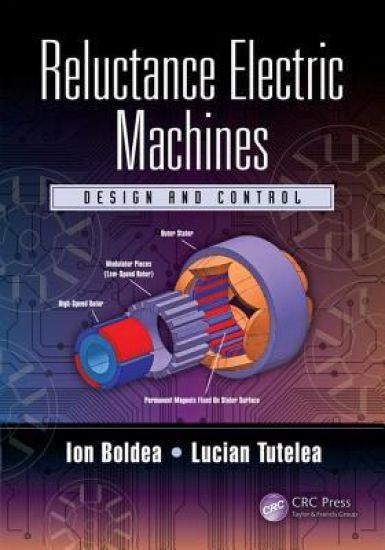
Electric energy is arguably a key agent for our material prosperity. With the notable exception of photovoltaic generators, electric generators are exclusively used to produce electric energy from mechanical energy. More than 60% of all electric energy is used in electric motors for useful mechanical work in various industries. This book presents the modeling, performance, design, and control of reluctance synchronous and flux-modulation machines developed for higher efficiency and lower cost. It covers one- and three-phase reluctance synchronous motors in line-start applications and various reluctance flux-modulation motors in pulse width modulation converter-fed variable speed drives.FEATURES Presents basic and up-to-date knowledge about the topologies, modeling, performance, design, and control of reluctance synchronous machines. Includes information on recently introduced reluctance flux-modulation electric machines (switched- flux, flux-reversal, Vernier, transverse flux, claw pole, magnetic-geared dual-rotor, brushless doubly fed, etc.). Features numerous examples and case studies throughout. Provides a comprehensive overview of all reluctance electric machines.
Induction Machines Handbook
The third edition of Induction Machines Handbook comprises two volumes, Induction Machines Handbook: Steady State Modeling and Performance and Induction Machines Handbook: Transients, Control Principles, Design and Testing. The promise of renewable (hydro and wind) energy via cage-rotor and doubly fed variable speed generators e-transport propulsion, i-home appliances makes this third edition state of the art tool, conceived with numerous case studies, timely for both Academia and Industry.The first volume offers a thorough treatment of steady state modeling and performance of induction machines, the most used electric motors (generators) in rather constant or variable speed drives for even lower energy consumption and higher productivity in basically all industries, from home appliances, through robotics to e-transport and wind energy conversion.The second volume presents a practical up to date treatment of intricate issues with induction machine (IM) required for design and testing both in rather constant and variable speed (with power electronics) drives. It contains ready to use in industrial design and testing knowledge with numerous case studies to facilitate thorough assimilation of new knowledge.
Induction Machines Handbook

Induction Machines Handbook

Ion Boldea

CRC Press
2020
sidottu
Induction Machines Handbook: Steady State Modeling and Performance offers a thorough treatment of steady-state induction machines (IM), the most used electric motor (generator) in rather constant or variable speed drives, forever lower energy consumption and higher productivity in basically all industries, from home appliances, through robotics to e-transport and wind energy conversion.Chapter 1 offers a detailed introduction from fundamental principles to topological classifications and most important applications and power ranges from tens of W to tens of MW.Then individual Chapters 2 and 4 deal in detail with specific issues, such as Magnetic, electric, and insulation materials Electric windings and their mmf Magnetization curve and inductance Leakage inductances and resistances Steady-state equivalent circuit and performance Starting and speed control methods Skin and on-load saturation effects Field harmonics, parasitic torques, radial forces, noise Losses Thermal modeling Single-phase induction machine basics Single-phase induction motors: steady-state modeling and performanceFully revised and updated to reflect the last decade’s progress in the field, this third edition adds new sections, such as Multiphase and multilayer tooth-wound coil windings The brushless doubly fed induction machine (BDFIM) Equivalent circuits for BDFIM Control principles for doubly fed IM Magnetic saturation effects on current and torque versus slip curves Rotor leakage reactance saturation Closed-slot IM saturation The origin of electromagnetic vibration by practical experience PM-assisted split-phase cage-rotor IM’s steady stateThe promise of renewable (hydro and wind) energy via cage-rotor and doubly fed variable speed generators e-transport propulsion and i-home appliances makes this third edition a state-of-the-art tool, conceived with numerous case studies and timely for both academia and industry.
Induction Machines Handbook

Induction Machines Handbook

Ion Boldea

CRC Press
2020
sidottu
Induction Machines Handbook: Transients, Control Principles, Design and Testing presents a practical up-to-date treatment of intricate issues with induction machines (IM) required for design and testing in both rather constant- and variable-speed (with power electronics) drives. It contains ready-to-use industrial design and testing knowledge, with numerous case studies to facilitate a thorough assimilation of new knowledge.Individual Chapters 1 through 14 discuss in detail the following: Three- and multiphase IM transients Single-phase source IM transients Super-high-frequency models and behavior of IM Motor specifications and design principles IM design below 100 kW and constant V1 and f1 IM design above 100 kW and constant V1 and f1 IM design principles for variable speed Optimization design Single-phase IM design Three-phase IM generators Single-phase IM generators Linear induction motors Testing of three-phase IMs Single-phase IM testingFully revised and amply updated to add the new knowledge of the last decade, this third edition includes special sections on Multiphase IM models for transients Doubly fed IMs models for transients Cage-rotor synchronized reluctance motors Cage-rotor PM synchronous motor Transient operation of self-excited induction generator Brushless doubly fed induction motor/generators Doubly fed induction generators with D.C. output Linear induction motor control with end effect Recent trends in IM testing with power electronics Cage-PM rotor line-start IM testing Linear induction motor (LIM) testingThis up-to-date book discusses in detail the transients, control principles, and design and testing of various IMs for line-start and variable-speed applications in various topologies, with numerous case studies. It will be of direct assistance to academia and industry in conceiving, designing, fabricating, and testing IMs (for the future) of various industries, from home appliances, through robotics, e-transport, and renewable energy conversion.
Reluctance Electric Machines

Reluctance Electric Machines

Ion Boldea; Lucian Tutelea

Productivity Press
2018
sidottu
Electric energy is arguably a key agent for our material prosperity. With the notable exception of photovoltaic generators, electric generators are exclusively used to produce electric energy from mechanical energy. More than 60% of all electric energy is used in electric motors for useful mechanical work in various industries. This book presents the modeling, performance, design, and control of reluctance synchronous and flux-modulation machines developed for higher efficiency and lower cost. It covers one- and three-phase reluctance synchronous motors in line-start applications and various reluctance flux-modulation motors in pulse width modulation converter-fed variable speed drives.FEATURES Presents basic and up-to-date knowledge about the topologies, modeling, performance, design, and control of reluctance synchronous machines. Includes information on recently introduced reluctance flux-modulation electric machines (switched- flux, flux-reversal, Vernier, transverse flux, claw pole, magnetic-geared dual-rotor, brushless doubly fed, etc.). Features numerous examples and case studies throughout. Provides a comprehensive overview of all reluctance electric machines.
Electric Drives

Electric Drives

Ion Boldea; Syed A. Nasar

Productivity Press
2016
sidottu
Electric Drives provides a practical understanding of the subtleties involved in the operation of modern electric drives. The Third Edition of this bestselling textbook has been fully updated and greatly expanded to incorporate the latest technologies used to save energy and increase productivity, stability, and reliability. Every phrase, equation, number, and reference in the text has been revisited, with the necessary changes made throughout. In addition, new references to key research and development activities have been included to accurately reflect the current state of the art. Nearly 120 new pages covering recent advances, such as those made in the sensorless control of A.C. motor drives, have been added; as have two new chapters on advanced scalar control and multiphase electric machine drives. All solved numerical examples have been retained, and the 10 MATLAB®–Simulink® programs remain online. Thus, Electric Drives, Third Edition offers an up-to-date synthesis of the basic and advanced control of electric drives, with ample material for a two-semester course at the university level.
Electric Generators Handbook - Two Volume Set
Electric Generators Handbook, Second Edition: Two-Volume Set supplies state-of-the-art tools necessary to design, validate, and deploy the right power generation technologies to fulfill tomorrow's complex energy needs.The first volume, Synchronous Generators, explores large- and medium-power synchronous generator topologies, steady state, modeling, transients, control, design, and testing. Numerous case studies, worked-out examples, sample results, and illustrations highlight the concepts. Fully revised and updated to reflect the last decade’s worth of progress in the field, the Second Edition adds coverage of high-power wind generators with fewer or no PMs, PM-assisted DC-excited salient pole synchronous generators, autonomous synchronous generators’ control, line switching parameter identification for isolated grids, synthetic back-to-back load testing with inverter supply, and more.The second volume, Variable Speed Generators, provides extensive coverage of variable speed generators in distributed generation and renewable energy applications around the world. Numerous design and control examples illustrate the exposition. Fully revised and updated to reflect the last decade’s worth of progress in the field, the Second Edition adds material on doubly fed induction generator control under unbalanced voltage sags and nonlinear loads, interior permanent magnet claw-pole-alternator systems, high power factor Vernier PM generators, PM-assisted reluctance synchronous motors/generators for electric hybrid vehicles, and more.