Kirjojen hintavertailu. Mukana 12 550 616 kirjaa ja 12 kauppaa.
Kirjailija
Ivan Szelenyi
Kirjat ja teokset yhdessä paikassa: 6 kirjaa, julkaisuja vuosilta 1988-2019, suosituimpien joukossa Varieties of Post-communist Capitalism. Vertaile teosten hintoja ja tarkista saatavuus suomalaisista kirjakaupoista.
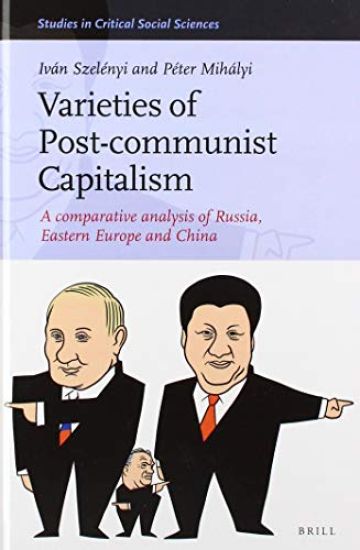
This book intends to be a contribution to the “varieties of capitalism” paradigm. The theoretical background is Weber’s theory of legitimacy. Was communism ever “legitimate”? What kind of legitimacy claims were made in the transition from communism to capitalism? Central Europe was closer to the Western “liberal” model. Russia built capitalism in a patrimonial way. China followed its own unique way; some called it “socialism with Chinese characteristics”. Putin experiments with an innovation for post-communist capitalism. He confronts the “oligarchs” and reallocates property from those who challenge his political authority to old and new loyal ones. In conclusion, the central question is to what extent is “Putinism” a generic model for post-communist capitalism?
Mihályi and Szelényi provide a timely contribution to contemporary debates about inequality of incomes and wealth, offering a careful examination of various sources of rent in contemporary societies, and considering several policy options to reduce inequality in order to preserve the meritocratic nature of liberal democracies. While Rent-Seekers, Profits, Wages and Inequality acknowledges the rapid and disturbing increase of incomes and wealth in the top 1 or 0.1%, it focuses on the increasing rent component of incomes and wealth in the top 20% as even more consequential. The attention to cutting-edge issues on inequality in macroeconomics, political science and sociology will appeal to social scientists interested in income distribution and wealth accumulation.
Making Capitalism without Capitalists offers a new theory of the transition to capitalism. By telling the story of how capitalism is being built without capitalists in post-communist Central Europe it guides us towards a deeper understanding of the origins of modern capitalism.
This provocative volume is the first book to offer an extensive examination of the nature of poverty and its relationship to gender and ethnicity in five post-communist societies. As nations make the difficult transition from socialism to capitalism, the extent and nature of poverty tends to change and, because of this, the proportion of the population living in poverty tends to change. As a result, the proportion of the population living in poverty has increased sharply in these countries. The contributors contend that a new poverty is in the making and that the growing underclass is strongly related to ethnicity, as such an underclass is more likely to form if there is a sizeable Roma (Gypsy) minority. The question of whether gender interacts with poverty the same way ethnicity does is the subject of intense controversy and is addressed here in lucid, accessible prose. In this comprehensive analysis of the interaction between poverty, ethnicity, and gender in East European transitional societies, the contributors thoughtfully address the relevant issues and relationships and conclude that poverty has become deeper and increasingly long-term in Eastern European nations.Although it is clear that poverty increased in Eastern Europe during the market transition, the extent and nature of the changes have not yet been illuminated. Covering Bulgaria, Hungary, Poland, Romania, and Slovakia, the contributors analyze the interaction between poverty, ethnicity, and gender in an effort to explain the changing nature of poverty and the formation of an underclass in these countries. Roma (Gypsies) arise as the most likely candidates for membership in the new underclass, as they were always economically disadvantaged and the targets of discriminatory practices. On the other hand, however because they were often better educated than men during socialism, women may have been relatively advantaged, at least temporarily, during the market transition. Thus while poverty may be racialized during the transformation, it may not yet be feminized. In this comparative assessment of social trends in this region, the contributors consider what they mean for the countries where they occur.
Understanding the dramatic political, social, and economic changes that have taken place in Poland in the mid-1980s is one key to predicting the future of the communist bloc. Jadwiga Staniszkis, an influential, internationally known expert on contemporary trends in Eastern Europe, provides an insider's analysis that deserves the attention of all scholars interested in the region. Staniszkis presents the breakthrough of 1989 as a consequence not only of systemic contradictions within socialism but also of a series of chance events. These events include unique historical circumstances such as the emergence of the 'globalist' faction in Mosow, with its new, world-system perception of crisis, and the discovery of the round-table technique as a productive ritual of communication, imitated all over Eastern Europe. After describing the development, collapse, and reorganization of a 'new center' in Poland in 1989-1990, she discusses the first attempt at privatizing the economy. Her analysis of the dilemmas accompanying breakthrough and transition is an invaluable guide to the challenges that face both capitalism and democracy in Eastern Europe.
Among the East European nations, Hungary has been noted in recent years for permitting, even encouraging, family entrepreneurship in agriculture. In this highly empirical study, Ivan Szelenyi and his collaborators explore this phenomenon, affording a rare view of the reemergence of private sector activity in a socialist society, and offering new insights into the very origins of capitalism. In the years since the government relaxed its policy of forced collectivization, approximately ten percent of rural Hungarian families have taken up entrepreneurial opportunities in agriculture. Why they have chosen this course—and why ninety percent of family have chosen to remain in proletarian or cadre positions—are central questions in Szelenyi’s inquiry. The theory advocated here is one of “interrupted embourgeoisement.” Those people who, during the years of Stalinism, found occupations in which they could successfully resist the dual pressures of proletarianization and cadrefication are the ones now able to reenter the interrupted embourgeoisement trajectory. As a result, the communist “revolution from above” has been challenged by a somewhat unexpected “revolution from below,” in the process producing a socialist mixed economic system that seems to be as different from Soviet—style communism as it is from Western capitalism.“This is a very, very important work, combining rich primary research by Szelenyi and four colleagues with a major ‘step toward a theory of articulation of a state socialist mixed economy.’ . . . Using surveys from 1972-73 and 1982-84, the authors traced life histories to identify variables that showed why families responded differently to proletarianization, formation of a new working class, or embourgeoisement.”—World Development