Kirjojen hintavertailu. Mukana 12 595 353 kirjaa ja 12 kauppaa.

Kirjailija

Ivana Marková

Kirjat ja teokset yhdessä paikassa: 13 kirjaa, julkaisuja vuosilta 2003-2025, suosituimpien joukossa Dialogue in Focus Groups. Vertaile teosten hintoja ja tarkista saatavuus suomalaisista kirjakaupoista.

Mukana myös kirjoitusasut: Ivana Markova, Ivana Markovà

13 kirjaa

Kirjojen julkaisuhaarukka 2003-2025.

The Making of a Dialogical Theory

The Making of a Dialogical Theory

Ivana Marková

Cambridge University Press
2025
pokkari
Creating a stimulating social theory with long-lasting in?uence for generations of scholars is driven by multiple interacting factors. The fortune of a theory is determined not only by the author's creative mind but also by the ways in which principal concepts are understood and interpreted. The proper understanding of a social theory requires a good grasp of major historical, political, and cultural challenges that contribute to its making. Considering these issues, Marková explores Serge Moscovici's theory of social representations and communication as a case study in the making of a dialogical social theory. She analyses both the undeveloped features and the forward-moving, inspirational highlights of the theory and presents them as a resource for linking issues and problems from diverse domains and disciplines. This dialogical approach has the potential to advance the dyad Self–Other as an irreducible intellectual, ethical, and aesthetic unit in epistemologies of the human and social sciences.
The Making of a Dialogical Theory

The Making of a Dialogical Theory

Ivana Marková

Cambridge University Press
2023
sidottu
Creating a stimulating social theory with long-lasting in?uence for generations of scholars is driven by multiple interacting factors. The fortune of a theory is determined not only by the author's creative mind but also by the ways in which principal concepts are understood and interpreted. The proper understanding of a social theory requires a good grasp of major historical, political, and cultural challenges that contribute to its making. Considering these issues, Marková explores Serge Moscovici's theory of social representations and communication as a case study in the making of a dialogical social theory. She analyses both the undeveloped features and the forward-moving, inspirational highlights of the theory and presents them as a resource for linking issues and problems from diverse domains and disciplines. This dialogical approach has the potential to advance the dyad Self–Other as an irreducible intellectual, ethical, and aesthetic unit in epistemologies of the human and social sciences.

Textile Fiber Microscopy

Textile Fiber Microscopy

Ivana Markova

Wiley-Blackwell
2019
nidottu
A groundbreaking text to the study of textile fibers that bridges the knowledge gap between fiber shape and end uses Textile Fiber Microscopy offers an important and comprehensive guide to the study of textile fibers and contains a unique text that prioritizes a review of fibers’ microstructure, macrostructure and chemical composition. The author – a noted expert in the field – details many fiber types and includes all the possible fiber shapes with a number of illustrative micrographs. The author explores a wealth of topics such as fiber end uses, fiber source and production, a history of each fiber and the sustainability of the various fibers. The text includes a review of environmentally friendly fibers and contains information on the most current fiber science by putting the focus on fibers that have been mechanically or chemically recycled, for use in textile production. The author also offers an exploration of issues of textile waste and the lack of textile recycling that can help public policymakers with ways to inform and regulate post-industrial and post-consumer textile waste issues. This vital guide: Contains an accompanied micrograph for many fibers presentedIncludes information on how fiber microstructure is connected to fabric properties and how it affects the end use of fabricsOffers a review of the sophistication of textile fibers from a scientific point of viewPresents a comparative textile fiber review that is appropriate for both for students, textile experts and forensic scientists Written for students and professionals of apparel design and merchandising, and forensic scientists, Textile Fiber Microscopy presents an important review of textile fibers from a unique perspective that explores fibers’ microstructure, macrostructure and chemical composition.
Human Awareness

Human Awareness

Ivana Marková

Routledge
2019
nidottu
Human awareness – which forms the basis of all interpersonal relationships – is perhaps the most fascinating phenomenon of biological and socio-cultural evolution.In this innovative book, originally published in 1987, the author introduces the subject of human awareness from the perspective of developmental and social psychology. Using a wide range of psychological and other sources, both classic and more recent from around the world, the book begins with a discussion of awareness as a biological and cultural-historical phenomenon. The reader is then guided through such issues as one’s awareness of others, self-awareness, interpersonal communication, and the search of human beings for recognition by others. The final chapter focuses on human awareness as a relationship between the self and society, with particular emphasis on social stability and change.Human Awareness provided the first comprehensive account of human consciousness in a text that reflected the most exciting recent research in the field at the time and emphasized the need for an integrated and coherent understanding of the various psychological disciplines.
The Dialogical Mind

The Dialogical Mind

Ivana Marková

Cambridge University Press
2018
pokkari
Dialogue has become a central theoretical concept in human and social sciences as well as in professions such as education, health, and psychotherapy. This 'dialogical turn' emphasises the importance of social relations and interaction to our behaviour and how we make sense of the world; hence the dialogical mind is the mind in interaction with others - with individuals, groups, institutions, and cultures in historical perspectives. Through a combination of rigorous theoretical work and empirical investigation, Marková presents an ethics of dialogicality as an alternative to the narrow perspective of individualism and cognitivism that has traditionally dominated the field of social psychology. The dialogical perspective, which focuses on interdependencies among the self and others, offers a powerful theoretical basis to comprehend, analyse, and discuss complex social issues. Marková considers the implications of dialogical epistemology both in daily life and in professional practices involving problems of communication, care, and therapy.
Human Awareness

Human Awareness

Ivana Marková

Routledge
2017
sidottu
Human awareness – which forms the basis of all interpersonal relationships – is perhaps the most fascinating phenomenon of biological and socio-cultural evolution.In this innovative book, originally published in 1987, the author introduces the subject of human awareness from the perspective of developmental and social psychology. Using a wide range of psychological and other sources, both classic and more recent from around the world, the book begins with a discussion of awareness as a biological and cultural-historical phenomenon. The reader is then guided through such issues as one’s awareness of others, self-awareness, interpersonal communication, and the search of human beings for recognition by others. The final chapter focuses on human awareness as a relationship between the self and society, with particular emphasis on social stability and change.Human Awareness provided the first comprehensive account of human consciousness in a text that reflected the most exciting recent research in the field at the time and emphasized the need for an integrated and coherent understanding of the various psychological disciplines.
The Dialogical Mind

The Dialogical Mind

Ivana Marková

Cambridge University Press
2016
sidottu
Dialogue has become a central theoretical concept in human and social sciences as well as in professions such as education, health, and psychotherapy. This 'dialogical turn' emphasises the importance of social relations and interaction to our behaviour and how we make sense of the world; hence the dialogical mind is the mind in interaction with others - with individuals, groups, institutions, and cultures in historical perspectives. Through a combination of rigorous theoretical work and empirical investigation, Marková presents an ethics of dialogicality as an alternative to the narrow perspective of individualism and cognitivism that has traditionally dominated the field of social psychology. The dialogical perspective, which focuses on interdependencies among the self and others, offers a powerful theoretical basis to comprehend, analyse, and discuss complex social issues. Marková considers the implications of dialogical epistemology both in daily life and in professional practices involving problems of communication, care, and therapy.
Dialogue in Focus Groups

Dialogue in Focus Groups

Ivana Markova; Per Linell; Michele Grossen; Anne Salazar Orvig

Equinox Publishing Ltd
2007
pokkari
In contrast to a vast literature that provides information and guides about focus groups as a methodological tool, this book is an introduction to understanding focus groups as analytical means exploring socially shared knowledge, e.g. social representations of AIDS, biotechnology or democracy, beliefs and lay explanations of social phenomena. The main emphasis of the book is to examine how to analyse interaction and ideas expressed in focus groups. The book considers, first, different kinds of dynamic interdependencies among participants who hold the diverse and heterogeneous positions. Second, it explores circulations of ideas and contents in focus groups. More generally, the book is concerned with: language in real social interactions and sense-making, which are embedded in history and culture; the ways people draw upon and transform social knowledge when they talk and think together in dialogue; the ways people generate heterogeneous meanings in the group dynamics; and communicative activities and genres represented by different kinds of focus groups. This original approach to understanding focus groups will be of interest to researchers and advanced students in social sciences, communication studies, psychology, and language sciences.
Dialogue in Focus Groups

Dialogue in Focus Groups

Ivana Markova; Per Linell; Michele Grossen; Anne Salazar Orvig

Equinox Publishing Ltd
2007
sidottu
In contrast to a vast literature that provides information and guides about focus groups as a methodological tool, this book is an introduction to understanding focus groups as analytical means exploring socially shared knowledge, e.g. social representations of AIDS, biotechnology or democracy, beliefs and lay explanations of social phenomena. The main emphasis of the book is to examine how to analyse interaction and ideas expressed in focus groups. The book considers, first, different kinds of dynamic interdependencies among participants who hold the diverse and heterogeneous positions. Second, it explores circulations of ideas and contents in focus groups. More generally, the book is concerned with: language in real social interactions and sense-making, which are embedded in history and culture; the ways people draw upon and transform social knowledge when they talk and think together in dialogue; the ways people generate heterogeneous meanings in the group dynamics; and communicative activities and genres represented by different kinds of focus groups. This original approach to understanding focus groups will be of interest to researchers and advanced students in social sciences, communication studies, psychology, and language sciences.
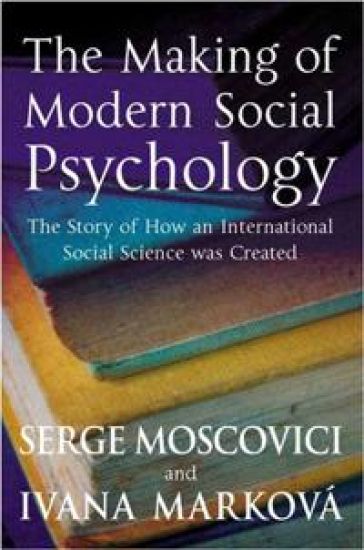
The Making of Modern Social Psychology

The Making of Modern Social Psychology

Serge Moscovici; Ivana Markovà

Polity Press
2006
nidottu
This fascinating book makes an important contribution to the history of the social sciences. It tells the largely hidden story of how social psychology became an international social science, vividly documenting the micro-politics of a virtually forgotten committee, the Committee on Transnational Social Psychology, whose work took place against the back-drop of some of the most momentous events of the twentieth century. Overcoming intellectual, institutional and political obstacles, including the Soviet invasion of Czechoslovakia, and the military coups in Chile or Argentine, the committee struggled to bring social psychology to global recognition, not as part of a programme of intellectual imperialism, but motivated by a mixture of intellectual philanthropy and self-interest. Few authors could tell this unique story. Serge Moscovici is undoubtedly the best-placed insider to do so, together with Ivana Markova providing a lucid, erudite and carefully documented account of the work of this remarkable group. This book will be an essential resource for any scholar interested in the history of social psychology, as well as upper-level students studying the history of the social sciences.
Dialogicality and Social Representations

Dialogicality and Social Representations

Ivana Marková

Cambridge University Press
2005
pokkari
The theory of social knowledge developed in this book is based on dialogicality and the theory of social representations. It is argued that dialogicality, the capacity of the human mind to conceive, create and communicate about social realities in terms of, or in opposition to, otherness, is the sine qua non of the human mind. Social representations are sharply distinguished from mental and collective representations. Being embedded in history and culture, social representations manifest themselves in public discourses and social thinking about phenomena, which touch in some fundamental ways upon social realities, e.g. political, ecological or health related. The theory of social representations places communication and the concept of change in the centre of social psychology. Ivana Marková's book is unique in bringing together the concept of dialogue and social knowledge and will make an important contribution to social psychology, social and human sciences and communication studies.
Insight in Psychiatry

Insight in Psychiatry

Ivana Marková

Cambridge University Press
2005
sidottu
Questions concerning the nature of insight in patients with mental illness have interested clinicians for a long time. To what extent can patients understand disorders which affect their mental function? Does insight carry a prognostic value? Is impaired insight determined by the illness or are other factors important? Despite considerable research examining insight in patients with psychoses, non-psychotic disorders and chronic organic brain syndromes, results are inconclusive and insight remains a source of some mystification. Ivana S. Marková examines the problems involved in studying insight in patients with mental illness in order to provide a clearer understanding of the factors that determine its clinical manifestation. She puts forward a new model to illustrate the relationship between different components of insight in theoretical and clinical terms, and points to directions for future research.
Dialogicality and Social Representations

Dialogicality and Social Representations

Ivana Marková

Cambridge University Press
2003
sidottu
The theory of social knowledge developed in this book is based on dialogicality and the theory of social representations. It is argued that dialogicality, the capacity of the human mind to conceive, create and communicate about social realities in terms of, or in opposition to otherness, is the sine qua non of the human mind. Social representations are sharply distinguished from mental and collective representations. Being embedded in history and culture, social representations manifest themselves in public discourses and social thinking about phenomena, which touch in some fundamental ways upon social realities, e.g. political, ecological or health related. The theory of social representations places communication and the concept of change in the centre of social psychology. Ivana Marková’s new book is unique in bringing together the concept of dialogue and social knowledge and will make an important contribution to social psychology, social and human sciences and communication studies.