Kirjojen hintavertailu. Mukana 12 152 606 kirjaa ja 12 kauppaa.

Kirjailija

Ivannia Soto

Kirjat ja teokset yhdessä paikassa: 6 kirjaa, julkaisuja vuosilta 2020-2024, suosituimpien joukossa The California ELD Standards Companion, Grades 9-12. Vertaile teosten hintoja ja tarkista saatavuus suomalaisista kirjakaupoista.

6 kirjaa

Kirjojen julkaisuhaarukka 2020-2024.

The California ELD Standards Companion, Grades 9-12

The California ELD Standards Companion, Grades 9-12

Ivannia Soto; Linda J. Carstens; Jim Burke

SAGE Publications Inc
2020
kierre
"This is an era of extraordinary promise and support for addressing the needs of California’s English learners. That’s why this book, The California ELD Standards Companion, is so important. It’s exactly the kind of bridge teachers need between standards and what it looks like in the classroom." —LAURIE OLSEN, Strategic Adviser, The Sobrato Early Academic Language (SEAL) Initiative California teachers: you’re going to love this! Here at last is that single teaching resource for making the critical link between our ELD Standards and the CCSS ELA Standards. Standard by standard, you’ll quickly discover how to integrate language development into your day-to-day content instruction, armed with an insider’s understanding of how best to support our many English learners. Modeled after Jim Burke’s Common Core series, this Grades 9-12 volume of The California ELD Standards Companion is every bit "that version of the standards you wish you had" because it’s just so easy to digest and apply. It’s all here: Horizontal and vertical views reveal how each ELD Standard changes and progresses grade by grade and proficiency level by proficiency level. What the Student Does Sections, also scannable by grade and proficiency level, unpack in student-friendly language what meeting a standard looks like in practice. CCSS ELA Standards are displayed side by side with California’s ELD Standards so you can appreciate the purposeful alignment between the two as the basis for remodeling instructional practice.What the Teacher Does Sections provide specific instructional guidance by grade band, including student prompts and tips for differentiation across proficiency level.A dedicated vocabulary section offers a quick-reference glossary of key words and phrases as they are used within each ELD Standard.Each section concludes with a vignette from the California ELA/ELD Framework to illustrate exemplary standards-based instruction. Thanks to the ELD Standards, we are now free to teach our ELs the way we knew best all along: language and content taught hand in hand across the school day. Lean on Ivannia Soto and Linda Carstens’ California ELD Standards Companion as your one-stop guide for delivering that excellent education our ELs so deeply deserve.
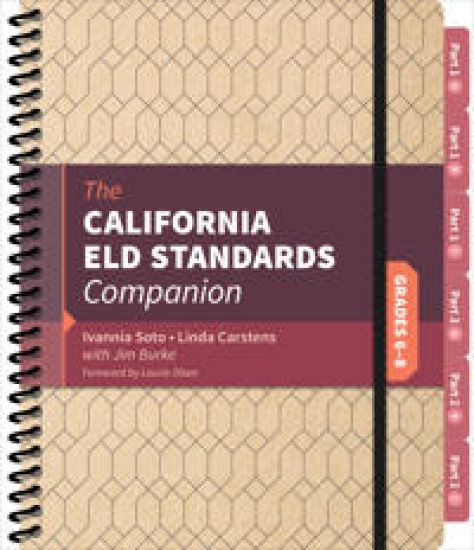
The California ELD Standards Companion, Grades 6-8

The California ELD Standards Companion, Grades 6-8

Ivannia Soto; Linda J. Carstens; Jim Burke

SAGE Publications Inc
2020
kierre
For California teachers only! Here at last is that single teaching resource for making the critical link between the ELD Standards and the CCSS ELA Standards. Standard by standard, you’ll quickly discover how to integrate language development into your day-to-day content instruction, fully armed with an insider’s understanding of how best to support our many ELs. Horizontal and vertical views reveal how each ELD Standard changes and progresses by grade and proficiency level.What the Student Does sections unpack what meeting a standard looks like in practice.CCSS ELA Standards are displayed side by side with California’s ELD Standards so you can appreciate the purposeful alignment. What the Teacher Does sections provide specific instructional guidance.
Breaking Down the Wall

Breaking Down the Wall

Margarita Espino Calderon; Maria G. Dove; Diane Staehr Fenner; Margo Gottlieb; Andrea Honigsfeld; Tonya W. Singer; Shawn M. Sinclair-Slakk; Ivannia Soto; Debbie Zacarian

SAGE Publications Inc
2020
nidottu
It was a dark and stormy night in Santa Barbara. January 19, 2017. The next day’s inauguration drumroll played on the evening news. Huddled around a table were nine Corwin authors and their publisher, who together have devoted their careers to equity in education. They couldn’t change the weather, they couldn’t heal a fractured country, but they did have the power to put their collective wisdom about EL education upon the page to ensure our multilingual learners reach their highest potential. Proudly, we introduce you now to the fruit of that effort: Breaking Down the Wall: Essential Shifts for English Learners’ Success. In this first-of-a-kind collaboration, teachers and leaders, whether in small towns or large urban centers, finally have both the research and the practical strategies to take those first steps toward excellence in educating our culturally and linguistically diverse children. It’s a book to be celebrated because it means we can throw away the dark glasses of deficit-based approaches and see children who come to school speaking a different home language for what they really are: learners with tremendous assets. The authors’ contributions are arranged in nine chapters that become nine tenets for teachers and administrators to use as calls to actions in their own efforts to realize our English learners’ potential: 1. From Deficit-Based to Asset-Based 2. From Compliance to Excellence 3. From Watering Down to Challenging 4. From Isolation to Collaboration 5. From Silence to Conversation 6. From Language to Language, Literacy, and Content 7. From Assessment of Learning to Assessment for and as Learning 8. From Monolingualism to Multilingualism 9. From Nobody Cares to Everyone/Every Community Cares Read this book; the chapters speak to one another, a melodic echo of expertise, classroom vignettes, and steps to take. To shift the status quo is neither fast nor easy, but there is a clear process, and it’s laid out here in Breaking Down the Wall. To distill it into a single line would go something like this: if we can assume mutual ownership, if we can connect instruction to all children’s personal, social, cultural, and linguistic identities, then all students will achieve.
Breaking Down the Monolingual Wall

Breaking Down the Monolingual Wall

Ivannia Soto; Sydney Cail Snyder; Margarita Espino Calderon; Margo Gottlieb; Andrea Honigsfeld; Joan R. Lachance; Margarita Marshall; David Nungaray; Rubí Flores; Lyn Scott

SAGE PUBLICATIONS INC
2024
nidottu
Your guide to culturally and linguistically sustaining practices in your dual language classroom and school. It’s time to set the record straight: Multilingualism is a tremendous asset that must be nurtured and valued and the most effective pathway to multilingualism is dual language education. Despite significant evidence attesting to the cognitive, social/emotional, and economic benefits of multilingualism, the majority of our classrooms and schools are monolingual. Encouragingly, recent shifts in state policies have increased the demand for dual language programming in our schools. This increased momentum brings new challenges, including the need for more bilingually authorized teachers, high-quality instructional resources, and accurate assessment and accountability in the target languages of instruction. With contributions from ten experts in multilingual education, Breaking Down the Monolingual Wall outlines the systemic and pedagogical approaches necessary for successful multilingual and dual language programs. The book supports educators to: Shift the paradigm from one that is subtractive and deficit-based to one that is additive and assets-basedEmbed culturally and linguistically sustaining practices in their instructionUnderstand how to promote multilingualism in the context of teaching academic contentDevelop assessments as, for, and of learning in multiple languages.Lead high-quality dual language schools and programsRecruit and retain highly qualified bilingual educators Offering a comprehensive overview of bilingual policies and historical context all educators should understand, Breaking Down the Monolingual Wall is an invaluable guide to creating dual language learning environments that build on the precious assets of our multilingual students and families.
Equity Moves to Support Multilingual Learners in Mathematics and Science, Grades K-8

Equity Moves to Support Multilingual Learners in Mathematics and Science, Grades K-8

Ivannia Soto; Theodore Sagun; Michael Beiersdorf

SAGE PUBLICATIONS INC
2023
nidottu
A strengths and assets-based approach to multilingual learner success As the number of multilingual learners (MLLs) in US schools continues to grow, educators need to learn the moves necessary to support the success of these students in mathematics and science. Equity Moves to Support Multilingual Learners in Mathematics and Science, Grades K-8 focuses on the literacy opportunities that MLLs can achieve when language scaffolds are taught alongside rigorous math and science content. It provides a framework teachers can use to develop equity-centered, scaffolded math, science, or STEAM lessons. Readers will find Anchor phenomena that demonstrate issues with lesson design and delivery and highlight areas to include language and content scaffoldsExamples for honoring the languages of students, families, and communitiesCulturally responsive techniques and easy-to-use tables featuring the equity movesVignettes showcasing the equity move in the classroom settingA focus on four language demands: vocabulary, discourse, multiple modes of representation, and text features With an assets-based approach to what MLLs can do, this book helps teachers unpack the language demands of mathematics and science and encourages reflection of their own practices in scaffolding for language and culture.
Responsive Schooling for Culturally and Linguistically Diverse Students
Rapidly changing and diverse student populations necessitate culturally responsive schooling. It can be a challenging balancing act for educators to respect diversity and teach to each student’s needs while adhering to restrictive curricula that mandate the use of standard English. Responsive Schooling for Culturally and Linguistically Diverse Students offers a balanced approach to developing students’ academic language proficiency while simultaneously honouring, acknowledging and valuing the richness of their home and community languages and cultures. Debbie Zacarian and Ivannia Soto provide a practical framework within which schools and educators can make students’ personal, cultural and social identities central to the curriculum by drawing on the experiences and interests they bring to the classroom. Filled with examples of responsive teaching and opportunities to reflect on current practice, the book is a rich resource for teachers and school leaders alike.