Kirjojen hintavertailu. Mukana 12 152 606 kirjaa ja 12 kauppaa.

Kirjailija

Ivo Balbaert

Kirjat ja teokset yhdessä paikassa: 10 kirjaa, julkaisuja vuosilta 2012-2022, suosituimpien joukossa The Way to Go. Vertaile teosten hintoja ja tarkista saatavuus suomalaisista kirjakaupoista.

10 kirjaa

Kirjojen julkaisuhaarukka 2012-2022.

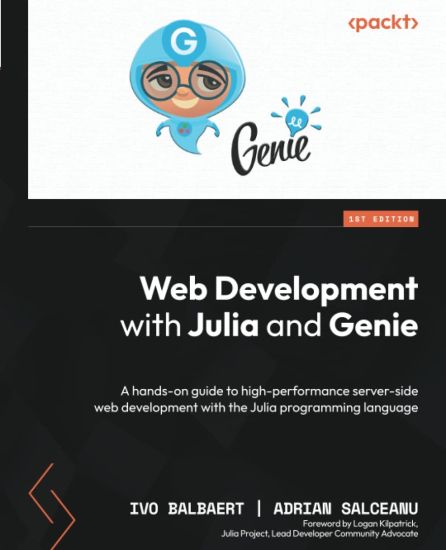
Web Development with Julia and Genie

Web Development with Julia and Genie

Ivo Balbaert; Adrian Salceanu; Logan Kilpatrick

PACKT PUBLISHING LIMITED
2022
nidottu
Get a practical overview of web development in Julia and learn how to build MVC applications with a REST API, and an interactive data dashboard using the Genie web frameworkKey FeaturesA tutorial on web development from Julia expert, Ivo Balbaert and the creator of the Genie framework, Adrian SalceanuA step-by-step approach to building a complete web app with the Genie frameworkDevelop secure and fast web apps using server-side development on JuliaBook DescriptionJulia’s high-performance and scalability characteristics and its extensive number of packages for visualizing data make it an excellent fit for developing web apps, web services, and web dashboards. The two parts of this book provide complete coverage to build your skills in web development.First, you'll refresh your knowledge of the main concepts in Julia that will further be used in web development. Then, you’ll use Julia’s standard web packages and examine how the building blocks of the web such as TCP-IP, web sockets, HTTP protocol, and so on are implemented in Julia’s standard library. Each topic is discussed and developed into code that you can apply in new projects, from static websites to dashboards. You’ll also understand how to choose the right Julia framework for a project. The second part of the book talks about the Genie framework. You’ll learn how to build a traditional to do app following the MVC design pattern. Next, you’ll add a REST API to this project, including testing and documentation. Later, you’ll explore the various ways of deploying an app in production, including authentication functionality. Finally, you’ll work on an interactive data dashboard, making various chart types and filters.By the end of this book, you’ll be able to build interactive web solutions on a large scale with a Julia-based web framework.What you will learnUnderstand how to make a web server with HTTP.jl and work with JSON data over the webDiscover how to build a static website with the Franklin frameworkExplore Julia web development frameworks and work with themUncover the Julia infrastructure for development, testing, package management, and deploymentDevelop an MVC web app with the Genie frameworkUnderstand how to add a REST API to a web appCreate an interactive data dashboard with charts and filtersTest, document, and deploy maintainable web applications using JuliaWho this book is forThis book is for beginner to intermediate-level Julia programmers who want to enhance their skills in designing and developing large-scale web applications. The book helps you adopt Genie without any prior experience with the framework. Julia programming experience and a beginner-level understanding of web development concepts are required.
Julia 1.0 Programming Complete Reference Guide

Julia 1.0 Programming Complete Reference Guide

Ivo Balbaert; Adrian Salceanu

Packt Publishing Limited
2019
nidottu
Learn dynamic programming with Julia to build apps for data analysis, visualization, machine learning, and the webKey FeaturesLeverage Julia's high speed and efficiency to build fast, efficient applicationsPerform supervised and unsupervised machine learning and time series analysisTackle problems concurrently and in a distributed environmentBook DescriptionJulia offers the high productivity and ease of use of Python and R with the lightning-fast speed of C++. There’s never been a better time to learn this language, thanks to its large-scale adoption across a wide range of domains, including fintech, biotech and artificial intelligence (AI).You will begin by learning how to set up a running Julia platform, before exploring its various built-in types. This Learning Path walks you through two important collection types: arrays and matrices. You’ll be taken through how type conversions and promotions work, and in further chapters you'll study how Julia interacts with operating systems and other languages. You’ll also learn about the use of macros, what makes Julia suitable for numerical and scientific computing, and how to run external programs.Once you have grasped the basics, this Learning Path goes on to how to analyze the Iris dataset using DataFrames. While building a web scraper and a web app, you’ll explore the use of functions, methods, and multiple dispatches. In the final chapters, you'll delve into machine learning, where you'll build a book recommender system.By the end of this Learning Path, you’ll be well versed with Julia and have the skills you need to leverage its high speed and efficiency for your applications.This Learning Path includes content from the following Packt products:Julia 1.0 Programming - Second Edition by Ivo BalbaertJulia Programming Projects by Adrian SalceanuWhat you will learnCreate your own types to extend the built-in type systemVisualize your data in Julia with plotting packagesExplore the use of built-in macros for testing and debuggingIntegrate Julia with other languages such as C, Python, and MATLABAnalyze and manipulate datasets using Julia and DataFramesDevelop and run a web app using Julia and the HTTP packageBuild a recommendation system using supervised machine learningWho this book is forIf you are a statistician or data scientist who wants a quick course in the Julia programming language while building big data applications, this Learning Path is for you. Basic knowledge of mathematics and programming is a must.
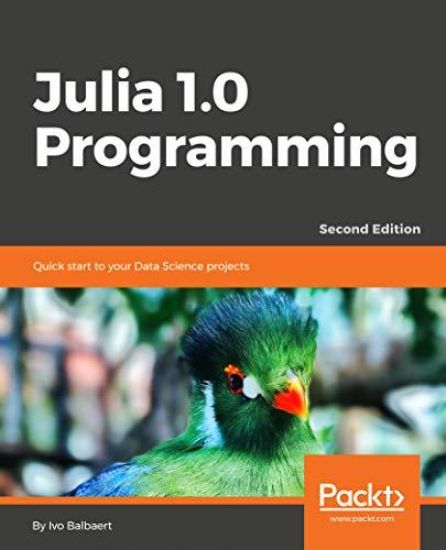
Julia 1.0 Programming

Julia 1.0 Programming

Ivo Balbaert

Packt Publishing Limited
2018
nidottu
Enter the exciting world of Julia, a high-performance language for technical computingKey FeaturesLeverage Julia's high speed and efficiency for your applicationsWork with Julia in a multi-core, distributed, and networked environmentApply Julia to tackle problems concurrently and in a distributed environmentBook DescriptionThe release of Julia 1.0 is now ready to change the technical world by combining the high productivity and ease of use of Python and R with the lightning-fast speed of C++. Julia 1.0 programming gives you a head start in tackling your numerical and data problems. You will begin by learning how to set up a running Julia platform, before exploring its various built-in types. With the help of practical examples, this book walks you through two important collection types: arrays and matrices. In addition to this, you will be taken through how type conversions and promotions work. In the course of the book, you will be introduced to the homo-iconicity and metaprogramming concepts in Julia. You will understand how Julia provides different ways to interact with an operating system, as well as other languages, and then you'll discover what macros are. Once you have grasped the basics, you’ll study what makes Julia suitable for numerical and scientific computing, and learn about the features provided by Julia. By the end of this book, you will also have learned how to run external programs. This book covers all you need to know about Julia in order to leverage its high speed and efficiency for your applications.What you will learnSet up your Julia environment to achieve high productivityCreate your own types to extend the built-in type systemVisualize your data in Julia with plotting packagesExplore the use of built-in macros for testing and debugging, among other usesApply Julia to tackle problems concurrentlyIntegrate Julia with other languages such as C, Python, and MATLABWho this book is forJulia 1.0 Programming is for you if you are a statistician or data scientist who wants a crash course in the Julia programming language while building big data applications. A basic knowledge of mathematics is needed to understand the various methods that are used or created during the course of the book to exploit the capabilities that Julia is designed with.
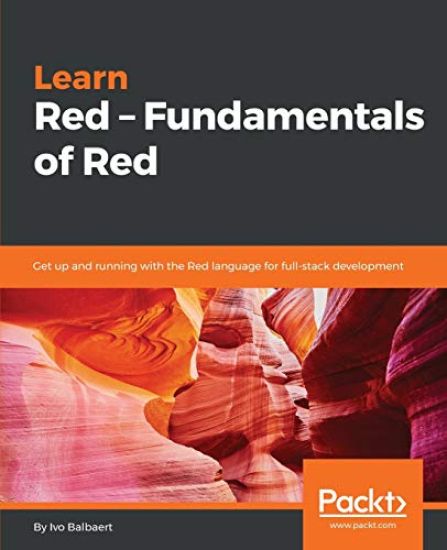
Learn Red – Fundamentals of Red

Learn Red – Fundamentals of Red

Ivo Balbaert

Packt Publishing Limited
2018
nidottu
Discover how to use the next-generation language Red for full-stack development, from systems coding over user-interfaces to blockchain programmingKey FeaturesExplore the latest features of Red to build scalable, fast, and secure applicationsLearn graphical programming and build highly sophisticated reactive applicationsGet familiar with the specific concepts and techniques of Red development, like working with series, viewing code as data, and using dialects.Book DescriptionA key problem of software development today is software bloat, where huge toolchains and development environments are needed in software coding and deployment. Red significantly reduces this bloat by offering a minimalist but complete toolchain. This is the first introductory book about it, and it will get you up and running with Red as quickly as possible.This book shows you how to write effective functions, reduce code redundancies, and improve code reuse. It will be helpful for new programmers who are starting out with Red to explore its wide and ever-growing package ecosystem and also for experienced developers who want to add Red to their skill set.The book presents the fundamentals of programming in Red and in-depth informative examples using a step-by-step approach. You will be taken through concepts and examples such as doing simple metaprogramming, functions, collections, GUI applications, and more. By the end of the book, you will be fully equipped to start your own projects in Red.What you will learn Set up your Red environment to achieve the highest productivity Get grounded in Red, gaining experience and insight through many examples and exercises Build simple, compact, and portable applications Analyze streams of data through Parse Compose GUI applications with View and Draw Get prepared for smart contract blockchain programming in RedWho this book is forThis book is for software developers and architects who want to learn Red because of its conciseness, flexibility, and expressiveness, and more specifically for its possibilities in GUI apps and blockchain / smart contracts programming. Some knowledge of the basic concepts and experience of any programming language is assumed.
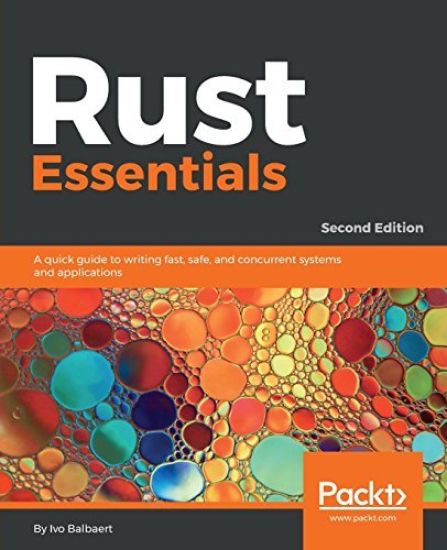
Rust Essentials -

Rust Essentials -

Ivo Balbaert

Packt Publishing Limited
2017
nidottu
Leverage the functional programming and concurrency features of Rust and speed up your application development About This Book • Get started with Rust to build scalable and high performance applications • Enhance your application development skills using the power of Rust • Discover the power of Rust when developing concurrent applications for large and scalable software Who This Book Is For The book is for developers looking for a quick entry into using Rust and understanding the core features of the language. Basic programming knowledge is assumed. What You Will Learn • Set up your Rust environment to achieve the highest productivity • Bridge the performance gap between safe and unsafe languages • Use pattern matching to create flexible code • Apply generics and traits to develop widely applicable code • Organize your code in modules and crates • Build macros to extend Rust's capabilities and reach • Apply tasks to tackle problems concurrently in a distributed environment In Detail Rust is the new, open source, fast, and safe systems programming language for the 21st century, developed at Mozilla Research, and with a steadily growing community. It was created to solve the dilemma between high-level, slow code with minimal control over the system, and low-level, fast code with maximum system control. It is no longer necessary to learn C/C++ to develop resource intensive and low-level systems applications. This book will give you a head start to solve systems programming and application tasks with Rust. We start off with an argumentation of Rust's unique place in today's landscape of programming languages. You'll install Rust and learn how to work with its package manager Cargo. The various concepts are introduced step by step: variables, types, functions, and control structures to lay the groundwork. Then we explore more structured data such as strings, arrays, and enums, and you'll see how pattern matching works. Throughout all this, we stress the unique ways of reasoning that the Rust compiler uses to produce safe code. Next we look at Rust's specific way of error handling, and the overall importance of traits in Rust code. The pillar of memory safety is treated in depth as we explore the various pointer kinds. Next, you'll see how macros can simplify code generation, and how to compose bigger projects with modules and crates. Finally, you'll discover how we can write safe concurrent code in Rust and interface with C programs, get a view of the Rust ecosystem, and explore the use of the standard library. Style and approach The book takes a pragmatic approach, showing various methods to solve systems programming tasks with Rust and develop resource intensive and low-level systems applications.
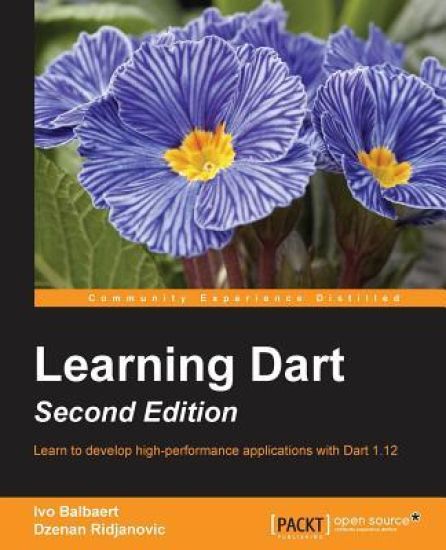
Learning Dart -

Learning Dart -

Ivo Balbaert; Dzenan Ridjanovic

Packt Publishing Limited
2015
nidottu
Learn to develop high performance applications with Dart 1.10 About This Book • Develop apps for the modern web using Dart and HTML5 • Clarify and shorten your Dart code using enums • Build a complex UI for business applications with Dart's Polymer framework, based on web components Who This Book Is For If you want to become a developer for the modern web, or wish to add Dart to your tool belt, then this book is for you. The book assumes you have basic HTML experience and know how web applications work. Some previous programming experience, preferably in a modern language like C#, Java, Python, Ruby or JavaScript, will give you a head start. You can work with Dart on your preferred platform, be it Linux, Mac OS X or Windows. What You Will Learn • Structure your code using functions, classes, generics, packages and libraries • Use the power of modern browsers to process and store data • Make games by drawing, and using audio and video in the browser • Develop an application with a model-driven and spiral-paced approach • Discover the Observatory tools for profiling memory and CPU usage of Dart programs • Store your app's data in MySQL and MongoDB through Dart • Build powerful HTML5 forms, validate and store data in local storage, and use web components to build your own user interface • Run your Dart server on an App Engine Managed VM In Detail Dart is an open source programming language for the web, developed at Google, with a steadily growing community. It is a single language for both client and server, appropriate for the full range of devices on the web – including phones, tablets, laptops, and servers. It encompasses the lessons of the last two decades of web programming. This book will give you a thorough overview of Dart, taking you through its ecosystem, syntax, and development principles. With this book, you will build web games using HTML5, audio, and video, and also dive into processing and displaying data in HTML5 forms with Dart. You will also learn how web components fit together with HTML5, and how to apply them in business web applications of the future. You will discover how to store data on the client, communicate data between client and server with JSON, and store JSON data with MongoDB and MySQL. Stop solving new challenges with the same old tools – let Dart show you a whole new way. Style and approach This book provides you a project-based approach, with everything you need to start or enhance your career in the future of web development with Dart. It follows the spiral approach: each project builds up in successive spirals, adding new features in each step.
Getting Started with Julia

Getting Started with Julia

Ivo Balbaert

Packt Publishing Limited
2015
nidottu
About This BookWork with Julia in a multi-core, distributed, and networked environmentLearn the techniques to create blazingly fast programs with JuliaThe book walks you through various practical examples to get to grips with JuliaWho This Book Is ForThis book is for you if you are a data scientist or working on any technical or scientific computation projects. The book assumes you have a basic working knowledge of high-level dynamic languages such as MATLAB, R, Python, or Ruby.
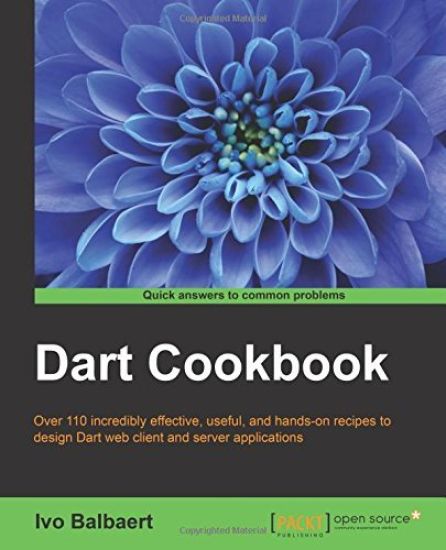
Dart Cookbook

Dart Cookbook

Ivo Balbaert

Packt Publishing Limited
2014
nidottu
If you are a Dart developer looking to sharpen your skills, and get insight and tips on how to put that knowledge into practice, then this book is for you. You should also have a basic knowledge of HTML, and how web applications with browser clients and servers work, in order to build dynamic Dart applications.
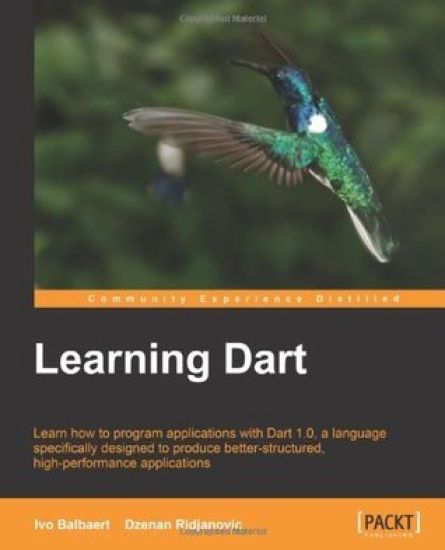
Learning Dart

Learning Dart

Ivo Balbaert; Dzenan Ridjanovic

Packt Publishing Limited
2014
nidottu
"Mastering Dart by Projects" is a step by step guide that aims to give you hands on knowledge about programming in Dart using an example based approach.If you want to become a web developer, or perhaps you already are a web developer but you want to add Dart to your tool belt, then this book is for you. This book assumes that you have at least some knowledge of HTML and how web applications work. Some previous programming experience, preferably in a modern language like C#, Java, Python, Ruby, or JavaScript, will also give you a head start. You can also work with Dart on your preferred platform, be it Linux, Mac OS X, or Windows.