Kirjojen hintavertailu. Mukana 12 192 676 kirjaa ja 12 kauppaa.

Kirjailija

J. Andrew Royle

Kirjat ja teokset yhdessä paikassa: 6 kirjaa, julkaisuja vuosilta 2005-2020, suosituimpien joukossa Occupancy Estimation and Modeling. Vertaile teosten hintoja ja tarkista saatavuus suomalaisista kirjakaupoista.

6 kirjaa

Kirjojen julkaisuhaarukka 2005-2020.

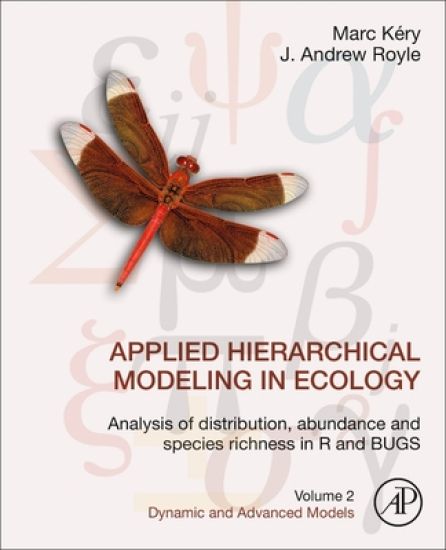
Applied Hierarchical Modeling in Ecology: Analysis of Distribution, Abundance and Species Richness in R and BUGS
Applied Hierarchical Modeling in Ecology: Analysis of Distribution, Abundance and Species Richness in R and BUGS, Volume Two: Dynamic and Advanced Models provides a synthesis of the state-of-the-art in hierarchical models for plant and animal distribution, also focusing on the complex and more advanced models currently available. The book explains all procedures in the context of hierarchical models that represent a unified approach to ecological research, thus taking the reader from design, through data collection, and into analyses using a very powerful way of synthesizing data.
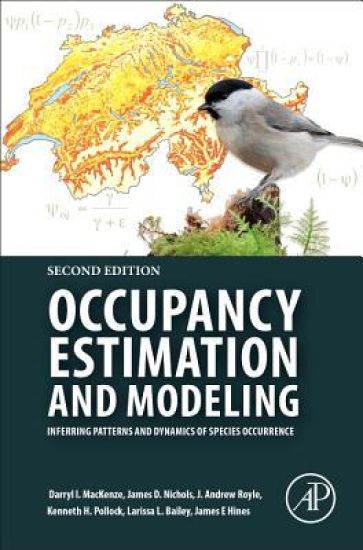
Occupancy Estimation and Modeling

Occupancy Estimation and Modeling

Darryl I. MacKenzie; James D. Nichols; J. Andrew Royle; Kenneth H. Pollock; Larissa Bailey; James E. Hines

Academic Press Inc
2017
nidottu
Occupancy Estimation and Modeling: Inferring Patterns and Dynamics of Species Occurrence, Second Edition, provides a synthesis of model-based approaches for analyzing presence-absence data, allowing for imperfect detection. Beginning from the relatively simple case of estimating the proportion of area or sampling units occupied at the time of surveying, the authors describe a wide variety of extensions that have been developed since the early 2000s. This provides an improved insight about species and community ecology, including, detection heterogeneity; correlated detections; spatial autocorrelation; multiple states or classes of occupancy; changes in occupancy over time; species co-occurrence; community-level modeling, and more. Occupancy Estimation and Modeling: Inferring Patterns and Dynamics of Species Occurrence, Second Edition has been greatly expanded and detail is provided regarding the estimation methods and examples of their application are given. Important study design recommendations are also covered to give a well rounded view of modeling.
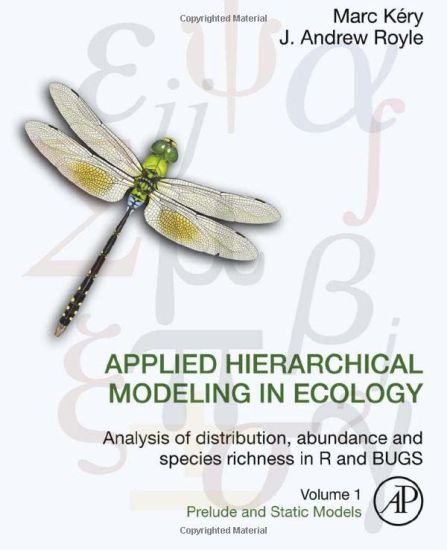
Applied Hierarchical Modeling in Ecology: Analysis of distribution, abundance and species richness in R and BUGS
Applied Hierarchical Modeling in Ecology: Distribution, Abundance, Species Richness offers a new synthesis of the state-of-the-art of hierarchical models for plant and animal distribution, abundance, and community characteristics such as species richness using data collected in metapopulation designs. These types of data are extremely widespread in ecology and its applications in such areas as biodiversity monitoring and fisheries and wildlife management. This first volume explains static models/procedures in the context of hierarchical models that collectively represent a unified approach to ecological research, taking the reader from design, through data collection, and into analyses using a very powerful class of models. Applied Hierarchical Modeling in Ecology, Volume 1 serves as an indispensable manual for practicing field biologists, and as a graduate-level text for students in ecology, conservation biology, fisheries/wildlife management, and related fields.
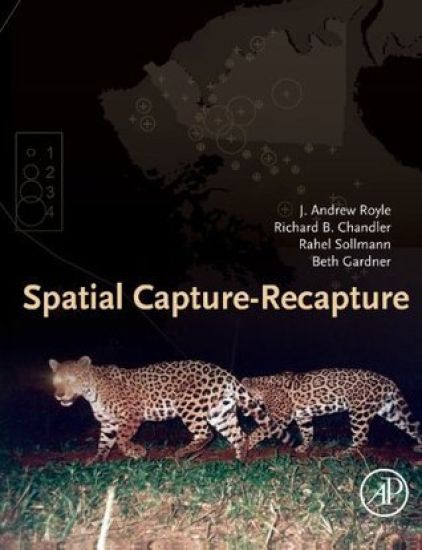
Spatial Capture-Recapture

Spatial Capture-Recapture

J. Andrew Royle; Richard B. Chandler; Rahel Sollmann; Beth Gardner

Academic Press Inc
2013
sidottu
Spatial Capture-Recapture provides a comprehensive how-to manual with detailed examples of spatial capture-recapture models based on current technology and knowledge. Spatial Capture-Recapture provides you with an extensive step-by-step analysis of many data sets using different software implementations. The authors' approach is practical – it embraces Bayesian and classical inference strategies to give the reader different options to get the job done. In addition, Spatial Capture-Recapture provides data sets, sample code and computing scripts in an R package.
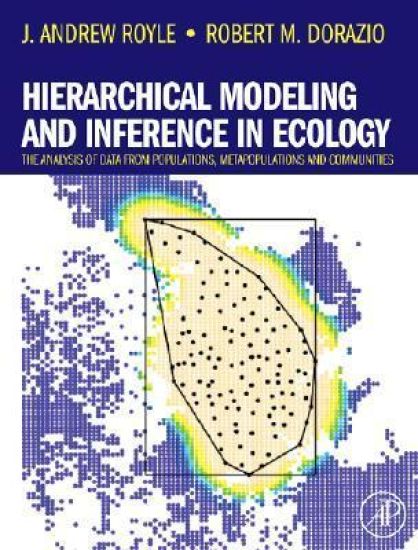
Hierarchical Modeling and Inference in Ecology

Hierarchical Modeling and Inference in Ecology

J. Andrew Royle; Robert M. Dorazio

Academic Press Inc
2008
sidottu
A guide to data collection, modeling and inference strategies for biological survey data using Bayesian and classical statistical methods. This book describes a general and flexible framework for modeling and inference in ecological systems based on hierarchical models, with a strict focus on the use of probability models and parametric inference. Hierarchical models represent a paradigm shift in the application of statistics to ecological inference problems because they combine explicit models of ecological system structure or dynamics with models of how ecological systems are observed. The principles of hierarchical modeling are developed and applied to problems in population, metapopulation, community, and metacommunity systems. The book provides the first synthetic treatment of many recent methodological advances in ecological modeling and unifies disparate methods and procedures. The authors apply principles of hierarchical modeling to ecological problems, including * occurrence or occupancy models for estimating species distribution * abundance models based on many sampling protocols, including distance sampling * capture-recapture models with individual effects * spatial capture-recapture models based on camera trapping and related methods * population and metapopulation dynamic models * models of biodiversity, community structure and dynamics
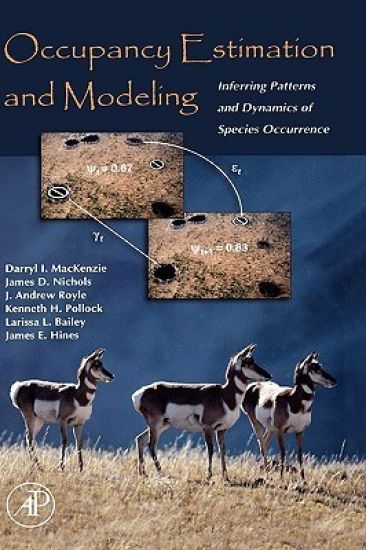
Occupancy Estimation and Modeling

Occupancy Estimation and Modeling

Darryl I. MacKenzie; James D. Nichols; J. Andrew Royle; Kenneth H. Pollock; Larissa Bailey; James E. Hines

Academic Press Inc
2005
sidottu
Occupancy Estimation and Modeling is the first book to examine the latest methods in analyzing presence/absence data surveys. Using four classes of models (single-species, single-season; single-species, multiple season; multiple-species, single-season; and multiple-species, multiple-season), the authors discuss the practical sampling situation, present a likelihood-based model enabling direct estimation of the occupancy-related parameters while allowing for imperfect detectability, and make recommendations for designing studies using these models.