Kirjojen hintavertailu. Mukana 12 390 323 kirjaa ja 12 kauppaa.

Kirjailija

J.B. Weinstein

Kirjat ja teokset yhdessä paikassa: 4 kirjaa, julkaisuja vuosilta 1997-2012, suosituimpien joukossa Forecasting Product Liability Claims. Vertaile teosten hintoja ja tarkista saatavuus suomalaisista kirjakaupoista.

4 kirjaa

Kirjojen julkaisuhaarukka 1997-2012.

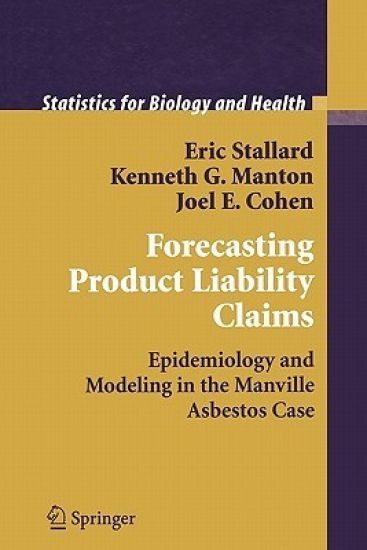
Forecasting Product Liability Claims

Forecasting Product Liability Claims

Eric Stallard; J.B. Weinstein; Kenneth G. Manton; Joel E. Cohen

Springer-Verlag New York Inc.
2010
nidottu
I write this foreword for two reasons: first, to acknowledge the gratitude of our court system to scientists willing to lend their talents to forensic tasks, and of myself, in particular, for the pathbreaking work of Eric Stallard, Kenneth G. Manton, and Joel E. Cohen in the Manville Asbestos Case; and second, because their work suggests both great strength and utility in their statisti­ cally based design and its limitations in predicting events strongly affected by political and social choices that are difficult to foretell as well as by de­ mographic and epidemiologic factors that can be prophesied with somewhat more confidence - at least in the short term. It is by now almost axiomatic that almost every important litigation in the United States requires experts to help judges and juries arrive at an under­ standing of the case sufficient to permit a sensible resolution within the flexible scope of our rules of law. The Supreme Court has laid down useful rough cri­ teria for the courts in assessing the capability of proffered experts beginning 1 with the Daubert line of cases. It has also allowed the courts to appoint ex­ 2 perts to supplement those designated by the parties. Dr. Joel E. Cohen and Professor Margaret E. Berger were appointed by me in the Manville asbestos cases pursuant to Rule 706 of the Federal Rules of Evidence to help project future claims. Discovery provisions have improved utilization of experts by 3 requiring advance reports and depositions.
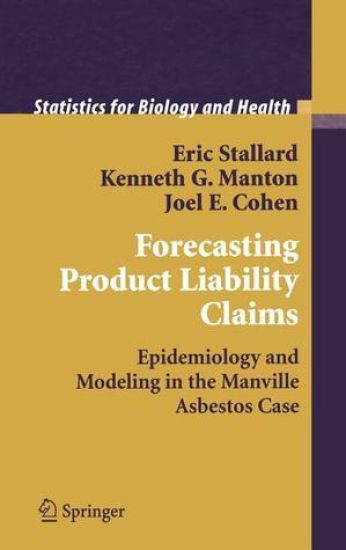
Forecasting Product Liability Claims

Forecasting Product Liability Claims

Eric Stallard; J.B. Weinstein; Kenneth G. Manton; Joel E. Cohen

Springer-Verlag New York Inc.
2004
sidottu
I write this foreword for two reasons: first, to acknowledge the gratitude of our court system to scientists willing to lend their talents to forensic tasks, and of myself, in particular, for the pathbreaking work of Eric Stallard, Kenneth G. Manton, and Joel E. Cohen in the Manville Asbestos Case; and second, because their work suggests both great strength and utility in their statisti­ cally based design and its limitations in predicting events strongly affected by political and social choices that are difficult to foretell as well as by de­ mographic and epidemiologic factors that can be prophesied with somewhat more confidence - at least in the short term. It is by now almost axiomatic that almost every important litigation in the United States requires experts to help judges and juries arrive at an under­ standing of the case sufficient to permit a sensible resolution within the flexible scope of our rules of law. The Supreme Court has laid down useful rough cri­ teria for the courts in assessing the capability of proffered experts beginning 1 with the Daubert line of cases. It has also allowed the courts to appoint ex­ 2 perts to supplement those designated by the parties. Dr. Joel E. Cohen and Professor Margaret E. Berger were appointed by me in the Manville asbestos cases pursuant to Rule 706 of the Federal Rules of Evidence to help project future claims. Discovery provisions have improved utilization of experts by 3 requiring advance reports and depositions.

Prove It with Figures

Prove It with Figures

Hans Zeisel; J.B. Weinstein; David Kaye

Springer-Verlag New York Inc.
2012
nidottu
"Prove It With Figures" displays some of the tools of the social and statistical sciences that have been applied to the proof of facts in the courtroom and to the study of questions of legal importance. It explains how researchers can extract the most valuable and reliable data that can conveniently be made available, and how these efforts sometimes go awry. In the tradition of Zeisel's "Say It with Figures," a standard in the field of social statistics since 1947, it clarifies, in non-technical language, some of the basic problems common to all efforts to discern cause-and-effect relationships. Designed as a textbook for law students who seek an appreciation of the power and limits of empirical methods, the work also is a useful reference for lawyers, policymakers, and members of the public who would like to improve their critical understanding of the statistics presented to them. The many case histories include analyses of the death penalty, jury selection, employment discrimination, mass torts, and DNA profiling. Hans Zeisel was Professor of Law and Sociology Emeritus at the University of Chicago, where he pioneered the application of social science to the law. Earlier, he had a distinguished career in public opinion and market research. He has written on a wide variety of topics, ranging from research methodology and history to law enforcement, juries, and Sheakespeare. He was elected Fellow of the American Statistical Assoication and the American Association for the Advancement of Science, and in 1980 he was inducted into the Market Research Hall of Fame. David Kaye is Regents Professor at the Arizona State University, where he teaches evidence and related topics. An author of several law textbooks and treatises, his work also has appeared in journals of
Prove It with Figures

Prove It with Figures

Hans Zeisel; J.B. Weinstein; David Kaye

Springer-Verlag New York Inc.
1997
sidottu
"Prove It With Figures" displays some of the tools of the social and statistical sciences that have been applied to the proof of facts in the courtroom and to the study of questions of legal importance. It explains how researchers can extract the most valuable and reliable data that can conveniently be made available, and how these efforts sometimes go awry. In the tradition of Zeisel's "Say It with Figures," a standard in the field of social statistics since 1947, it clarifies, in non-technical language, some of the basic problems common to all efforts to discern cause-and-effect relationships. Designed as a textbook for law students who seek an appreciation of the power and limits of empirical methods, the work also is a useful reference for lawyers, policymakers, and members of the public who would like to improve their critical understanding of the statistics presented to them. The many case histories include analyses of the death penalty, jury selection, employment discrimination, mass torts, and DNA profiling. Hans Zeisel was Professor of Law and Sociology Emeritus at the University of Chicago, where he pioneered the application of social science to the law. Earlier, he had a distinguished career in public opinion and market research. He has written on a wide variety of topics, ranging from research methodology and history to law enforcement, juries, and Sheakespeare. He was elected Fellow of the American Statistical Assoication and the American Association for the Advancement of Science, and in 1980 he was inducted into the Market Research Hall of Fame. David Kaye is Regents Professor at the Arizona State University, where he teaches evidence and related topics. An author of several law textbooks and treatises, his work also has appeared in journals of