Kirjojen hintavertailu. Mukana 12 390 323 kirjaa ja 12 kauppaa.

Kirjailija

J. Brooks Flippen

Kirjat ja teokset yhdessä paikassa: 5 kirjaa, julkaisuja vuosilta 2006-2018, suosituimpien joukossa Speaker Jim Wright. Vertaile teosten hintoja ja tarkista saatavuus suomalaisista kirjakaupoista.

5 kirjaa

Kirjojen julkaisuhaarukka 2006-2018.

Speaker Jim Wright

Speaker Jim Wright

J. Brooks Flippen

University of Texas Press
2018
sidottu
Honorable Mention, Ramirez Family Award for Most Significant Scholarly Book, Texas Institute of Letters, 2019Jim Wright made his mark on virtually every major public policy issue in the later twentieth century-energy, education, taxes, transportation, environmental protection, civil rights, criminal justice, and foreign relations, among them. He played a significant role in peace initiatives in Central America and in the Camp David Accords, and he was the first American politician to speak live on Soviet television. A Democrat representing Texas’s twelfth district (Fort Worth), Wright served in the US House of Representatives from the Eisenhower administration to the presidency of George H. W. Bush, including twelve years (1977–1989) as majority leader and speaker. His long congressional ascension and sudden fall in a highly partisan ethics scandal spearheaded by Newt Gingrich mirrored the evolution of Congress as an institution.Speaker Jim Wright traces the congressman’s long life and career in a highly readable narrative grounded in extensive interviews with Wright and access to his personal diaries. A skilled connector who bridged the conservative and liberal wings of the Democratic party while forging alliances with Republicans to pass legislation, Wright ultimately fell victim to a new era of political infighting, as well as to his own hubris and mistakes. J. Brooks Flippen shows how Wright’s career shaped the political culture of Congress, from its internal rules and power structure to its growing partisanship, even as those new dynamics eventually contributed to his political demise. To understand Jim Wright in all his complexity is to understand the story of modern American politics.
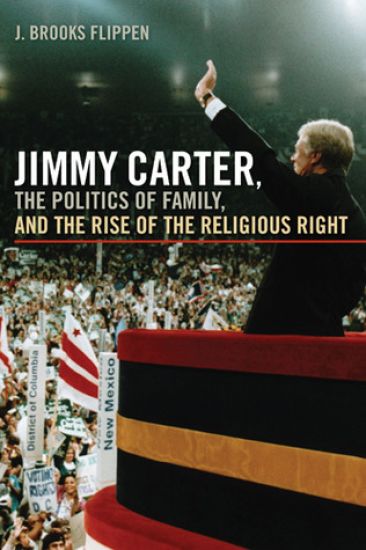
Jimmy Carter, the Politics of Family, and the Rise of the Religious Right
As Jimmy Carter ascended to the presidency the heir apparent to Democratic liberalism, he touted his background as a born-again evangelical. Once in office, his faith indeed helped form policy on a number of controversial moral issues. By acknowledging certain behaviors as sinful while insisting that they were private matters beyond government interference, J. Brooks Flippen argues, Carter unintentionally alienated both social liberals and conservative Christians, thus ensuring that the debate over these moral “family issues” acquired a new prominence in public and political life.The Carter era, according to Flippen, stood at a fault line in American culture, religion, and politics. In the wake of the 1960s, some Americans worried that the traditional family faced a grave crisis. This newly politicized constituency viewed secular humanism in education, the recognition of reproductive rights established by Roe v. Wade, feminism, and the struggle for homosexual rights as evidence of cultural decay and as a challenge to religious orthodoxy. Social liberals viewed Carter’s faith with skepticism and took issue with his seeming unwillingness to build on recent progressive victories. Ultimately, Flippen argues, conservative Christians emerged as the Religious Right and were adopted into the Republican fold.Examining Carter’s struggle to placate competing interests against the backdrop of difficult foreign and domestic issues—a struggling economy, the stalled Strategic Arms Limitation Talks, disputes in the Middle East, handover of the Panama Canal, and the Iranian hostage crisis—Flippen shows how a political dynamic was formed that continues to this day.
Jimmy Carter, the Politics of Family, and the Rise of the Religious Right
As Jimmy Carter ascended to the presidency the heir apparent to Democratic liberalism, he touted his background as a born-again evangelical. Once in office, his faith indeed helped form policy on a number of controversial moral issues. By acknowledging certain behaviors as sinful while insisting that they were private matters beyond government interference, J. Brooks Flippen argues, Carter unintentionally alienated both social liberals and conservative Christians, thus ensuring that the debate over these moral “family issues” acquired a new prominence in public and political life.The Carter era, according to Flippen, stood at a fault line in American culture, religion, and politics. In the wake of the 1960s, some Americans worried that the traditional family faced a grave crisis. This newly politicized constituency viewed secular humanism in education, the recognition of reproductive rights established by Roe v. Wade, feminism, and the struggle for homosexual rights as evidence of cultural decay and as a challenge to religious orthodoxy. Social liberals viewed Carter’s faith with skepticism and took issue with his seeming unwillingness to build on recent progressive victories. Ultimately, Flippen argues, conservative Christians emerged as the Religious Right and were adopted into the Republican fold.Examining Carter’s struggle to placate competing interests against the backdrop of difficult foreign and domestic issues—a struggling economy, the stalled Strategic Arms Limitation Talks, disputes in the Middle East, handover of the Panama Canal, and the Iranian hostage crisis—Flippen shows how a political dynamic was formed that continues to this day.
Conservative Conservationist

Conservative Conservationist

J. Brooks Flippen

Louisiana State University Press
2006
sidottu
In the history of American environmentalism, Russell E. Train plays a starring role. Few individuals have been so influential in creating the United States' environmental policies and encouraging conservation efforts around the world. In this absorbing new biography, J. Brooks Flippen describes Train's significance within the fascinating history of the contemporary environmental movement.A lifelong Republican, Train left a successful judicial career to found the African Wildlife Leadership Foundation. As the problems of pollution and unrestrained growth became apparent, he adopted a more ecological approach to nature and became a leader of the emerging environmental movement of the 1960s. He soon headed the Conservation Foundation, one of the first organizations to appreciate that humans represent only one strand in the ""web of life."" President Richard Nixon appointed Train as the initial chairman of the Council on Environmental Quality just as the country celebrated its first Earth Day. There he helped craft the most important environmental legislation in U.S. history. After three years, he became administrator of the Environmental Protection Agency, enforcing regulations during the Energy Crisis and much of the troubled 1970s.With the election of Democrat Jimmy Carter, Train returned to the private sector as head of the American affiliate of the World Wildlife Fund. He found himself increasingly at odds with many Republicans as a new, more ideological brand of conservatism grew and bipartisanship faded. Train's Republican credentials and environmental advocacy made him a vestige of the past and, in a sense, a hope for the future.Given complete access to the personal papers and recollections of Russell Train, Flippen casts an unbiased eye on this remarkable man and the causes he has so fervently promoted. Of a prominent Washington family, Train has known every president from Herbert Hoover to George W. Bush. His life and career illustrate the political dynamics of modern environmentalism and illuminate the insider culture of Washington, D.C.
Nixon and the Environment

Nixon and the Environment

J. Brooks Flippen

University of New Mexico Press
2012
nidottu
No one remembers Richard M. Nixon as an environmental president, but a year into his presidency, he committed his administration to regulate and protect the environment. The public outrage over the Santa Barbara oil spill in early 1969, culminating in the first Earth Day in 1970, convinced Nixon that American environmentalism now enjoyed extraordinary political currency.No nature lover at heart, Nixon opportunistically tapped the burgeoning Environmental Movement and signed the Endangered Species Act in 1969 and the National Environmental Protection Act in 1970 to challenge political rivals such as Senators Edmund Muskie and Henry Jackson. As Nixon jockeyed for advantage on regulatory legislation, he signed laws designed to curb air, water, and pesticide pollution, regulate ocean dumping, protect coastal zones and marine mammals, and combat other problems. His administration compiled an unprecedented environmental record, but anti-Vietnam War protests, outraged industrialists, a sluggish economy, the growing energy crisis, and the Watergate upheaval drove Nixon to turn his back on the very programs he signed into law. Only late in life did he re-embrace the substantial environmental legacy of his tumultuous presidency.