Kirjojen hintavertailu. Mukana 12 290 406 kirjaa ja 12 kauppaa.

Kirjailija

J. C. Lester

Kirjat ja teokset yhdessä paikassa: 8 kirjaa, julkaisuja vuosilta 1905-2025, suosituimpien joukossa Two Dialogues. Vertaile teosten hintoja ja tarkista saatavuus suomalaisista kirjakaupoista.

Mukana myös kirjoitusasut: J.C. Lester, J C Lester, J.C Lester

8 kirjaa

Kirjojen julkaisuhaarukka 1905-2025.

The General Theory of Liberty

The General Theory of Liberty

J.C. Lester

Carus Books
2025
nidottu
Liberty, or freedom, is the absence of some sort of constraint on something. Most people think their own liberty is important. Classical liberals and libertarians love interpersonal or political liberty and almost worship it, but most of them, sadly, can’t explain what it is. Other people, even socialists, often declare that they like liberty a lot, but usually they too can’t tell us what it is. Interpersonal liberty is not about the freedom to jump over buildings or levitate. That people are constrained by natural laws is not the issue. At first glance, interpersonal liberty looks to be about the absence of interpersonal or social constraints: people not interfering with (or constraining) each other in certain ways. Sometimes people, including classical liberals, explicitly adapt the notion of liberty that Thomas Hobbes appealed to. They say that someone is free when other people don’t or can’t stop him from doing or having what he wants. The big problem with this is that it’s zero-sum. If I have the liberty to murder or rob you, then you don’t have the liberty not to be murdered or robbed (and vice versa). We can only choose which liberties we prefer by using some other, apparently higher, principle than liberty; such as utility, happiness, or prudential choice. Hobbes’s liberty is a common-sense intuition, but John Locke had a better one. Roughly, we have liberty when people don’t interfere with or constrain us in our person or property. In this sense, not being murdered or robbed is part of liberty but murdering or robbing is not: murder and robbery are impositions or licenses. Such liberty can be decreased or increased. This is what most people, including classical liberals, intend to advocate. We see how it promotes human welfare as the satisfaction of wants or preferences: people don’t want to be imposed on and do want the products of free markets. But we still have a big problem. Liberty, property, and welfare (well-being) have been conflated. What is the abstract theory of liberty that is being presupposed, independently of property and human well-being? How does that theory relate to property and well-being or prosperity? Can want-satisfaction be an adequate theory of welfare? J.C. Lester’s new book starts by explaining and defending the abstract theory of liberty and then applying it until libertarian property is eventually derived. The bulk of the book defends many aspects of the overall theory from criticisms. It concludes with some important and controversial applications.
Two Dialogues

Two Dialogues

J.C Lester

The University of Buckingham Press
2017
nidottu
Why learn about philosophy? Because it is the master subject, more fundamental than all of the others. Philosophical discourse critically examines fundamental assumptions and presuppositions without which one cannot be truly intellectually autonomous.Why learn about libertarianism? Because politics causes or exacerbates the very problems that it purports to solve, misperceiving voluntary behaviour and free markets as problems. Liberty is always preferable. Its maximal practical observance entailing self-ownership, private property and consensual interactions. And libertarianism will be the ideological framework of the future of humankind.These bold claims are expounded and defended in J P Lester's Two Dialogues: Introduction to Philosophy and Libertarianism. Amusing and stimulating, these brief introductions to philosophy and libertarianism offer a unique insight and can be read without prior knowledge of the subjects. Lester's often highly unorthodox critical commentary makes this a sharp and necessary read.
Arguments For Liberty

Arguments For Liberty

J. C. Lester

The University of Buckingham Press
2016
nidottu
An essential book on liberty. Liberty is what libertarians advocate, both because of the inherent value of human liberty and because of the increasing wealth and welfare it brings to all. They see the aggressive coercion of the state as the main enemy of liberty. The solution is to roll back the state until there is little or no state left. Libertarianism has been rapidly growing since the 1970s but it is still not commonly understood or even given a proper hearing. You will increasingly come across it. Often it will be state enthusiasts disingenuously claiming to be libertarians. At other times it will be state enthusiasts attacking libertarianism as an extremist ideology. And very occasionally it will be real libertarians explaining and defending their views. J C Lester is a libertarian philosopher who has been writing about why liberty is preferable to politics for about 30 years. This book contains many of his shorter writings on the subject. These range from the populist to the philosophical. Together they function as a miscellaneous introduction to libertarianism. The various different topics and approaches should give the reader a good cross-reference grasp of the subject.
Explaining Libertarianism

Explaining Libertarianism

J.C. Lester

The University of Buckingham Press
2014
nidottu
Explaining Libertarianism: four theses: 1. Interpersonal liberty requires an explicit, pre-propertarian, purely factual, theory. 2. Liberty is and need only be morally desirable in systematic practice, not in every logically possible case. In practice, there is no clash between the two main moral contenders: rights and consequences. 3. Nothing can ever justify, support or ground any theory of liberty or its applications because it is logically impossible to transcend assumptions. Theories can only be explained, criticised and defended within conjectural frameworks. 4. The state is inherently authoritarian and also negative-sum. It reduces welfare overall, with the losses compounding over time. Libertarian anarchic order is the positive-sum solution to illiberal political chaos. J C Lester is a philosopher of libertarianism. He has written widely on the subject in books, articles and dialogues. His solution to the crucial philosophical problem of interpersonal liberty provides an explicit theory of liberty and explains how its application entails self-ownership and external property, and relates to all other interpersonal matters.
Escape From Leviathan

Escape From Leviathan

J. C. Lester

The University of Buckingham Press
2012
nidottu
"The most relevant and plausible conceptions of economic rationality, interpersonal liberty, human welfare and private-property anarchy do not conflict in theory or practice."Using philosophy and social science, Escape from Leviathan defends this bold, non-normative thesis from contrary positions in the scholarly literature.Considering authors such as David Friedman, John Gray, R. M. Hare, Robert Nozick, Karl Popper, John Rawls, Murray Rothbard, Alan Ryan, Amartya Sen and Bernard Williams, the rationality assumptions of neoclassical and Austrian School economics are reconciled and related to liberty and welfare. A new pre-propertarian theory of interpersonal liberty as the absence of (initiated or proactively) imposed cost is argued to be libertarian. Human welfare is defended as the satisfaction of unimposed wants. Practical anarchy is simply unconstrained private property. Related topics include free will, weakness of will, the nature of moralising, intellectual property and restitution and retribution.This is a ground-breaking piece of work, functioning as an excellent introduction to libertarianism and social thought.
Arguments for Liberty

Arguments for Liberty

J. C. Lester

The University of Buckingham Press
2011
nidottu
An essential book on liberty.Liberty is what libertarians advocate, both because of the inherent value of human liberty and the increasing wealth and welfare it brings to all. The aggressive coercion of the state is regarded by libertarians as the "enemy of liberty". The solution: to roll back the state until there is little or no state left.Libertarianism is a movement and philosophy that has been rapidly emerging since the 1970s, and yet it remains a largely misunderstood concept. You might find state enthusiasts disingenuously claiming to be libertarians, or state enthusiasts attacking libertarianism as being an extremist ideology. And very occasionally you'll come across a real libertarian explaining and defending their views.J C Lester is a libertarian philosopher who has been writing about liberty politics for almost 30 years. Arguments for Liberty features a range of his shorter writings on the subject, ranging from the populist to the philosophical. Together they function as a miscellaneous introduction to libertarianism.
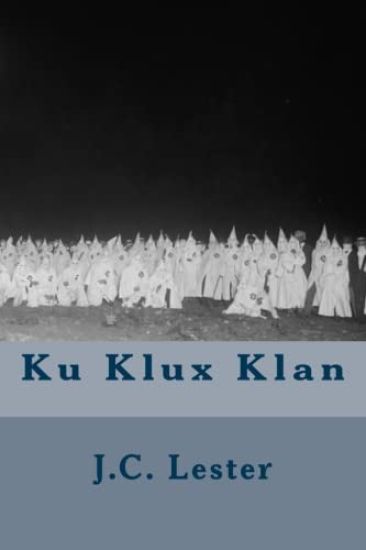
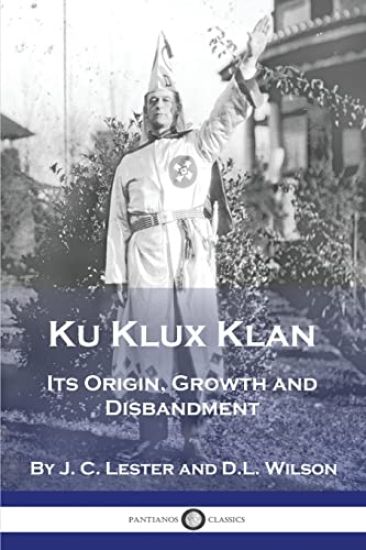
Ku Klux Klan

Ku Klux Klan

J C Lester; D L Wilson

Pantianos Classics
1905
pokkari
The KKK's early history from its formation to its first disbandment is revealed with astonishing detail - writing in 1905, the author includes eyewitness accounts from those alive at the time.Following the American Civil War, the emancipation of black Americans occurred - the peoples formerly owned by plantation owners and farmers were accorded freedom, citizenship and rights as citizens of the United States. However, a segment of the population were unhappy with the emancipation of the enslaved - a desire for white domination led many, particularly in the Deep South, to perpetrate violence, mischief and murder. In the southern states, six former officers of the Confederate States of America formed the Ku Klux Klan. Intentionally shrouding the initiation ceremonies, doctrines and customs in mystery, the group was formed to amuse its members and attract public curiosity. Only later, as the group gained in membership and perpetrated violent and murderous acts, did their white hoods and rituals acquire notoriety and become synonymous with white supremacy and menace against the black minority.This book details the formation and progress of the 1st Klan, which operated between the years 1865 and 1871. Authored in 1905, it benefits from eyewitness accounts; at the time, the KKK's first appearance was within living memory, thought a curious event firmly confined to the past. However, a decade after Fleming published this book the KKK was revived, becoming far larger than before.Although overshadowed by later events, histories such as Fleming's shed light on an era of upheaval. Backlash against emancipation was anticipated, and the KKK was not the only extra-judicial group of its kind; although such organizations successfully intimidated many blacks into departing politics, laws and crackdowns by the government contained the organization, albeit temporarily.