Kirjojen hintavertailu. Mukana 12 595 353 kirjaa ja 12 kauppaa.

Kirjailija

J.E. McGuire

Kirjat ja teokset yhdessä paikassa: 5 kirjaa, julkaisuja vuosilta 1984-2011, suosituimpien joukossa How Things Are. Vertaile teosten hintoja ja tarkista saatavuus suomalaisista kirjakaupoista.

Mukana myös kirjoitusasut: J. E. McGuire

5 kirjaa

Kirjojen julkaisuhaarukka 1984-2011.

How Things Are

How Things Are

J. Bogen; J.E. McGuire

Springer
2011
nidottu
One of the earliest and most influential treatises on the subject of this volume is Aristotle's Categories. Aristotle's title is a form of the Greek verb for speaking against or submitting an accusation in a legal proceeding. By the time of Aristotle, it also meant: to signify or to predicate. Surprisingly, the "predicates" Aristotle talks about include not only bits of language, but also such nonlinguistic items as the color white in a body and the knowledge of grammar in a man's soul. (Categories I/ii) Equally surprising are such details as Aristotle's use of the terms 'homonymy' and 'synonymy' in connection with things talked about rather than words used to talk about them. Judging from the evidence in the Organon, the Metaphysics, and elsewhere, Aristotle was both aware of and able to mark the distinction between using and men­ tioning words; and so we must conclude that in the Categories, he was not greatly concerned with it. For our purposes, however, it is best to treat the term 'predication' as if it were ambiguous and introduce some jargon to disambiguate it. Code, Modrak, and other authors of the essays which follow use the terms 'linguistic predication' and 'metaphysical predication' for this.
Tradition and Innovation

Tradition and Innovation

J.E. McGuire

Springer
2011
nidottu
In my early years I was constituted in the exacting imperatives of philosophical analysis. That stern face is present in the composition of the Newton essays chosen here for republication. It is my hope that potential readers will be patient with the old Adam of analysis, and seize the portrait of Newton's intellec­ tual world presented in these essays. It is gratifying for me to acknowledge the encouragement of Robert Butts and John Nicholas of the University of Western Ontario, intellectual comrades in arms. It was at Western that I began my intellectual journey, and many of the present members of the Philosophy Department remain my friends and mentors. I thank also Marta Spranzi­ Zuber who long ago believed in the merit of my Newton scholarship. But most important to me is the sustaining encouragement of Professor Barbara Tuchanska, who shares my vision of the historicity of scientific thought. It is a pleasure to express my gratitude for membership, over twenty years, in the Department of History and Philosophy of Science at the University of Pittsburgh. It is the mecca for one who seeks to understand. J. E.
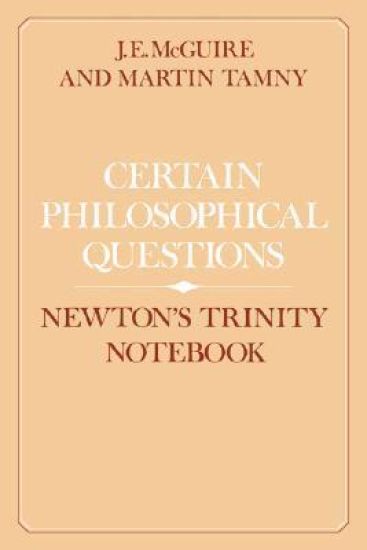
Certain Philosophical Questions

Certain Philosophical Questions

J. E. McGuire; Martin Tamny

Cambridge University Press
2003
pokkari
Isaac Newton wrote the manuscript Questiones quaedam philosophicae at the very beginning of his scientific career. This small notebook thus affords rare insight into the beginnings of Newton’s thought and the foundations of his subsequent intellectual development. The Questiones contains a series of entries in Newton’s hand that range over many topics in science, philosophy, psychology, theology, and the foundations of mathematics. These notes, written in English, provide a very detailed picture of Newton’s early interests, and record his critical appraisal of contemporary issues in natural philosophy. Written predominantly in 1664–5, they give a significant perspective on Newton’s thought just prior to his annus mirabilis, 1666. This volume provides a complete transcription of the Questiones, together with an ‘expansion’ into modern English, and a full editorial commentary on the content and significance of the notebook in the development of Newton’s thought. It will be essential reading for all those interested in Newton and the intellectual foundations of science.
Tradition and Innovation

Tradition and Innovation

J.E. McGuire

Springer
1995
sidottu
In my early years I was constituted in the exacting imperatives of philosophical analysis. That stern face is present in the composition of the Newton essays chosen here for republication. It is my hope that potential readers will be patient with the old Adam of analysis, and seize the portrait of Newton's intellec­ tual world presented in these essays. It is gratifying for me to acknowledge the encouragement of Robert Butts and John Nicholas of the University of Western Ontario, intellectual comrades in arms. It was at Western that I began my intellectual journey, and many of the present members of the Philosophy Department remain my friends and mentors. I thank also Marta Spranzi­ Zuber who long ago believed in the merit of my Newton scholarship. But most important to me is the sustaining encouragement of Professor Barbara Tuchanska, who shares my vision of the historicity of scientific thought. It is a pleasure to express my gratitude for membership, over twenty years, in the Department of History and Philosophy of Science at the University of Pittsburgh. It is the mecca for one who seeks to understand. J. E.
How Things Are

How Things Are

J. Bogen; J.E. McGuire

Kluwer Academic Publishers
1984
sidottu
One of the earliest and most influential treatises on the subject of this volume is Aristotle's Categories. Aristotle's title is a form of the Greek verb for speaking against or submitting an accusation in a legal proceeding. By the time of Aristotle, it also meant: to signify or to predicate. Surprisingly, the "predicates" Aristotle talks about include not only bits of language, but also such nonlinguistic items as the color white in a body and the knowledge of grammar in a man's soul. (Categories I/ii) Equally surprising are such details as Aristotle's use of the terms 'homonymy' and 'synonymy' in connection with things talked about rather than words used to talk about them. Judging from the evidence in the Organon, the Metaphysics, and elsewhere, Aristotle was both aware of and able to mark the distinction between using and men­ tioning words; and so we must conclude that in the Categories, he was not greatly concerned with it. For our purposes, however, it is best to treat the term 'predication' as if it were ambiguous and introduce some jargon to disambiguate it. Code, Modrak, and other authors of the essays which follow use the terms 'linguistic predication' and 'metaphysical predication' for this.