Kirjojen hintavertailu. Mukana 12 530 820 kirjaa ja 12 kauppaa.
Kirjailija
J. Edward Taylor
Kirjat ja teokset yhdessä paikassa: 10 kirjaa, julkaisuja vuosilta 1996-2020, suosituimpien joukossa Worlds in Motion. Vertaile teosten hintoja ja tarkista saatavuus suomalaisista kirjakaupoista.
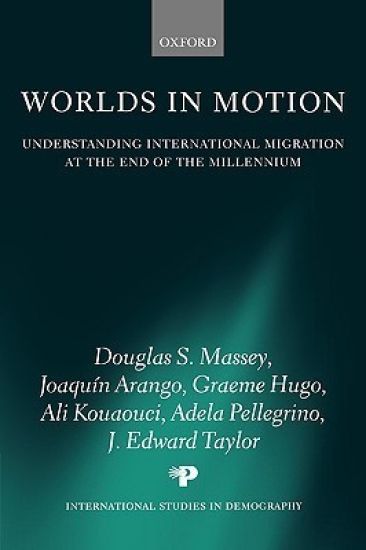
At the end of the 20th century nearly all developed nations have become countries of immigration, absorbing growing numbers of immigrants not only from developed regions, but increasingly from developing nations of the Third World. Although international migration has come to play a central role in the social, economic, and demographic dynamics of both immigrant-sending and immigrant-receiving countries, social scientists have been slow to construct a comprehensive theory to explain it. Efforts at theoretical explanation have been fragmented by disciplinary, geographic, and methodological boundaries. Worlds in Motion seeks to overcome these schisms to create a comprehensive theory of international migration for the next century. After explicating the various propositions and hypotheses of current theories, and identifying area of complementarity and conflict, the authors review empirical research emanating from each of the world's principal international migration systems: North America, Western Europe, the Gulf, Asia and the Pacific, and the Southern Cone of South America. Using data from the 1980s, levels and patterns of migration within each system are described to define their structure and organization. Specific studies are then comprehensively surveyed to evaluate the fundamental propositions of neoclassical economics, the new economics of labour migration, segmented labour market theory, world systems theory, social capital theory, and the theory of cumulative causation. The various theories are also tested by applying them to the relationship between international migration and economic development. Although certain theories seem to function more effectively in certain systems, all contain elements of truth supported by empirical research. The task of the theorist is thus to identify which theories are most effective in accounting for international migration in the world today, and what regional and national circumstances lead to a predominance of one theoretical mechanism over another. The book concludes by offering an empirically-grounded theoretical synthesis to serve as a guide for researchers and policy-makers in the 21st century.
At the end of the 20th century nearly all developed nations have become countries of immigration, absorbing growing numbers of immigrants not only from developed regions, byt increasingly from developing nations of the Third World. Although international migration has come to play a central role in the social, economic, and demographic dynamics of both immigrant-sending and immigrant-receiving countries, social scientist have been slow to construct a comprehensive theory to explain it. Efforts at theoretical explanation have been fragmented by disciplinary, geographic, and methodological boudaries. Worlds in Motion seeks to overcome these schisms to create a comprehensive theory of international migration for the next century. After explicating the various propositions and hypotheses of current theories, and identifying area of complementarity and conflict, the authors review empirical research emanting from each of the world's principal international migration systems: North America, Western Europe, the Gulf, Asia and the Pacific, and the Southern Cone of South America. Using data from the 1980s, levels and patterns of migration within each system are described to define their structure and organization. Specific studies are then comprehensively surveyed to evaluate the fundamental propositions of neoclassical economics, the new economics of labour migration, segmented labour market theory, world systems theory, social capital theory, and the theory of cumulative causation. The various theories are also tested by applying them to the relationship between international migration and economic development. Although certain theories seem to function more effectively in certain systems, all contain elements of truth supported by empirical research. The task of the theorist is thus to identify which theories are most effective in accounting for international migration in the world today, and what regional and national circumstances lead to a predominance of one theoretical mechanism over another. The book concludes by offering an empirically-grounded theoretical synthesis to serve as a guide for researchers and policy-makers in the 21st century.
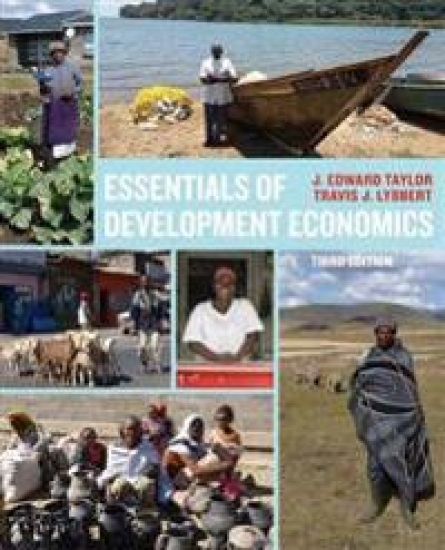
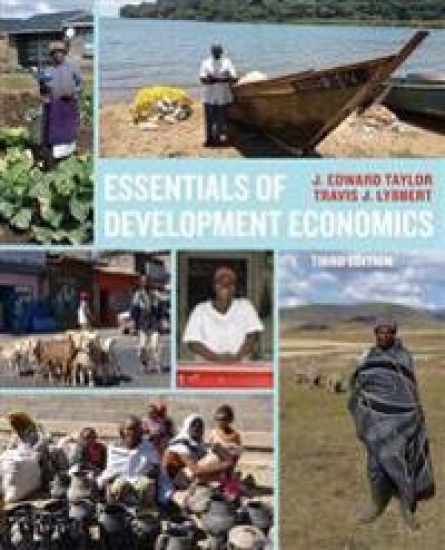
Written to provide students with the critical tools and approaches used by development economists, Essentials of Development Economics represents an alternative approach to traditional textbooks on the subject. Compact and less expensive than other textbooks for undergraduate development economics courses, Essentials of Development Economics offers a broad overview of key topics and methods in the field. Its fourteen easy-to-read chapters introduce cutting-edge research and present best practices and state-of-the-art methods. By mastering the material in this time-tested book, students will have the conceptual grounding needed to move on to more advanced development economics courses. This new edition includes: updated references to international development policy process and goalssubstantial updates to several chapters with new and revised material to make the text both current and policy relevantreplacement of several special features with new ones featuring widely cited studies
The Farm Labor Problem: A Global Perspective explores the unique character of agricultural labor markets and the implications for food production, farm worker welfare and advocacy, and immigration policy. Agricultural labor markets differ from other labor markets in fundamental ways related to seasonality and uncertainty, and they evolve differently than other labor markets as economies develop. We weave economic analysis with the history of agricultural labor markets using data and real-world events. The farm labor history of California and the United States is particularly rich, so it plays a central role in the book, but the book has a global perspective ensuring its relevance to Europe and high-income Asian countries. The chapters in this book provide readers with the basics for understanding how farm labor markets work (labor in agricultural household models, farm labor supply and demand, spatial market equilibria); farm labor and immigration policy; farm labor organizing; farm employment and rural poverty; unionization and the United Farm Workers movement; the Fair Food Program as a new approach to collective bargaining; the declining immigrant farm labor supply; and what economic development in relatively low-income countries portends for the future of agriculture in the United States and other high-income countries. The book concludes with a chapter called "Robots in the Fields," which extrapolates current trends to a perhaps not-so-distant future. The Farm Labor Problem serves as both a guide to policy makers, farmworker advocates and international development organizations and as a textbook for students of agricultural economics and economics.
Essentials of Applied Econometrics prepares students for a world in which more data surround us every day and in which econometric tools are put to diverse uses. Written for students in economics and for professionals interested in continuing an education in econometrics, this succinct text not only teaches best practices and state-of-the-art techniques, but uses vivid examples and data obtained from a variety of real world sources. The book's emphasis on application uniquely prepares the reader for today's econometric work, which can include analyzing causal relationships or correlations in big data to obtain useful insights.
This book provides researchers, students, and practitioners with a methodology to evaluate the impacts of a wide diversity of development projects and policies on local economies. Projects and policies often create spillovers within project areas. LEWIE uses simulation methods to quantify these spillovers. It has become a complement to randomized control trials (RCTs), as governments and donors become interested in documenting impacts beyond the treated, comparing the likely impacts of alternative interventions, and designing complementary interventions to influence program and policy impacts. It is also a tool for impact evaluation where RCTs are not feasible. Chapters 1-4 motivate and present the basics of impact simulation, including how to design a LEWIE model, how to estimate the model, and how to obtain the necessary data. The remaining chapters provide a diversity of interesting real-world applications and extensions of the basic models. The applications include evaluations of the impacts of cash transfers for the poor, ecotourism, global food-price shocks, irrigation projects, migration, and corruption. Each chapter provide readers with the tools they need to conduct their own local economy-wide impact evaluations. All models and data used in this book are available on-line.
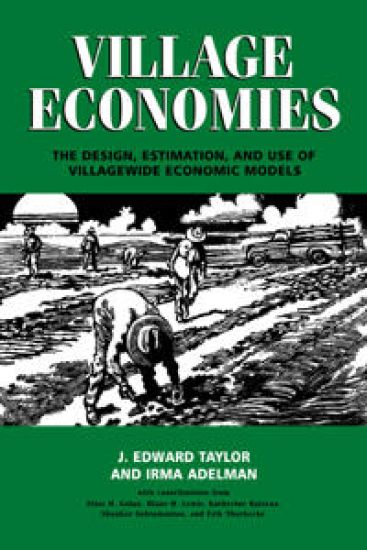
Most of the world's population and the vast majority of the world's poor live and work in villages. Their activities are usually centred in households, but interactions among households shape the impacts of policy, market and environmental changes on rural production, incomes, employment and migration. This book presents a generation of villagewide economic modelling designed to capture these interactions when assessing the impacts of policy, market and environmental changes on rural economies in less developed countries. The authors present a general framework for modelling village economies based on computable general-equilibrium techniques, estimate models for villages and a village-town in five different countries, and use these models to conduct a series of comparative experiments. The findings offer explanations for some paradoxical outcomes of exogenous shocks as their influence winds its way through rural economies, and they underline the importance of adopting a local economy-wide perspective when designing development policies.