Kirjojen hintavertailu. Mukana 12 595 353 kirjaa ja 12 kauppaa.

Kirjailija

J. Moller

Kirjat ja teokset yhdessä paikassa: 5 kirjaa, julkaisuja vuosilta 1995-2011, suosituimpien joukossa Testosterone Treatment of Cardiovascular Diseases. Vertaile teosten hintoja ja tarkista saatavuus suomalaisista kirjakaupoista.

5 kirjaa

Kirjojen julkaisuhaarukka 1995-2011.

Testosterone Treatment of Cardiovascular Diseases

Testosterone Treatment of Cardiovascular Diseases

J. Moller; H. Einfeldt

Springer-Verlag Berlin and Heidelberg GmbH Co. K
2011
nidottu
For many years now I have devoted much of my time to lecturing and writing on the subject of cardiovascular disease (CVD). In this book I have outlined the development of my approach to this problem. I must admit that the details of my theories have undergone continuous modification as a result of the lessons learned in treating a large number of patients, but the basic message has remained the same. I believe that the delay in the utilization oftestosterone treatment for CVD has arisen from a failure by specialists in endocrinology, biochemistry, physi­ ology, and cardiology to understand each other's point of view and therefore to effectively coordinate their clinical efforts. This is like four people starting to climb the various faces of a pyramid, unaware of each other's presence until they reach the apex. It is hoped that bringing specialists in these different disciplines together at "summit meetings" will help them discover the true nature of this disease, the cardiovascular specialist understanding the underlying lack of anabolic steroids, and the other three grasping the way in which treatment with these compounds can effectively counteract the metabolic disturbance which is the cause of CVD. Even apart of the language barrier, writing this book has by no means been an easy task. Please consider my situation; one cannot be a cardiologist, endocrinologist, biologist, biochemist, and physiologist all in one person. This fact may open me to criticism.

The End of Internationalism

The End of Internationalism

J. Moller

Praeger Publishers Inc
2000
sidottu
Since 1945, the world has moved, haltingly but relentlessly, toward internationalism. And with the end of the Cold War and the apparent dominance of the West and its democratic and free-market systems, that march toward internationalism has proceeded apace, seemingly unstoppable. Or is it? With the Asian financial contagion spreading worldwide, the Russian democratic experiment coming undone, and cultural-ethnic violence flaring up around the world, one wonders.Ambassador M^D/oller examines some of the major trends in the world system as we approach the new millennium: the stresses of globalization, the future role of the nation-state, the free-market system versus state-managed capitalism, and democratic pluralism versus Asian/Islamic/African/and other values. And he brings to this examination his background as a futurist, as a trade and economic affairs negotiator in the European Union, and as Ambassador to Singapore, one country where all these dynamics are at work. The larger question raised by Ambassador M^D/oller is: Are we poised on the brink of a new and truly internationalism millennium, or is this a sort of neo-Wilsonian phase destined for an abject and abrupt end? This book will be of interest to concerned citizens, futurists, and scholars and students of international relations around the world.
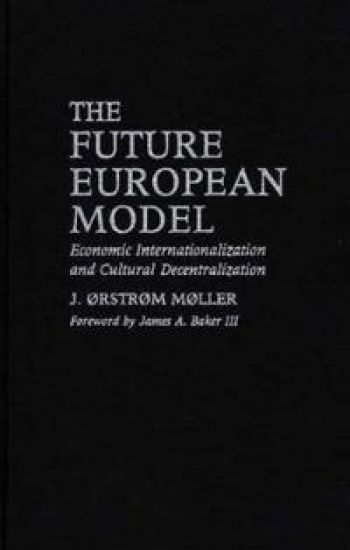
The Future European Model

The Future European Model

J. Moller

Praeger Publishers Inc
1995
sidottu
This work by a well-known futurist and Danish diplomat, examines Europe's future, analyzing the deepest currents governing the evolution of Europe in relation to the interaction of culture and technology. The book describes the role of the European nation-states, regions, and enterprises. It provides a sketch of the European role vis-a-vis the United States and Japan. And it outlines the author's view of Europe's passage from the industrial to the immaterial age: the competitive parameter of Europe's future will be primarily that of culture, and the cultural attribute will define the profile of all European enterprises. Culture, knowledge, and entertainment will take over as the engines of future economic development. Moller is buoyant with regard to the future of European integration, and in suggesting culture as the driving force behind that integration, he offers a new and refreshing vision for Europe's future.
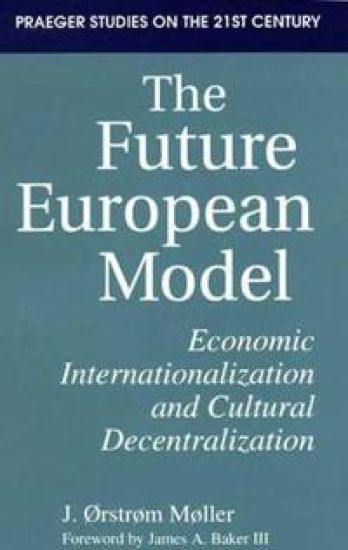
The Future European Model

The Future European Model

J. Moller

Praeger Publishers Inc
1995
nidottu
This work by a well-known futurist and Danish diplomat, examines Europe's future, analyzing the deepest currents governing the evolution of Europe in relation to the interaction of culture and technology. The book describes the role of the European nation-states, regions, and enterprises. It provides a sketch of the European role vis-a-vis the United States and Japan. And it outlines the author's view of Europe's passage from the industrial to the immaterial age: the competitive parameter of Europe's future will be primarily that of culture, and the cultural attribute will define the profile of all European enterprises. Culture, knowledge, and entertainment will take over as the engines of future economic development. Moller is buoyant with regard to the future of European integration, and in suggesting culture as the driving force behind that integration, he offers a new and refreshing vision for Europe's future.