Kirjojen hintavertailu. Mukana 12 390 323 kirjaa ja 12 kauppaa.

Kirjailija

J. North Conway

Kirjat ja teokset yhdessä paikassa: 9 kirjaa, julkaisuja vuosilta 2014-2022, suosituimpien joukossa Queen of Thieves. Vertaile teosten hintoja ja tarkista saatavuus suomalaisista kirjakaupoista.

9 kirjaa

Kirjojen julkaisuhaarukka 2014-2022.

The Wreck of the Portland

The Wreck of the Portland

J. North Conway

Taylor Trade Publishing
2022
pokkari
The SS Portland was a solid and luxurious ship, and its loss in 1898 in a violent storm with some 200 people aboard was later remembered as “New England’s Titanic.” The Portland was one of New England's largest and most luxurious paddle steamers, and after nine years' solid performance, she had earned a reputation as a safe and dependable vessel.In November 1898, a perfect storm formed off the New England coast. Conditions would produce a blizzard with 100 miles per hour winds and 60-foot waves that pummeled the coast. At the time there was no radio communication between ships and shore, no sonar to navigate by, and no vastly sophisticated weather forecasting capacity. The luxurious SS Portland, a sidewheel steamer furnished with chandeliers, red velvet carpets and fine china, was carrying more than 200 passengers from Boston to Portland, Maine, over Thanksgiving weekend when it ran headlong into a monstrous, violent gale off Cade Cod.It was never seen again.All passengers and crew were lost at sea. More than half the crew on board were African Americans from Portland. Their deaths decimated the Maine African American community.Before the storm abated it became one of the worst ever recorded in New England waters. The storm, now known as “The Portland Gale,” killed 400 people along the coast and sent more than 200 ships to the bottom, including the doomed Portland. To this day it is not known exactly how many passengers were aboard or even who many of them were. The only passenger list was aboard the vessel. As a result of this tragedy, ships would thereafter leave a passenger manifest ashore. The disaster has been blamed on the hubris of the captain of the Portland, Hollis Blanchard, who decided to leave the safety of Boston Harbor despite knowing that a severe storm was hurtling up the coast. Blanchard, a long-time mariner, had been passed over for a promotion for a younger captain. He decided he wanted to show the steamship company that they had made a mistake by getting the Portland safely into port ahead of the imminent storm. Author J. North Conway has created here a personal, visceral account of the sinking and the times and the people involved, with stories to bring readers onto the Portland that day:Here is Eben Heuston, the chief steward onboard the ill-fated ship. More than half of the crew of the ship were African Americans. Hueston was an African American who lived in the Portland community of Munjoy Hill and was a member of the Abyssinian Church. After the sinking of the Portland the African American community disappeared and the church closed. And Emily Cobb a nineteen year old singer from Portland’s First Parish Church who was scheduled to give her first recital at the church on that Sunday. And Hope Thomas who came to Boston to shop for Christmas and because she decided to exchange some shoes she purchased missed taking the ill-fated Portland.Because of the lack of communications from Maine to Cape Cod, it was days before anyone was able to get word about the fate of the ship or survivors. Author J. North Conway has painstakingly recreated the events, using first-hand sources and testimonies to weave a dramatic, can’t-put-it down narrative in the tradition of Erik Larson’s Isaac’s Storm and Walter Lord’s enduring classic, A Night to Remember. He brings the tragedy to life with contemporaneous accounts the Coast Guard, from Boston newspapers such as the Globe, Herald, and Journal, and from The New York Times and the Brooklyn DailyEagle.
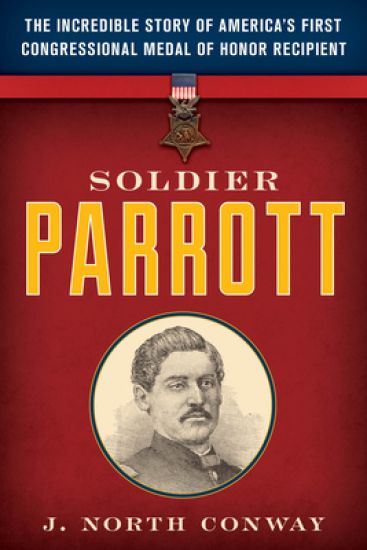
Soldier Parrott

Soldier Parrott

J. North Conway

Stackpole Books
2021
sidottu
Soldier Parrot brings a new level of research and personal grit to Civil War history with this riveting account of how Jacob Parrott, an 18-year-old, illiterate orphan from Ohio became the first soldier to be awarded the Congressional Medal of Honor. Parrott, a private in the Union Army, volunteered in 1862 for a secret mission behind Confederate lines to steal a train, tear up railroad tracks, burn bridges, and cut telegraph lines. The mission failed. Parrott and his companions were captured. Several were hung as spies and Parrott spent nearly two years in a Confederate prison. Parrott was only eighteen-years old when he volunteered for the secret mission. He had never been farther than ten miles from his home in Fairfield County. Soldier Parrott is literally the stuff of history--a fast-paced, extremely well-told tale of espionage, capture, trial, and escape. Half the team was executed; the half that escaped received the newly established Medal of Honor.
Crime Time

Crime Time

J. North Conway

The Lyons Press
2021
sidottu
THE CHANTICLEER OF CRIME is a collection of 21 riveting, page-turning historic true crime stories from 1724 to 1913 covering a host of monstrous American and English criminals, their crimes and their punishment. It includes stories of criminals— men, women and children, whose gruesome tales have been obscured by the passage of time.
King of Heists

King of Heists

J. North Conway

The Lyons Press
2019
pokkari
King of Heists is a spellbinding and unprecedented account of the greatest bank robbery in American history, which took place on October 27, 1878, when thieves broke into the Manhattan Savings Institution and stole nearly $3 million in cash and securities—around $50 million in today’s terms. Bringing the notorious Gilded Age to life in a thrilling narrative, J. North Conway tells the story of those who plotted and carried out this infamous robbery, how they did it, and how they were tracked down and captured. The robbery was planned to the minutest detail by criminal mastermind George Leonidas Leslie—a society architect and ladies’ man whose double life as the nation’s most prolific bank robber led him to be dubbed the “King of the Bank Robbers.” The New York Times proclaimed the 1878 heist “the most sensational in the history of bank robberies in this country.” An absorbing tale of greed, sex, crime, betrayal, and murder, King of Heists blends all the richness of history with the thrills of the best fiction.
The Big Policeman

The Big Policeman

J. North Conway

The Lyons Press
2019
pokkari
The remarkable career of one of America's greatest detectives—a story of murder, mayhem, and intriguePhilip Marlowe, Dirty Harry, and even Law & Order—none of these would exist as they do today were it not for the legendary career of nineteenth-century New York City cop Thomas Byrnes. From 1854 to 1895, Byrnes rose through the ranks of the city's police department to become one of the most celebrated detectives in American history, a larger-than-life figure who paved the way for modern-day police methods, both good and bad.During the age of Gangs of New York, Byrnes solved many of the most sensational and high-profile cases in the city and the country. He captured Manhattan's Jack the Ripper copy-cat killer; solved the murder of prostitute Maude Merrill, who was killed by her jealous lover—her own uncle; solved the largest bank heist in American history; arrested anarchist Emma Goldman for inciting a riot in Union Square; and accomplished much more. For both good and ill, according to the New York Times, Byrnes "shaped not just the New York City Detective Bureau but the template for detective work . . . in every modern American metropolis." He not only pioneered crime scene investigation, but also perfected the brutal interrogation process called "the third degree." He revolutionized the gathering of evidence and was the first to use mug shots and keep criminal records. But when Police Commissioner Theodore Roosevelt investigated the corruption that had plagued the department for decades, the man one prominent journalist had dubbed the "big policeman" was forced to resign.Bringing the Gilded Age to life as he did in his acclaimed King of Heists: The Sensational Bank Robbery of 1878 That Shocked America, J. North Conway narrates in thrilling, vivid detail the crimes, murders, corruption, and gritty police work associated with the father of the American detective.
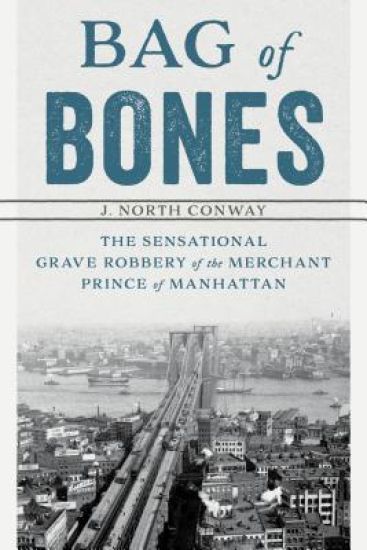
Bag of Bones

Bag of Bones

J. North Conway

The Lyons Press
2019
pokkari
Completing J. North Conway's widely acclaimed trilogy of Gilded Age New York City Crime—following King of Heists and The Big Policeman—Bag of Bones combines the era's affluence, decadence, and corruption with a gruesome deed fit for the tabloids of today. In 1878, the body of multi-millionaire A. T. Stewart was stolen from St. Mark's Churchyard. The ghoulish crime, the chase for the culprits, the years-long ransom negotiations, and the demise of the Stewart retail empire fed a media frenzy. When the widow Stewart eventually exchanged $20,000 for a burlap bag of bones on a country road, not everyone was convinced that the remains were truly those of "The Merchant Prince of Manhattan," the department store pioneer who had risen from the flood of Irish immigration to a place alongside names like Astor, Vanderbilt, and Rockefeller. As Bag of Bones details the futile tactics used by police to identify the grave robbers, it also unveils the villainy of Judge Henry Hilton, the Stewart family advisor who not only interfered in the case repeatedly but also dismantled a once-great business empire . . . all the while profiting quite nicely. By the end of this fascinating slice of history, one is left to wonder who displayed the greater evil: the grave robbers or Judge Hilton.
New England Rocks: Historic Geological Wonders

New England Rocks: Historic Geological Wonders

Michael J. Vieira; J. North Conway

History Press Library Editions
2017
sidottu
New England is a rocky, rugged region. Its towns are marked by stone walls and its cities anchored by native granite and marble buildings. Historically significant boulders, many with Native American as well as colonial and neo-pagan origins, attract tourists from around the world. Some are formations that are complex in shape, form and significance, while others contain enigmatic messages, meanings and intriguing characteristics. Learn more about the famous sites like Plymouth Rock, the Old Man of the Mountain and the Sleeping Giant, as well as the lesser-known such as Profile Rock, Dighton Rock and Slate Rock. Authors Michael J. Vieira and J. North Conway examine the history, the legends and the people associated with forty-five notable geological wonders.
Queen of Thieves

Queen of Thieves

J. North Conway

Skyhorse Publishing
2014
sidottu
Queen of Thieves is the gritty, fast-paced story of Fredericka ?Marm” Mandelbaum, a poor Jewish woman who rose to the top of her profession in organized crime during the Gilded Age in New York City. During her more than twenty-five-year reign as the country’s top receiver of stolen goods, she accumulated great wealth and power inconceivable for women engaged in business, legitimate or otherwise. The New York Times called Mandelbaum ?the nucleus and center of the whole organization of crime in New York City.” Having emigrated from Germany in 1850, she began her climb to the top of the crime world as a peddler on the rough-and-tumble, crowded streets of the city. By 1880, she had amassed a fortune estimated at more than $1 million. Mandelbaum was known for running an orderly criminal enterprise. She enlisted the services of an extensive network of criminals of every ilk and bribed police officials, politicians, and judges. If someone wanted to move stolen goods, needed protection from the law, or sought money to finance a caper, Marm was the person to see. In 1884, Mandelbaum escaped from the clutches of Pinkerton detectives, who were casing her house, and fled to Canada. Mandelbaum lived out the rest of her life in luxury on a small farm with her family and ill-got fortune. Hundreds of people turned out for her funeral. Dozens of people later reported to police that they had their pockets picked at the service.
Attack of the HMS Nimrod: Wareham and the War of 1812

Attack of the HMS Nimrod: Wareham and the War of 1812

J. North Conway; Jesse Dubuc

History Press Library Editions
2014
sidottu
On the morning of June 13, 1814, the British warship HMS Nimrod" attacked the town of Wareham, Massachusetts. As a center for shipbuilding and iron, Wareham was a perfect target for the British fleet. When the lead barge deceptively appeared with a white flag at its bow, Wareham never suspected anything but a truce and was ill prepared for the attack. A raiding party with six barges and two hundred men burned the town's cotton mill, destroyed its vessels and took its citizens as hostages. When "Nimrod" tried to flee the shores, it ran aground and had to throw its cannons and guns overboard in order to lighten its load and sail away. Wareham was left smoldering in its wake. Follow authors J. North Conway and Jesse Dubuc as they trace the attack from the initial spotting of the British fleet to the discovery of the lost "Nimrod "cannons."