Kirjojen hintavertailu. Mukana 12 390 323 kirjaa ja 12 kauppaa.

Kirjailija

J. Ramsey Michaels

Kirjat ja teokset yhdessä paikassa: 10 kirjaa, julkaisuja vuosilta 1989-2020, suosituimpien joukossa Passing by the Dragon. Vertaile teosten hintoja ja tarkista saatavuus suomalaisista kirjakaupoista.

Mukana myös kirjoitusasut: J Ramsey Michaels

10 kirjaa

Kirjojen julkaisuhaarukka 1989-2020.

1 Peter

1 Peter

J. Ramsey Michaels

ZONDERVAN
2020
nidottu
A companion series to the acclaimed Word Biblical Commentary Finding the great themes of the books of the Bible is essential to the study of God's Word and to the preaching and teaching of its truths. These themes and ideas are often like precious gems: they lie beneath the surface and can only be discovered with some difficulty. While commentaries are useful for helping readers understand the content of a verse or chapter, they are not usually designed to help the reader to trace important subjects systematically within a given book a Scripture.The Word Biblical Themes series helps readers discover the important themes of a book of the Bible. This series distills the theological essence of a given book of Scripture and serves it up in ways that enrich the preaching, teaching, worship, and discipleship of God's people. Volumes in this series:Are written by top biblical scholarsFeature authors who wrote on the same book of the Bible for the Word Biblical Commentary seriesDistill deep and focused study on a biblical book into the most important themes and practical applications of themGive readers an ability to see the "big picture" of a book of the Bible by understanding what topics and concerns were most important to the biblical writersHelp address pressing issues in the church today by showing readers see how the biblical writers approached similar issues in their dayAre ideal for sermon preparation and for other teaching in the church Word Biblical Themes are an ideal resource for any reader who has used and benefited from the Word Biblical Commentary series, and will help pastors, bible teachers, and students as they seek to understand and apply God’s word to their ministry and learning.
The News From Babylon

The News From Babylon

J Ramsey Michaels

Wipf Stock Publishers
2018
pokkari
First published as Word Biblical Themes: 1 Peter (Word Publishing, 1989), this volume explores Peter's effort to build a sense of identity and responsibility among the Christians to whom he wrote, scattered through several Roman provinces in Asia Minor. Their past is a biblical past, he tells them, rooted in the history of the Jews as the people of God. Consequently, they are called to live as strangers in a strange land, never fully at home in Roman society. Their present journey is a journey in the footsteps of Jesus, in paths of servanthood, and undeserved suffering. Their future is the completion of this journey to heaven, wrapped in a hope of victory over death and the devil and issuing at last in ""joy unspeakable and full of glory"" when their Lord Jesus Christ is revealed. Because these distant Gentile Christians are not personally known to Peter in Rome (which he calls ""Babylon,"" reminding them that he is as much a stranger as they are), he deals in the great universals of Christian experience: faith, baptism, and doing good; love, suffering and the hope of salvation. These universals make 1 Peter a letter for twentieth (or twenty-first) century American Christians no less than for his first century readers. The concluding chapter, ""The Message of 1 Peter Today,"" begins to explore certain parallels between Peter's readers in the Roman Empire and Christians in America, where we, no less than they in the provinces and Peter himself in ""Babylon"" are not fully at home either. This is even more the case now than it was in 1989 when the book first appeared, so that we need to listen ever more closely to ""The News from Babylon"" that 1 Peter sent so long ago. To this end a postscript has been added, addressing candidly the difficulties of being Christian in America in a new millennium. J. Ramsey Michaels, now living in Portsmouth, New Hampshire, is Professor Emeritus of Religious Studies at Missouri State University in Springfield. He is the author of a major commentary on First Peter in the Word Biblical Commentary series (1988) and a much shorter one in the one-volume Mercer Commentary on the Bible (1994). He has also written commentaries on Revelation, on Hebrews, and most notably the Gospel of John in the New International Commentary on the New Testament (2010). In a different vein, he recently published Passing by the Dragon: The Biblical Tales of Flannery O'Connor (Wipf & Stock, 2013), marking a crossover into American literary criticism.
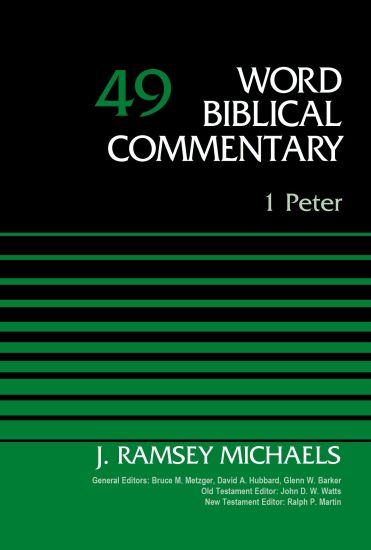
1 Peter, Volume 49

1 Peter, Volume 49

J. Ramsey Michaels

Zondervan
2015
sidottu
The Word Biblical Commentary delivers the best in biblical scholarship, from the leading scholars of our day who share a commitment to Scripture as divine revelation. This series emphasizes a thorough analysis of textual, linguistic, structural, and theological evidence. The result is judicious and balanced insight into the meanings of the text in the framework of biblical theology. These widely acclaimed commentaries serve as exceptional resources for the professional theologian and instructor, the seminary or university student, the working minister, and everyone concerned with building theological understanding from a solid base of biblical scholarship.Overview of Commentary OrganizationIntroduction—covers issues pertaining to the whole book, including context, date, authorship, composition, interpretive issues, purpose, and theology.Each section of the commentary includes:Pericope Bibliography—a helpful resource containing the most important works that pertain to each particular pericope.Translation—the author’s own translation of the biblical text, reflecting the end result of exegesis and attending to Hebrew and Greek idiomatic usage of words, phrases, and tenses, yet in reasonably good English.Notes—the author’s notes to the translation that address any textual variants, grammatical forms, syntactical constructions, basic meanings of words, and problems of translation.Form/Structure/Setting—a discussion of redaction, genre, sources, and tradition as they concern the origin of the pericope, its canonical form, and its relation to the biblical and extra-biblical contexts in order to illuminate the structure and character of the pericope. Rhetorical or compositional features important to understanding the passage are also introduced here.Comment—verse-by-verse interpretation of the text and dialogue with other interpreters, engaging with current opinion and scholarly research.Explanation—brings together all the results of the discussion in previous sections to expose the meaning and intention of the text at several levels: (1) within the context of the book itself; (2) its meaning in the OT or NT; (3) its place in the entire canon; (4) theological relevance to broader OT or NT issues.General Bibliography—occurring at the end of each volume, this extensive bibliographycontains all sources used anywhere in the commentary.
Revelation

Revelation

J. Ramsey Michaels

INTERVARSITY PRESS
2011
nidottu
Most interpretations of Revelation fail to take seriously what John saw and consequently fail to comprehend the value of his vision to Christians of every age. J. Ramsey Michaels strives to restore Revelation to its rightful status as a prophetic letter of testimony--a testimony of striking relevance to the church today.
Revelation

Revelation

J Ramsey Michaels

Inter-Varsity Press
2008
pokkari
Interpretations of the book of Revelation abound. One view suggests that the book indirectly describes events in John's own time. Another interpretation sees Revelation as a prophetic survey of the history of the church. Still another views the book as a precise prediction of the end of the world. The trouble with all three, argues Ramsey Michaels, is that they make the Revelation of John irrelevant to Christians throughout much of history. Failing to take seriously what John saw, such interpreters fail to comprehend the value of Revelation to Christians in any age. Michaels restores Revelation to its rightful status as a prophetic letter of testimony, a testimony as relevant to the church today as it was in John's day. In this stimulating, pastorally oriented commentary, readers will find an introduction with background material concerning authorship, date and purpose, as well as a summary of important theological themes. A passage-by-passage exposition follows that focuses on what John had to say to his original readers in order to see the relevance of his book for the church today.
John

John

J. Ramsey Michaels

Baker Books
1989
nidottu
The Understanding the Bible Commentary Series helps readers navigate the strange and sometimes intimidating literary terrain of the Bible. These accessible volumes break down the barriers between the ancient and modern worlds so that the power and meaning of the biblical texts become transparent to contemporary readers. The contributors tackle the task of interpretation using the full range of critical methodologies and practices, yet they do so as people of faith who hold the text in the highest regard. Pastors, teachers, and lay people alike will cherish the truth found in this commentary series.
Gospel of John

Gospel of John

J. Ramsey Michaels

William B Eerdmans Publishing Co
2010
sidottu
This new commentary -- part of Eerdmans's acclaimed NICNT series -- gives primary attention to John's gospel in its present form rather than the sources or traditions behind it. J. Ramsey Michaels assumes that the John who authored the book is someone very close to Jesus and, therefore, that the gospel is a testimony to events that actually happened in the life of Jesus. Yet Michaels does not ignore the literary character of the gospel of John or its theological contribution to the larger Christian community from its own time to the present day. Through a detailed verse-by-verse commentary, Michaels reveals how the gospel of -the disciple whom Jesus loved- is a unified composition, intertwined with the synoptics, yet drawing on material none of them cover.