Kirjojen hintavertailu. Mukana 12 390 323 kirjaa ja 12 kauppaa.

Kirjailija

J. Timmons Roberts

Kirjat ja teokset yhdessä paikassa: 8 kirjaa, julkaisuja vuosilta 2001-2020, suosituimpien joukossa Greening Aid?. Vertaile teosten hintoja ja tarkista saatavuus suomalaisista kirjakaupoista.

8 kirjaa

Kirjojen julkaisuhaarukka 2001-2020.

Greening Aid?

Greening Aid?

Robert L. Hicks; Bradley C. Parks; J. Timmons Roberts; Michael J. Tierney

Oxford University Press
2010
nidottu
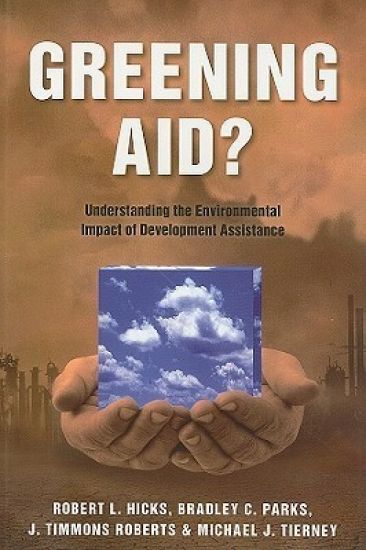
Every year, billions of dollars of environmental aid flow from the rich governments of the North to the poor governments of the South. Why do donors provide this aid? What do they seek to achieve? How effective is the aid given? And does it always go to the places of greatest environmental need? From the first Earth Summit in Stockholm in 1972 to the G8 Gleneagles meeting in 2005, the issue of the impact of aid on the global environment has been the subject of vigorous protest and debate. How much progress has there been in improving environmental protection and clean-up in the developing world? What explains the patterns of environmental aid spending and distribution - is it designed to address real problems, achieve geopolitical or commercial gains abroad, or buy political mileage at home? And what are the consequences for the estimated 4 million people that die each year from air pollution, unsafe drinking water, and lack of sanitation? All of these questions and many more are addressed in this groundbreaking text, which is based on the authors' work compiling the most comprehensive dataset of foreign aid ever assembled. By evaluating the likely environment impact of over 400,000 development projects by more than 50 donors to over 170 recipient nations between 1970 and 2001, Greening Aid represents a unique, state of the art picture of what is happening in foreign assistance, and its impact on the environment. Greening Aid explains major trends and shifts over the last three decades, ranks donors according to their performance, and offers case studies which compare and contrast donors and types of environmental aid.
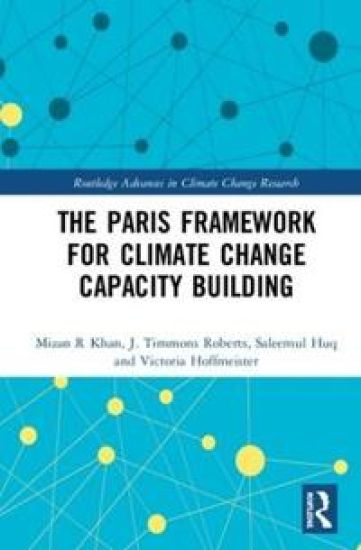
The Paris Framework for Climate Change Capacity Building

The Paris Framework for Climate Change Capacity Building

Mizan R Khan; J. Timmons Roberts; Saleemul Huq; Victoria Hoffmeister

Routledge
2020
nidottu
The Paris Framework for Climate Change Capacity Building pioneers a new era of climate change governance, performing the foundational job of clarifying what is meant by the often ad-hoc, one-off, uncoordinated, ineffective and unsustainable practices of the past decade described as 'capacity building' to address climate change. As an alternative, this book presents a framework on how to build effective and sustainable capacity systems to meaningfully tackle this long-term problem. Such a reframing of capacity building itself requires means of implementation. The authors combine their decades-long experiences in climate negotiations, developing climate solutions, climate activism and peer-reviewed research to chart a realistic roadmap for the implementation of this alternative framework for capacity building. As a result, this book convincingly makes the case that universities, as the highest and sustainable seats of learning and research in the developing countries, should be the central hub of capacity building there. This will be a valuable resource for students, researchers and policy-makers in the areas of climate change and environmental studies.
The Paris Framework for Climate Change Capacity Building

The Paris Framework for Climate Change Capacity Building

Mizan R Khan; J. Timmons Roberts; Saleemul Huq; Victoria Hoffmeister

Routledge
2018
sidottu
The Paris Framework for Climate Change Capacity Building pioneers a new era of climate change governance, performing the foundational job of clarifying what is meant by the often ad-hoc, one-off, uncoordinated, ineffective and unsustainable practices of the past decade described as 'capacity building' to address climate change. As an alternative, this book presents a framework on how to build effective and sustainable capacity systems to meaningfully tackle this long-term problem. Such a reframing of capacity building itself requires means of implementation. The authors combine their decades-long experiences in climate negotiations, developing climate solutions, climate activism and peer-reviewed research to chart a realistic roadmap for the implementation of this alternative framework for capacity building. As a result, this book convincingly makes the case that universities, as the highest and sustainable seats of learning and research in the developing countries, should be the central hub of capacity building there. This will be a valuable resource for students, researchers and policy-makers in the areas of climate change and environmental studies.
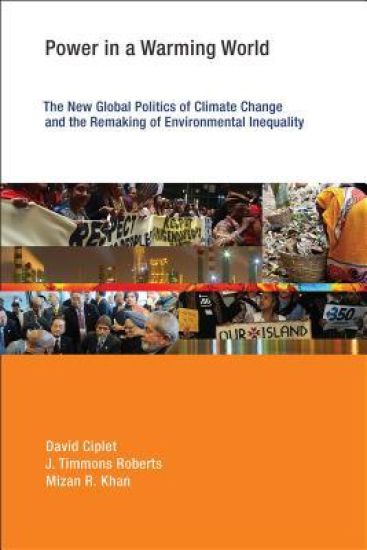
Power in a Warming World

Power in a Warming World

David Ciplet; J. Timmons Roberts; Mizan R. Khan

MIT Press
2015
pokkari
An examination of shifting global power dynamics in climate change politics, and how this affects our ability to achieve equitable and sustainable climate outcomes.After nearly a quarter century of international negotiations on climate change, we stand at a crossroads. A new set of agreements is likely to fail to prevent the global climate's destabilization. Islands and coastlines face inundation, and widespread drought, flooding, and famine are expected to worsen in the poorest and most vulnerable countries. How did we arrive at an entirely inequitable and scientifically inadequate international response to climate change? In Power in a Warming World, David Ciplet, J. Timmons Roberts, and Mizan Khan, bring decades of combined experience as negotiators, researchers, and activists to bear on this urgent question. Combining rich empirical description with a political economic view of power relations, they document the struggles of states and social groups most vulnerable to a changing climate and describe the emergence of new political coalitions that take climate politics beyond a simple North-South divide. They offer six future scenarios in which power relations continue to shift as the world warms. A focus on incremental market-based reform, they argue, has proven insufficient for challenging the enduring power of fossil fuel interests, and will continue to be inadequate without a bolder, more inclusive and aggressive response.
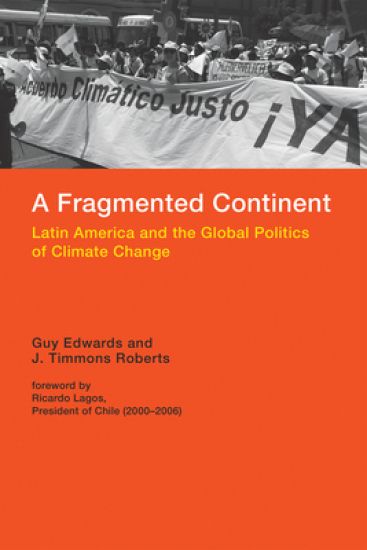
A Fragmented Continent

A Fragmented Continent

Guy Edwards; J. Timmons Roberts; Ricardo Lagos

MIT Press
2015
pokkari
How Latin American countries became leading voices and innovators on addressing climate change-and what threatens their leadership.Latin American countries have increased their influence at the United Nations climate change negotiations and offered potential solutions on coping with global warming. But in the face of competing priorities, sometimes these climate policies are jettisoned, undermined, or simply ignored. A Fragmented Continent focuses on Latin America's three major blocs at the U.N. climate negotiations and how they attempt to balance climate action with building prosperity. Brazil has reduced its deforestation but continues its drive for economic growth and global recognition. A leftist group led by Venezuela, Bolivia, and Ecuador decries the injustice of climate change but is highly dependent on the export of fossil fuels. A new group, including Chile, Costa Rica, and Peru and supported by Mexico, offers sharp reductions in their carbon emissions in return for greater action by others; these countries now have to deliver on their promises. Weaving together issues of politics and economy, trade, foreign policy, civil society, and environmental protection, A Fragmented Continent offers a long-missing perspective on one of this century's greatest challenges and neglected regions.
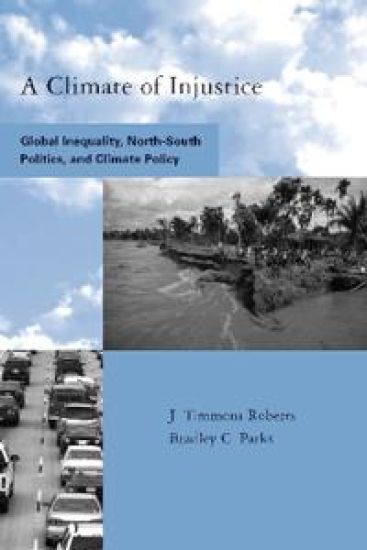
A Climate of Injustice

A Climate of Injustice

J. Timmons Roberts; Bradley Parks

MIT Press
2006
pokkari
The global debate over who should take action to address climate change is extremely precarious, as diametrically opposed perceptions of climate justice threaten the prospects for any long-term agreement. Poor nations fear limits on their efforts to grow economically and meet the needs of their own people, while powerful industrial nations, including the United States, refuse to curtail their own excesses unless developing countries make similar sacrifices. Meanwhile, although industrialized countries are responsible for 60 percent of the greenhouse gas emissions that contribute to climate change, developing countries suffer the "worst and first" effects of climate-related disasters, including droughts, floods, and storms, because of their geographical locations. In A Climate of Injustice, J. Timmons Roberts and Bradley Parks analyze the role that inequality between rich and poor nations plays in the negotiation of global climate agreements. Roberts and Parks argue that global inequality dampens cooperative efforts by reinforcing the "structuralist" worldviews and causal beliefs of many poor nations, eroding conditions of generalized trust, and promoting particularistic notions of "fair" solutions. They develop new measures of climate-related inequality, analyzing fatality and homelessness rates from hydrometeorological disasters, patterns of "emissions inequality," and participation in international environmental regimes. Until we recognize that reaching a North-South global climate pact requires addressing larger issues of inequality and striking a global bargain on environment and development, Roberts and Parks argue, the current policy gridlock will remain unresolved.
Chronicles from the Environmental Justice Frontline

Chronicles from the Environmental Justice Frontline

J. Timmons Roberts; Melissa M. Toffolon-Weiss

Cambridge University Press
2001
sidottu
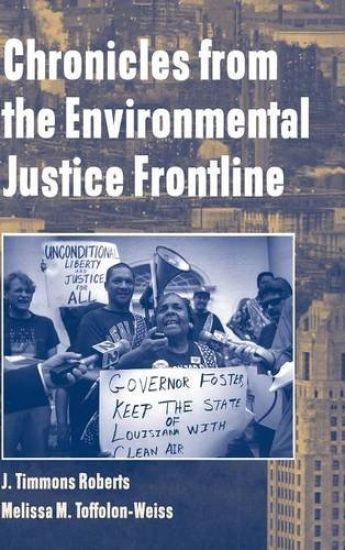
Chronicles from the Environmental Justice Frontline, first published in 1991, provides a rare glimpse of the environmental justice movement as it plays out in four landmark struggles at the end of the twentieth century. The book describes the stories of everyday people who have decided to take to the streets to battle what they perceive as injustice: the unequal exposure of minorities and the poor to the 'bads' produced by our industrial society. In these struggles residents and local, state, and national environmental and social justice groups are on one side pitted against local and state government representatives and industry on the other. By employing historical and theoretical lenses in viewing these struggles, the book reveals how situations of environmental injustice are created and how they are resolved. These cases bear great similarity to battles occurring across the nation, and are setting precedents for national and state agencies as they handle these cases.
Chronicles from the Environmental Justice Frontline

Chronicles from the Environmental Justice Frontline

J. Timmons Roberts; Melissa M. Toffolon-Weiss

Cambridge University Press
2001
pokkari
Chronicles from the Environmental Justice Frontline provides a rare glimpse of the environmental justice movement as it plays out in four landmark struggles at the end of the twentieth century. The book describes the stories of everyday people who have decided to take to the streets to battle what they perceive as injustice: the unequal exposure of minorities and the poor to the ‘bads’ produced by our industrial society. In these struggles residents and local, state, and national environmental and social justice groups are on one side pitted against local and state government representatives and industry on the other. By employing historical and theoretical lenses in viewing these struggles, the book reveals how situations of environmental injustice are created and how they are resolved. These cases bear great similarity to battles occurring across the nation, and are setting precedents for national and state agencies as they handle these cases.