Kirjojen hintavertailu. Mukana 12 390 323 kirjaa ja 12 kauppaa.

Kirjailija

Jaakko Hintikka

Kirjat ja teokset yhdessä paikassa: 27 kirjaa, julkaisuja vuosilta 1974-2011, suosituimpien joukossa Knowledge and Belief. Vertaile teosten hintoja ja tarkista saatavuus suomalaisista kirjakaupoista.

27 kirjaa

Kirjojen julkaisuhaarukka 1974-2011.

Socratic Epistemology

Socratic Epistemology

Jaakko Hintikka

Cambridge University Press
2007
sidottu
Most current work in epistemology deals with the evaluation and justification of information already acquired. In this book, Jaakko Hintikka instead discusses the more important problem of how knowledge is acquired in the first place. His model of information-seeking is the old Socratic method of questioning, which has been generalized and brought up-to-date through the logical theory of questions and answers that he has developed. Hintikka also argues that philosophers' quest for a definition of knowledge is ill-conceived and that the entire notion of knowledge should be replaced by the concept of information. He offers an analysis of the different meanings of the concept of information and of their interrelations. The result is a new and illuminating approach to the field of epistemology.
Socratic Epistemology

Socratic Epistemology

Jaakko Hintikka

Cambridge University Press
2007
pokkari
Most current work in epistemology deals with the evaluation and justification of information already acquired. In this book, Jaakko Hintikka instead discusses the more important problem of how knowledge is acquired in the first place. His model of information-seeking is the old Socratic method of questioning, which has been generalized and brought up-to-date through the logical theory of questions and answers that he has developed. Hintikka also argues that philosophers' quest for a definition of knowledge is ill-conceived and that the entire notion of knowledge should be replaced by the concept of information. He offers an analysis of the different meanings of the concept of information and of their interrelations. The result is a new and illuminating approach to the field of epistemology.
Analyses of Aristotle

Analyses of Aristotle

Jaakko Hintikka

Springer-Verlag New York Inc.
2004
sidottu
Aristotle thought of his logic and methodology as applications of the Socratic questioning method. In particular, logic was originally a study of answers necessitated by earlier answers. For Aristotle, thought-experiments were real experiments in the sense that by realizing forms in one's mind, one can read off their properties and interrelations. Treating forms as independent entities, knowable one by one, committed Aristotle to his mode of syllogistic explanation. He did not think of existence, predication and identity as separate senses of estin. Aristotle thus serves as an example of a thinker who did not rely on the distinction between the allegedly different Fregean senses, thereby shedding new light on our own conceptual presuppositions. This collection comprises several striking interpretations that Jaakko Hintikka has put forward over the years, constituting a challenge not only to Aristotelian scholars and historians of ideas, but to everyone interested in logic, epistemology or metaphysics and in their history.
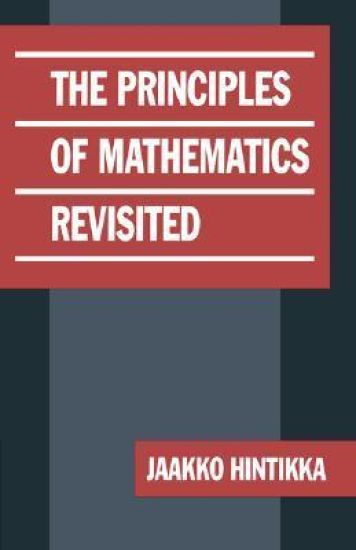
The Principles of Mathematics Revisited

The Principles of Mathematics Revisited

Jaakko Hintikka

Cambridge University Press
1998
pokkari
This book, written by one of philosophy’s pre-eminent logicians, argues that many of the basic assumptions common to logic, philosophy of mathematics and metaphysics are in need of change. It is therefore a book of critical importance to logical theory. Jaakko Hintikka proposes a new basic first-order logic and uses it to explore the foundations of mathematics. This new logic enables logicians to express on the first-order level such concepts as equicardinality, infinity, and truth in the same language. The famous impossibility results by Gödel and Tarski that have dominated the field for the last sixty years turn out to be much less significant than has been thought. All of ordinary mathematics can in principle be done on this first-order level, thus dispensing with the existence of sets and other higher-order entities.
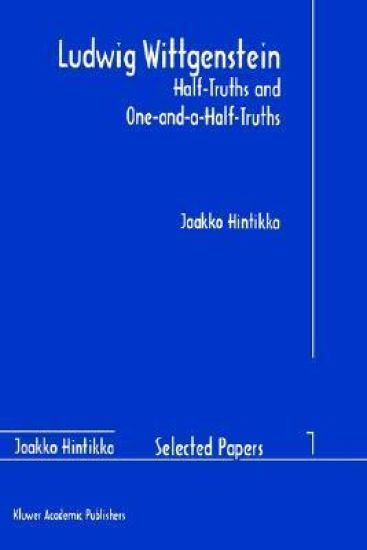
Ludwig Wittgenstein: Half-Truths and One-and-a-Half-Truths
IF WITI'GENSTEIN COULD TALK, COULD WE UNDERSTAND HIM? Perusing the secondary literature on Wittgenstein, I have frequently experienced a perfect Brechtean Entfremdungseffekt. This is interesting, I have felt like saying when reading books and papers on Wittgenstein, but who is the writer talking about? Certainly not Ludwig Wittgenstein the actual person who wrote his books and notebooks and whom I happened to meet. Why is there this strange gap between the ideas of the actual philosopher and the musings of his interpreters? Wittgenstein is talking to us through the posthumous publication of his writings. Why don't philosophers understand what he is saying? A partial reason is outlined in the first essay of this volume. Wittgenstein was far too impatient to explain in his books and book drafts what his problems were, what it was that he was trying to get clear about. He was even too impatient to explain in full his earlier solutions, often merely referring to them casually as it were ina shorthand notation. For one important instance, in The Brown Book, Wittgenstein had explained in some detail what name-object relationships amount to in his view. There he offers both an explanation of what his problem is and an account of his own view illustrated by means of specific examples of language-games. But when he raises the same question again in Philosophical Investigations I, sec.
Ludwig Wittgenstein: Half-Truths and One-and-a-Half-Truths
IF WITI'GENSTEIN COULD TALK, COULD WE UNDERSTAND HIM? Perusing the secondary literature on Wittgenstein, I have frequently experienced a perfect Brechtean Entfremdungseffekt. This is interesting, I have felt like saying when reading books and papers on Wittgenstein, but who is the writer talking about? Certainly not Ludwig Wittgenstein the actual person who wrote his books and notebooks and whom I happened to meet. Why is there this strange gap between the ideas of the actual philosopher and the musings of his interpreters? Wittgenstein is talking to us through the posthumous publication of his writings. Why don't philosophers understand what he is saying? A partial reason is outlined in the first essay of this volume. Wittgenstein was far too impatient to explain in his books and book drafts what his problems were, what it was that he was trying to get clear about. He was even too impatient to explain in full his earlier solutions, often merely referring to them casually as it were ina shorthand notation. For one important instance, in The Brown Book, Wittgenstein had explained in some detail what name-object relationships amount to in his view. There he offers both an explanation of what his problem is and an account of his own view illustrated by means of specific examples of language-games. But when he raises the same question again in Philosophical Investigations I, sec.
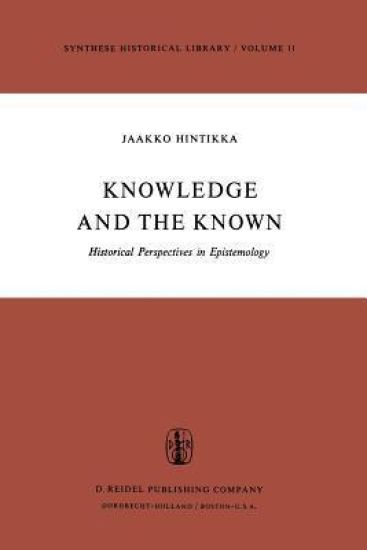
Knowledge and the Known

Knowledge and the Known

Jaakko Hintikka

Springer
2011
nidottu
A word of warning concerning the aims of this volume is in order. Other­ wise some readers might be unpleasantly surprised by the fact that two of the chapters of an ostensibly historical book are largely topical rather than historical. They are Chapters 7 and 9, respectively entitled 'Are Logical Truths Analytic?' and 'A Priori Truths and Things-In-Them­ selves'. Moreover, the history dealt with in Chapter 11 is so recent as to have more critical than antiquarian interest. This mixture of materials may seem all the more surprising as I shall myself criticize (in Chapter I) too facile assimilations of earlier thinkers' concepts and problems to later ones. There is no inconsistency here, it seems to me. The aims of the present volume are historical, and for that very purpose, for the purpose of understanding and evaluating earlier thinkers it is vital to know the conceptual landscape in which they were moving. A crude analogy may be helpful here. No military historian can afford to neglect the topo­ graphy of the battles he is studying. If he does not know in some detail what kind of pass Thermopylae is or on what sort of ridge the battle of Bussaco was fought, he has no business of discussing these battles, even if this topographical information alone does not yet amount to historical knowledge.
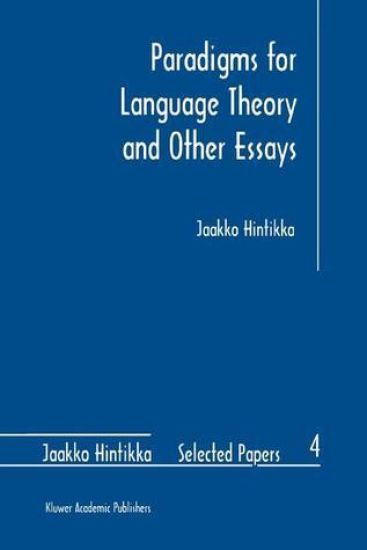
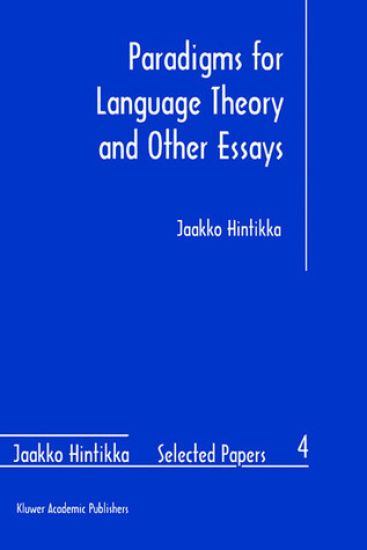
Paradigms for Language Theory and Other Essays
Several of the basic ideas of current language theory are subjected to critical scrutiny and found wanting, including the concept of scope, the hegemony of generative syntax, the Frege-Russell claim that verbs like `is' are ambiguous, and the assumptions underlying the so-called New Theory of Reference. In their stead, new constructive ideas are proposed.
Language, Truth and Logic in Mathematics
One can distinguish, roughly speaking, two different approaches to the philosophy of mathematics. On the one hand, some philosophers (and some mathematicians) take the nature and the results of mathematicians' activities as given, and go on to ask what philosophical morals one might perhaps find in their story. On the other hand, some philosophers, logicians and mathematicians have tried or are trying to subject the very concepts which mathematicians are using in their work to critical scrutiny. In practice this usually means scrutinizing the logical and linguistic tools mathematicians wield. Such scrutiny can scarcely help relying on philosophical ideas and principles. In other words it can scarcely help being literally a study of language, truth and logic in mathematics, albeit not necessarily in the spirit of AJ. Ayer. As its title indicates, the essays included in the present volume represent the latter approach. In most of them one of the fundamental concepts in the foundations of mathematics and logic is subjected to a scrutiny from a largely novel point of view. Typically, it turns out that the concept in question is in need of a revision or reconsideration or at least can be given a new twist. The results of such a re-examination are not primarily critical, however, but typically open up new constructive possibilities. The consequences of such deconstructions and reconstructions are often quite sweeping, and are explored in the same paper or in others.
Inquiry as Inquiry: A Logic of Scientific Discovery
Is a genuine logic of scientific discovery possible? In the essays collected here, Hintikka not only defends an affirmative answer; he also outlines such a logic. It is the logic of questions and answers. Thus inquiry in the sense of knowledge-seeking becomes inquiry in the sense of interrogation. Using this new logic, Hintikka establishes a result that will undoubtedly be considered the fundamental theorem of all epistemology, viz., the virtual identity of optimal strategies of pure discovery with optimal deductive strategies. Questions to Nature, of course, must include observations and experiments. Hintikka shows, in fact, how the logic of experimental inquiry can be understood from the interrogative vantage point. Other important topics examined include induction (in a forgotten sense that has nevertheless played a role in science), explanation, the incommensurability of theories, theory-ladenness of observations, and identifiability.
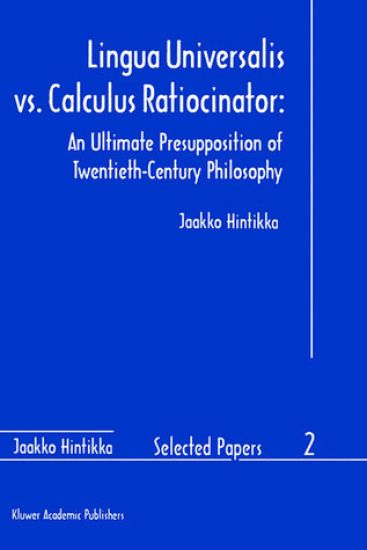
Lingua Universalis vs. Calculus Ratiocinator:
R. G. Collingwood saw one of the main tasks of philosophers and of historians of human thought in uncovering what he called the ultimate presuppositions of different thinkers, of different philosophical movements and of entire eras of intellectual history. He also noted that such ultimate presuppositions usually remain tacit at first, and are discovered only by subsequent reflection. Collingwood would have been delighted by the contrast that constitutes the overall theme of the essays collected in this volume. Not only has this dichotomy ofviews been one ofthe mostcrucial watersheds in the entire twentieth-century philosophical thought. Not only has it remained largely implicit in the writings of the philosophers for whom it mattered most. It is a truly Collingwoodian presupposition also in that it is not apremise assumed by different thinkers in their argumentation. It is the presupposition of a question, an assumption to the effect that a certain general question can be raised and answered. Its role is not belied by the fact that several philosophers who answered it one way or the other seem to be largely unaware that the other answer also makes sense - if it does. This Collingwoodian question can be formulated in a first rough approximation by asking whether language - our actual working language, Tarski's "colloquiallanguage" - is universal in the sense of being inescapable. This formulation needs all sorts of explanations, however.
Analyses of Aristotle

Analyses of Aristotle

Jaakko Hintikka

Springer
2010
nidottu
Aristotle thought of his logic and methodology as applications of the Socratic questioning method. In particular, logic was originally a study of answers necessitated by earlier answers. For Aristotle, thought-experiments were real experiments in the sense that by realizing forms in one's mind, one can read off their properties and interrelations. Treating forms as independent entities, knowable one by one, committed Aristotle to his mode of syllogistic explanation. He did not think of existence, predication and identity as separate senses of estin. Aristotle thus serves as an example of a thinker who did not rely on the distinction between the allegedly different Fregean senses, thereby shedding new light on our own conceptual presuppositions. This collection comprises several striking interpretations that Jaakko Hintikka has put forward over the years, constituting a challenge not only to Aristotelian scholars and historians of ideas, but to everyone interested in logic, epistemology or metaphysics and in their history.
Les Principes Des Mathematiques Revisites

Les Principes Des Mathematiques Revisites

Jaakko Hintikka

Librarie Philosophique J. Vrin
2007
nidottu
Les Principes des mathematiques revisites de Jaakko Hintikka sont l'une des contributions les plus importantes des vingt dernieres annees a la philosophie des mathematiques. Son titre, inspire des celebres Principes des mathematiques publies par Russell en 1903, marque l'ambition d'un renouvellement des fondements de la logique et des mathematiques un siecle apres l'age d'or du logicisme. L'auteur dispose pour cela de moyens nouveaux, la semantique des jeux et la logique faite pour l'independance, qu'il a developpes depuis les annees 1980. La parution des Principes de Hintikka en 1996 a ete accompagnee de la publication de nombreux articles techniques dans les revues specialisees, mais le livre lui-meme n'est pas un ouvrage technique: c'est un essai philosophique abordable par un public non specialiste de philosophie des mathematiques ou de logique.
Inquiry as Inquiry: A Logic of Scientific Discovery
Is a genuine logic of scientific discovery possible? In the essays collected here, Hintikka not only defends an affirmative answer; he also outlines such a logic. It is the logic of questions and answers. Thus inquiry in the sense of knowledge-seeking becomes inquiry in the sense of interrogation. Using this new logic, Hintikka establishes a result that will undoubtedly be considered the fundamental theorem of all epistemology, viz., the virtual identity of optimal strategies of pure discovery with optimal deductive strategies. Questions to Nature, of course, must include observations and experiments. Hintikka shows, in fact, how the logic of experimental inquiry can be understood from the interrogative vantage point. Other important topics examined include induction (in a forgotten sense that has nevertheless played a role in science), explanation, the incommensurability of theories, theory-ladenness of observations, and identifiability.
Language, Truth and Logic in Mathematics
One can distinguish, roughly speaking, two different approaches to the philosophy of mathematics. On the one hand, some philosophers (and some mathematicians) take the nature and the results of mathematicians' activities as given, and go on to ask what philosophical morals one might perhaps find in their story. On the other hand, some philosophers, logicians and mathematicians have tried or are trying to subject the very concepts which mathematicians are using in their work to critical scrutiny. In practice this usually means scrutinizing the logical and linguistic tools mathematicians wield. Such scrutiny can scarcely help relying on philosophical ideas and principles. In other words it can scarcely help being literally a study of language, truth and logic in mathematics, albeit not necessarily in the spirit of AJ. Ayer. As its title indicates, the essays included in the present volume represent the latter approach. In most of them one of the fundamental concepts in the foundations of mathematics and logic is subjected to a scrutiny from a largely novel point of view. Typically, it turns out that the concept in question is in need of a revision or reconsideration or at least can be given a new twist. The results of such a re-examination are not primarily critical, however, but typically open up new constructive possibilities. The consequences of such deconstructions and reconstructions are often quite sweeping, and are explored in the same paper or in others.
Paradigms for Language Theory and Other Essays
Several of the basic ideas of current language theory are subjected to critical scrutiny and found wanting, including the concept of scope, the hegemony of generative syntax, the Frege-Russell claim that verbs like `is' are ambiguous, and the assumptions underlying the so-called New Theory of Reference. In their stead, new constructive ideas are proposed.
Lingua Universalis vs. Calculus Ratiocinator:
R. G. Collingwood saw one of the main tasks of philosophers and of historians of human thought in uncovering what he called the ultimate presuppositions of different thinkers, of different philosophical movements and of entire eras of intellectual history. He also noted that such ultimate presuppositions usually remain tacit at first, and are discovered only by subsequent reflection. Collingwood would have been delighted by the contrast that constitutes the overall theme of the essays collected in this volume. Not only has this dichotomy ofviews been one ofthe mostcrucial watersheds in the entire twentieth-century philosophical thought. Not only has it remained largely implicit in the writings of the philosophers for whom it mattered most. It is a truly Collingwoodian presupposition also in that it is not apremise assumed by different thinkers in their argumentation. It is the presupposition of a question, an assumption to the effect that a certain general question can be raised and answered. Its role is not belied by the fact that several philosophers who answered it one way or the other seem to be largely unaware that the other answer also makes sense - if it does. This Collingwoodian question can be formulated in a first rough approximation by asking whether language - our actual working language, Tarski's "colloquiallanguage" - is universal in the sense of being inescapable. This formulation needs all sorts of explanations, however.
The Logic of Epistemology and the Epistemology of Logic

The Logic of Epistemology and the Epistemology of Logic

Jaakko Hintikka; Merrill B.P. Hintikka

Springer
1989
nidottu
somewhat like Henkin's nonstandard interpretation of higher-order logics, while the right semantics [or logical modalities is an analogue to the standard of type theory in Henkin's sense. interpretation Another possibility would be to follow W.V. Quine's advice to give up logi- cal modalities as being beyond repair. Or we could also try to develop a logic of conceptual possibility, restricting the range of our "possible worlds" to those compatible with the transcendental presuppositions of our own conceptual sys- tem. This looks in fact like one of the most interesting possible theories I have dreamt of developing but undoubtedly never will. Its kinship with Kant's way of thinking should be obvious. Besides putting the entire enterprise of possible-worlds semantics into a perspective, we can also see that the actual history of possible-worlds seman- tics is more complicated than it might first appear to be. For the standard in- terpretation of modal logics has reared its beautiful head repeatedly in the writings of Stig Kanger, Richard Montague the pre-Montague-semantics theorist, and Nino Cocchiarella.
The Logic of Epistemology and the Epistemology of Logic

The Logic of Epistemology and the Epistemology of Logic

Jaakko Hintikka; Merrill B.P. Hintikka

Springer
1989
sidottu
somewhat like Henkin's nonstandard interpretation of higher-order logics, while the right semantics [or logical modalities is an analogue to the standard of type theory in Henkin's sense. interpretation Another possibility would be to follow W.V. Quine's advice to give up logi- cal modalities as being beyond repair. Or we could also try to develop a logic of conceptual possibility, restricting the range of our "possible worlds" to those compatible with the transcendental presuppositions of our own conceptual sys- tem. This looks in fact like one of the most interesting possible theories I have dreamt of developing but undoubtedly never will. Its kinship with Kant's way of thinking should be obvious. Besides putting the entire enterprise of possible-worlds semantics into a perspective, we can also see that the actual history of possible-worlds seman- tics is more complicated than it might first appear to be. For the standard in- terpretation of modal logics has reared its beautiful head repeatedly in the writings of Stig Kanger, Richard Montague the pre-Montague-semantics theorist, and Nino Cocchiarella.