Kirjojen hintavertailu. Mukana 12 499 485 kirjaa ja 12 kauppaa.

Kirjailija

Jaan Valsiner

Kirjat ja teokset yhdessä paikassa: 35 kirjaa, julkaisuja vuosilta 1988-2026, suosituimpien joukossa Child Development Within Culturally Structured Environments, Volume 4. Vertaile teosten hintoja ja tarkista saatavuus suomalaisista kirjakaupoista.

35 kirjaa

Kirjojen julkaisuhaarukka 1988-2026.

Child Development Within Culturally Structured Environments, Volume 4

Child Development Within Culturally Structured Environments, Volume 4

Maria C.D.P. Lyra; Jaan Valsiner

Praeger Publishers Inc
1998
nidottu
This volume brings together a collection of papers centred on the theme of the psychological functions that are built up by communication in the developing child. It is part of a series that aims to integrate social and cognitive development research on the developing child within his/her environment. The approach strives to overcome impasses that are outgrowths of two traditional themes in psychology. First is the fundamental general biological issue of the contributions of the organism and its environment to the development of the former. The second is how we can understand social development in human ontogeny, and in which ways (if any) human social development differs from that of other species.
The Moonlight Doctor

The Moonlight Doctor

Jaan Valsiner

Springer International Publishing AG
2025
nidottu
This is the very first authoritative book on the role of Carl Gustav Carus (1789-1869) in the history of psychology. Carus was the initiator of the notions of development, unconscious, and archetype in psychology. The book emphasizes the interdisciplinary focus of Carus’ work as it was based on the literature and art of his time and is closely related with medicine and Naturphilosophie. The readership of the book will get access to the life course of a key figure of science of the 19th century.
Dynamic Semiosis

Dynamic Semiosis

Jaan Valsiner

Springer International Publishing AG
2024
nidottu
This book aims to bring to readers the author’s elaborated focus on the dynamic process of sign emergence, use, fixation and un-fixation, and dismissal. Its uniqueness is in its reliance on the organizing limits of irreversible time that renders the meaning construction by human beings to be constantly open-ended to face the uncertainties of the immediate future. This book emerged from a 9-month series of seminars at the Department of Semiotics at Tartu University in 2021-2022 as a Välis-Eesti Külalisprofessor, during which the linkages between semiotics and cultural psychology were scrutinized. In collaboration with doctoral students from various countries, the present SpringerBrief outlines the theoretical innovations that the author started during the seminars but completed in the two years after their end.
The Moonlight Doctor

The Moonlight Doctor

Jaan Valsiner

Springer International Publishing AG
2024
sidottu
This is the very first authoritative book on the role of Carl Gustav Carus (1789-1869) in the history of psychology. Carus was the initiator of the notions of development, unconscious, and archetype in psychology. The book emphasizes the interdisciplinary focus of Carus’ work as it was based on the literature and art of his time and is closely related with medicine and Naturphilosophie. The readership of the book will get access to the life course of a key figure of science of the 19th century.
General Human Psychology

General Human Psychology

Jaan Valsiner

Springer Nature Switzerland AG
2022
nidottu
The book includes a new theoretical synthesis of William Stern’s classic personology published in the 1930s with contemporary cultural psychology of semiotic mediation developed by the author over the last two decades. It looks at the human mind as it operates in its full complexity, starting from the most complex general levels of aesthetic and political participation in society and ending with individual willful actions in everyday life contexts.
General Human Psychology

General Human Psychology

Jaan Valsiner

Springer Nature Switzerland AG
2021
sidottu
The book includes a new theoretical synthesis of William Stern’s classic personology published in the 1930s with contemporary cultural psychology of semiotic mediation developed by the author over the last two decades. It looks at the human mind as it operates in its full complexity, starting from the most complex general levels of aesthetic and political participation in society and ending with individual willful actions in everyday life contexts.
Sensuality in Human Living

Sensuality in Human Living

Jaan Valsiner

Springer Nature Switzerland AG
2020
nidottu
This book is a theoretical account for general psychology of how human beings meaningfully relate with their bodies-- from the basic physiological processes upwards to the highest psychological functions of religiosity, ethical reasoning, and devotional practices. It unites art and science into a new theory of affective synthesis that human minds are constantly involved in their everyday life worlds. Provides a new theory of aesthetic synthesis;Demonstrates the links between art and science;Provides a new understanding of the role of affect in human cognition.
ORNAMENTED LIVES

ORNAMENTED LIVES

Jaan Valsiner

Information Age Publishing
2018
sidottu
Ornamented Lives is a theoretical synthesis of cultural psychology, aesthetics, and philosophy of meaning construction. It is an extension of the author’s theory of Semiotic Dynamics (Culture in Minds and Societies, 2007) to the field of ornaments. Ornaments are not merely “decorations” but play the important role of guiding the affective depths of the human minds. This is done by capturing the whole fields of perceivable peripheral spaces and filling them with highly recursive forms. The book concentrates on the visual ornaments of various kinds, indicating in them the tensions between basic forms—linear and curvilinear. This tension is present in human construction of environments—natural growth involves curvilinear forms while human constructions introduce linearity. The basic tension between linear and curvilinear infinities is expressed in the use of spiral forms in art and architecture. The book builds a theoretical account of human beings constantly creating sublime life occasions that give them affective charge for dramatizations of ordinary living. Episodically the sublime acquires new quality—becomes aesthetic. The coverage in this book links the aesthetic, the sublime, and the mundane into one theoretical scheme within cultural psychology.
ORNAMENTED LIVES

ORNAMENTED LIVES

Jaan Valsiner

Information Age Publishing
2018
nidottu
Ornamented Lives is a theoretical synthesis of cultural psychology, aesthetics, and philosophy of meaning construction. It is an extension of the author’s theory of Semiotic Dynamics (Culture in Minds and Societies, 2007) to the field of ornaments. Ornaments are not merely “decorations” but play the important role of guiding the affective depths of the human minds. This is done by capturing the whole fields of perceivable peripheral spaces and filling them with highly recursive forms. The book concentrates on the visual ornaments of various kinds, indicating in them the tensions between basic forms—linear and curvilinear. This tension is present in human construction of environments—natural growth involves curvilinear forms while human constructions introduce linearity. The basic tension between linear and curvilinear infinities is expressed in the use of spiral forms in art and architecture. The book builds a theoretical account of human beings constantly creating sublime life occasions that give them affective charge for dramatizations of ordinary living. Episodically the sublime acquires new quality—becomes aesthetic. The coverage in this book links the aesthetic, the sublime, and the mundane into one theoretical scheme within cultural psychology.
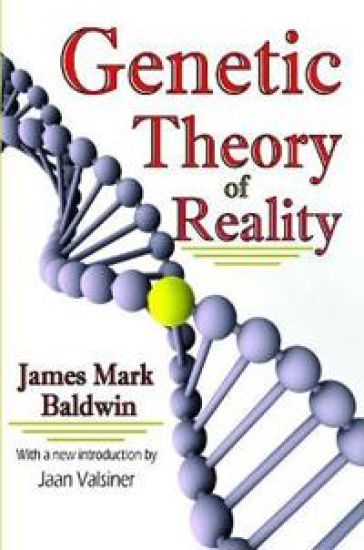
Genetic Theory of Reality

Genetic Theory of Reality

James Mark Baldwin; Jaan Valsiner

Routledge
2017
sidottu
James Mark Baldwin left a legacy that has yet to be fully examined, one with profound implications for science and the humanities. In some sense it paralleled that of his friend Charles Sanders Peirce, whose semiotics became understood only a century later. Baldwin was trying to make sense of complex biological and social processes that only now have come into the limelight as biological sciences have re-emerged in psychology. Baldwin's focus on development, based on the observation of his own children and extrapolated to his general theoretical scheme, is fully in line with where contemporary biological sciences are heading. This is exemplified by the bounded flexibility of the work of the genetic system. The general principle of persistent exploration of the environment with the result of creating novelty, which was the core of Baldwin's theoretical system, has since the 1960s become the guiding idea in genetics. Contemporary developmental science is rooted in Baldwin's thinking. In his new introduction, Jaan Valsiner shows that Baldwin's Genetic Theory of Reality demonstrates how human beings are in their nature social beings, establishes an alternative conceptualization of evolutionary theory, and formulates a system of developmental logic, all of which serve as the foundation for developmental psychology as a whole. This is a work of social science rediscovery long overdue.
From Methodology to Methods in Human Psychology

From Methodology to Methods in Human Psychology

Jaan Valsiner

Springer International Publishing AG
2017
nidottu
This Brief aims to provide a theoretically innovative introduction to the methodology of the human sciences. It presents a new version of methodology, as a system of mutually linked acts of creating knowledge where both abstract and concrete features of research are intricately intertwined. It shows how the constructions of particular methods that are used in the science of psychology are interdependent with general psychology. This is exemplified as the Methodology Cycle. The need for an emphasis on the Methodology Cycle grows out of the habitual presentation of methods as if they were independent from the assumptions which they are built upon, with the ultimate goal of searching for and creating universal principles. Chapters discuss the Methodology Cycle and its uses in various areas of empirical study in psychological functions. Featured topics in this Brief include: The strict separation between methodology and methods.Introspection, the primary method of psychology.Extrospection, the act of introspection turned outwards.Generalization and its effect on uniqueness. From Methodology to Methods in Human Psychology will be of interest to psychologists, undergraduate and graduate students, and researchers.
Giambattista Vico and the New Psychological Science

Giambattista Vico and the New Psychological Science

Luca Tateo; Jaan Valsiner

AldineTransaction
2016
sidottu
Giambattista Vico (1668–1744) was an Italian philosopher, rhetorician, and historian. As one of the great thinkers of the Enlightenment, he exerted tremendous influence on the social sciences. He was the first to stress cultural and linguistic dimensions in the development of both the human mind and social institutions. Although his ideas on the relationship between mind and culture and his epistemology have inspired the work of many scholars in psychology, his sizeable influence has been scarcely acknowledged. The volume is organized in two sections. The first locates Vico in his historical context and in the landscape of contemporary human and social sciences. The second part presents those of Vico's concepts that seem promising for the development of a new way of looking at psychological phenomena. In the book's conclusion, Luca Tateo gathers the ideas of the volume's contributors to suggest future development of the psychological sciences. This book aims to show how Vico's insights can inspire future research in the psychological sciences. It collects multidisciplinary contributions of leading international scholars that draw upon the thought of this original thinker. Collectively, the contributors remind us of the legacy and continuing influence of this inspiring historical figure.
An Invitation to Cultural Psychology

An Invitation to Cultural Psychology

Jaan Valsiner

SAGE Publications Ltd
2014
nidottu
An Invitation to Cultural Psychology looks at the everyday life worlds of human beings through the lens of a new synthetic perspective in cultural psychology – that of semiotic dynamics. Based on historical work from many different fields in the social and behavioural sciences, and the humanities too, this perspective applied to cultural psychology suggests that human beings are constantly creating, maintaining and abandoning hierarchies of meanings within all cultural contexts they experience. It’s a perspective that leans heavily on the work of the great French philosopher, Henri Bergson, only now being realised as a core basis for human cultural living. Jaan Valsiner is the founding editor of the major journal in the field, Culture & Psychology, and Editor of the Oxford Handbook of Culture and Psychology. He is the first Niels Bohr Professor of Cultural Psychology at Aalborg University in Denmark, where he leads Europe's first Research Centre on Cultural Psychology.
An Invitation to Cultural Psychology

An Invitation to Cultural Psychology

Jaan Valsiner

SAGE Publications Ltd
2014
sidottu
An Invitation to Cultural Psychology looks at the everyday life worlds of human beings through the lens of a new synthetic perspective in cultural psychology – that of semiotic dynamics. Based on historical work from many different fields in the social and behavioural sciences, and the humanities too, this perspective applied to cultural psychology suggests that human beings are constantly creating, maintaining and abandoning hierarchies of meanings within all cultural contexts they experience. It’s a perspective that leans heavily on the work of the great French philosopher, Henri Bergson, only now being realised as a core basis for human cultural living. Jaan Valsiner is the founding editor of the major journal in the field, Culture & Psychology, and Editor of the Oxford Handbook of Culture and Psychology. He is the first Niels Bohr Professor of Cultural Psychology at Aalborg University in Denmark, where he leads Europe's first Research Centre on Cultural Psychology.
Human Development in the Life Course

Human Development in the Life Course

Tania Zittoun; Jaan Valsiner; Dankert Vedeler; João Salgado; Miguel M. Gonçalves; Dieter Ferring

Cambridge University Press
2013
sidottu
Drawing on philosophy, the history of psychology and the natural sciences, this book proposes a new theoretical foundation for the psychology of the life course. It features the study of unique individual life courses in their social and cultural environment, combining the perspectives of developmental and sociocultural psychology, psychotherapy, learning sciences and geronto-psychology. In particular, the book highlights semiotic processes, specific to human development, that allow us to draw upon past experiences, to choose among alternatives and to plan our futures. Imagination is an important outcome of semiotic processes and enables us to deal with daily constraints and transitions, and promotes the transformation of social representation and symbolic systems - giving each person a unique style, or 'melody', of living. The book concludes by questioning the methodology and epistemology of current life course studies.
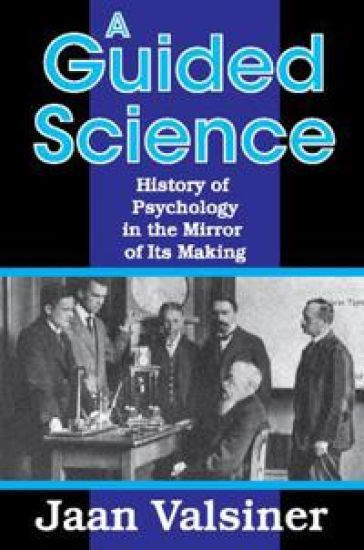
A Guided Science

A Guided Science

Jaan Valsiner

AldineTransaction
2013
nidottu
That sciences are guided by explicit and implicit ties to their surrounding social world is not new. Jaan Valsiner fills in the wide background of scholarship on the history of science, the recent focus on social studies of sciences, and the cultural and cognitive analyses of knowledge making. The theoretical scheme that he uses to explain the phenomena of social guidance of science comes from his thinking about processes of development in general--his theory of bounded indeterminacy--and on the relations of human beings with their culturally organized environments. Valsiner examines reasons for the slow and nonlinear progress of ideas in psychology as a science at the border of natural and social sciences. Why is that intellectual progress occurs in different countries at different times? Most responses are self-serving blinders for presenting science as a given rather than understanding it as a deeply human experience. For Valsiner, scientific knowledge is cultural at its core. Major changes have occurred in contemporary sciences--collective authorship, fragmentation of knowledge into small, quickly published (and equally quickly retractable) journal articles, and the counting of numbers of such articles by institutions as if that is a measure of "scientific productivity." Scientists are inherently ambivalent about the benefit of these changes for the actual development of knowledge. There is a gradual "takeover" of the domain of scientific knowledge creation by other social institutions with vested interests in defending and promoting knowledge that serves their social interests. Sciences are entering into a new form of social servitude.
Cultural Psychology of Human Values

Cultural Psychology of Human Values

Angela Uchoa Branco; Jaan Valsiner

Information Age Publishing
2012
sidottu
The book provides conceptual and theoretical elaborations on human values from a cultural psychological approach. The authors illustrate their original contributions with empirical data, allowing for productive discussion on the topic of ontogenesis of values from a historical-cultural perspective.
Cultural Psychology of Human Values

Cultural Psychology of Human Values

Angela Uchoa Branco; Jaan Valsiner

Information Age Publishing
2012
nidottu
The book provides conceptual and theoretical elaborations on human values from a cultural psychological approach. The authors illustrate their original contributions with empirical data, allowing for productive discussion on the topic of ontogenesis of values from a historical-cultural perspective.