Kirjojen hintavertailu. Mukana 12 595 353 kirjaa ja 12 kauppaa.

Kirjailija

Jack N. Lightstone

Kirjat ja teokset yhdessä paikassa: 10 kirjaa, julkaisuja vuosilta 1988-2023, suosituimpien joukossa Ritual and Ethnic Identity. Vertaile teosten hintoja ja tarkista saatavuus suomalaisista kirjakaupoista.

Mukana myös kirjoitusasut: Jack N Lightstone

10 kirjaa

Kirjojen julkaisuhaarukka 1988-2023.

Ritual and Ethnic Identity

Ritual and Ethnic Identity

Jack N. Lightstone; Frederick B. Bird; Simcha Fishbane; Marc P. Lalonde; Victor Levin; Louise Mayer; Madeleine Mcbrearty

Wilfrid Laurier University Press
1995
sidottu
In this innovative and comprehensive collection of essays Jack Lightstone and Frederick Bird document and interpret ritual practice among contemporary Canadian Jews. They particularly focus on the character and meaning of the public performance of the Sabbath liturgy in six urban Canadian synagogues, ranging from Orthodox to Reform, and from large congregations to a small house synagogue-yeshiva (rabbinic academy). Their examination of synagogue ritual is complemented with accounts of the ritual life of contemporary Canadian Jews outside the synagogue â amongst their families, within their homes and beyond. In contrast with other studies of Jewish observance, Lightstone and Bird document not simply which rituals are practised and how often; rather they stress the meaning, including the social meaning, of these rituals and treat them as complex symbolic systems. Their multidisciplinary approach together with their openness to include a wide variety of phenomena in their study (for example, the organization of the physical setting of the Sabbath, dress codes and patterns of greeting and handshaking) place this work at the very forefront of current research. Ritual and Ethnic Identity will be of great value to historians and sociologists of religion, anthropologists and all those concerned with religion, ritual and Canadian Jewish and ethnic studies.
The Rhetoric of the Babylonian Talmud, Its Social Meaning and Context

The Rhetoric of the Babylonian Talmud, Its Social Meaning and Context

Jack N. Lightstone

Wilfrid Laurier University Press
1994
nidottu
Virtually from its redaction about the sixth century A.D., the Babylonian Talmud became the rabbinic document par excellence. Through its lens almost all previous canonical rabbinic tradition was refracted. Study and mastery of the Talmud marked one as a rabbi, a "master." This book examines the character, use and social meaning of the formalized rhetoric which pervades the Babylonian Talmud. It explores, first, how the editors of the Talmud employ a consistent and highly laconic code of formalized linguistic terms and literary patterns to create the Talmud's (renowned) dialectical, analytic "essays." Second, the work considers the social meanings implicitly communicated by the use of this rhetoric, which not only provided an authoritative model for modes of thought and for treatment of earlier authoritative Judaic tradition, but also reflected, reinforced or helped engender new social definitions. Through comparison of the Talmud's rhetoric with that of other, earlier rabbinic documents and by placing the editing of the Talmud against the backdrop of the social and political situation of Rabbinism in the Late Persian Empire, the book relates the Talmud's creation and promulgation to a major shift in Rabbinism's understanding of the social role, "rabbi," and to the emergence and ascendancy of the talmudic academy (the Yeshiva) as the primary institution of Rabbinism toward the end of Late Antiquity. In its agenda, and methodological and theoretical perspectives, The Rhetoric of the Babylonian Talmud brings together the insights and tools of historical, literary and rhetorical analysis of the New Testament and of early rabbinic literature, on the one hand, and the sociological and anthropological study of religion, on the other.
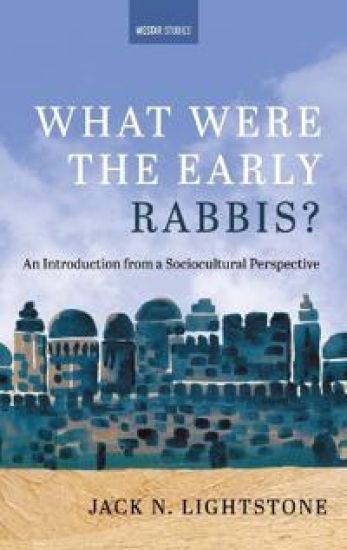
What Were the Early Rabbis?

What Were the Early Rabbis?

Jack N Lightstone

Cascade Books
2023
pokkari
Over the first eight centuries CE, the religious cultures of Middle Eastern, Mediterranean and many European lands transformed. Worship of "the gods" largely gave way to the worship of YHWH, the God of Israel, under Christianity and Islam, both developments of contemporary Judaism, after Rome destroyed Judaism's central shrine, the Jerusalem Temple, in 70 CE. But concomitant changes occurred within contemporary Judaism. The events of 70 wiped away well-established Judaic institutions in the Land of Israel, and over time the authority of a cadre of new "masters" of Judaic law, life, and practice, the "rabbis," took hold. What was the core, professional-like profile of members of this emerging cadre in the late second and early third centuries, when this group first attained a level of stable institutionalization (even if not yet well-established authority)? What views did they promote about the authoritative basis of their profile? What in their surrounding and antecedent sociocultural contexts lent prima facie legitimacy and currency to that profile? Geared to a nonspecialist readership, What Were the Early Rabbis? addresses these questions and consequently sheds light on eventual shifts in power that came to underpin Judaic communal life, while Christianity and Islam "Judaized" non-Jews under their expansive hegemonies.
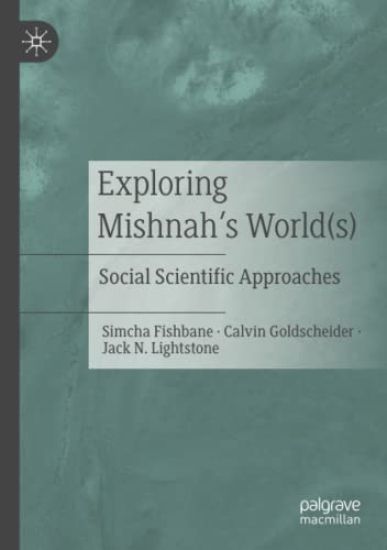
Exploring Mishnah's World(s)

Exploring Mishnah's World(s)

Simcha Fishbane; Calvin Goldscheider; Jack N. Lightstone

Springer Nature Switzerland AG
2021
nidottu
This book provides a new conceptual and methodological framework the social scientific study of Mishnah, as well as a series of case studies that apply social science perspectives to the analysis of Mishnah's evidence. The framework is one that takes full account of the historical and literary-historical issues that impinge upon the use of Mishnah for any scholarly purposes beyond philological study, including social scientific approaches to the materials. Based on the framework, each chapter undertakes, with appropriate methodological caveats, an avenue of inquiry open to the social scientist that brings to bear social scientific questions and modes of inquiry to Mishnaic evidence.
Exploring Mishnah's World(s)

Exploring Mishnah's World(s)

Simcha Fishbane; Calvin Goldscheider; Jack N. Lightstone

Springer Nature Switzerland AG
2020
sidottu
This book provides a new conceptual and methodological framework the social scientific study of Mishnah, as well as a series of case studies that apply social science perspectives to the analysis of Mishnah's evidence. The framework is one that takes full account of the historical and literary-historical issues that impinge upon the use of Mishnah for any scholarly purposes beyond philological study, including social scientific approaches to the materials. Based on the framework, each chapter undertakes, with appropriate methodological caveats, an avenue of inquiry open to the social scientist that brings to bear social scientific questions and modes of inquiry to Mishnaic evidence.
In the Seat of Moses

In the Seat of Moses

Jack N Lightstone

Cascade Books
2020
sidottu
In the Seat of Moses offers readers a unique, frank, and penetrating analysis of the rise of rabbinic Judaism in the late Roman period. Over time and through masterly rhetorical strategy, rabbinic writings in post-temple Judaism come to occupy an authoritarian place within a pluralistic tradition. Slowly, the rabbis occupy the seat of Moses, and Lightstone introduces readers to this process, to the most significant texts, to the rhetorical styles and appeals to authority, and even to how authority came to be authority. As a seasoned and honest scholar, Lightstone achieves his goal of introducing novice readers to the often obscure world of rabbinic literary conventions with astounding success. This book is an excellent contribution to the Westar Studies series focused on religious literacy.
Mishnah and the Social Formation of the Early Rabbinic Guild

Mishnah and the Social Formation of the Early Rabbinic Guild

Jack N. Lightstone

Wilfrid Laurier University Press
2002
nidottu
Where do the origins of the rabbinic movement lie, and how might evidence from the early rabbinic literature be made to reveal those origins? In order to shed light on the early social formation of the rabbinic guild of masters, Lightstone brings the theoretical and methodological insights of socio-rhetorical analysis to examine Mishnah, the first document authored by the early rabbinic movement and its principal object of study for several centuries. He argues that the enshrinement of Mishnah served to model, via its pervasive rhetoric, the principal authoritative guild expertise that qualified and marked one as a member of the rabbinic guild. Furthermore, he establishes the social and historical venue in late second- and early third-century Galilee. The author concludes that the social formation of the early rabbinic guild coalesced around the institution of the Jewish Patriarchy, for which the early rabbis served as bureaucratic-scribal retainers. He further suggests that the development of both the Patriarchy in the Land of Israel and the social formation of the rabbinic guild may have been spurred by the imposition of Roman-style urbanization in the region over the course of the latter half of the second and beginning of the third century. Lightstone's approach is informed by the insights and methods of several cognate disciplines, encompassing literary analysis, sociology and anthropology, and history (including, in the last chapter, the history of material culture). The book will be of interest to advanced students in the history of Judaism, rabbinic literature, biblical studies, early Christianity, and the history of religion and culture in the late Roman Near East.
Society, the Sacred and Scripture in Ancient Judaism

Society, the Sacred and Scripture in Ancient Judaism

Jack N. Lightstone

Wilfrid Laurier University Press
1988
nidottu
This work explores the relationship between religion, social patterns, and the perception of the character of scripture in four modes of Ancient Judaism: (1) the Jerusalem community of the fifth to fourth centuries B.C.E. (ie, the Early Second Temple Period); (2) the Judaism of the Graeco-Roman Disapora down to the end of the fourth century of the Christian Era; (3) earliest rabbinic Judaism in the second century C.E> in the land of Israel; (4) Late Antique Talmudic Rabbinism, primarily inn Babylonia, down to the sixth century of the Christian Era. Lightstone attempts not only to describe these perceptions and relationships but also to account for them, to explore why scripture should be thus perceived. His imaginative approach to the challenging descriptive and theoretical tasks is influenced by literary and form-critical methods as well as by the methods and perspectives of social anthropology and sociology of the mind. This unique attempts at revising the perception of the character of scripture should arouse the interest of scholars and students of Ancient Judaism.