Kirjojen hintavertailu. Mukana 12 595 353 kirjaa ja 12 kauppaa.

Kirjailija

Jack Quarter

Kirjat ja teokset yhdessä paikassa: 10 kirjaa, julkaisuja vuosilta 1996-2019, suosituimpien joukossa Understanding the Social Economy. Vertaile teosten hintoja ja tarkista saatavuus suomalaisista kirjakaupoista.

10 kirjaa

Kirjojen julkaisuhaarukka 1996-2019.

Pensions at Work

Pensions at Work

Jack Quarter; Isla Carmichael; Sherida Ryan

University of Toronto Press
2019
pokkari
Pension funds have come to play an increasingly important role within the new economy. According to Statistics Canada, in 2006, trusteed pension funds in Canada had $836 billion of assets and represented the savings of 4.6 million Canadian workers. Pensions at Work is a unique collection of papers that uses a labour perspective to deal with the socially responsible investment of pension funds. Featuring leading Canadian and international scholars, it builds on existing scholarship on socially responsible investment and on the growing interest of the Canadian labour movement in joint trusteeship. What is unique about this collection is that it synthesizes three distinct themes - socially responsible investment, pension funds, and labour studies. The contributors address an array of critical issues such as gaps in the education of union trustees of pension funds, the impact of human capital criteria on shareholder returns, the influence of corporate engagement upon corporate performance, and the nature of public-private partnerships (PPPs). Although the essays in Pensions at Work all address the nexus between socially responsible investment, pension funds, and unions, each looks at a particular manifestation of that relationship through a different disciplinary lens. This collection moves the discussion to pension funds in which union representatives are also trustees, a relatively new approach that will be of great interest to institutional investors, the labour movement, and instructors in labour studies programs.

Understanding the Social Economy

Understanding the Social Economy

Jack Quarter; Laurie Mook; Ann Armstrong

University of Toronto Press
2017
pokkari
Suitable for courses addressing community economic development, non-profit organizations, co-operatives and the social economy more broadly, the second edition of Understanding the Social Economy expands on the authors’ ground-breaking examination of organizations founded on a social mission – social enterprises, non-profits, co-operatives, credit unions, and community development organizations. While the role of the private and public sectors are very much in the public light, the social economy is often taken for granted. However, try to imagine a society without the many forms of organizations that form the social economy: social service organizations, arts and recreation organizations, ethno-cultural associations, social clubs, self-help groups, universities and colleges, hospitals and other healthcare providers, foundations, housing co-operatives, or credit unions. Not only do these organizations provide valuable services, but they employ many people, and purchase goods and services. They are both social and economic entities. Understanding the Social Economy illustrates how organizations in the social economy interact with the other sectors of the economy and highlights the important social infrastructure that these organizations create. The second edition contains six new case studies as well three new chapters addressing leadership and strategic management, and human resources management. A much-needed work on an important but neglected facet of organizational studies, Understanding the Social Economy continues to be an invaluable resource for the classroom and for participants working in the social sector.
Understanding the Social Economy of the United States

Understanding the Social Economy of the United States

Laurie Mook; John R. Whitman; Jack Quarter; Ann Armstrong

University of Toronto Press
2015
sidottu
Understanding the Social Economy of the United States is a comprehensive introduction to the operation and study of organizations with social goals – public sector nonprofits, civil society organizations, social enterprises, cooperatives and other organizations with a social mission – under the rubric of the social economy. This text is rich in examples and case studies that explain the social economy framework in the context of the United States. The book not only highlights the differences between these organizations and traditional businesses, but also provides applied chapters on organizational development, strategic management and leadership, human resources, finance, and social accounting and accountability in social economy organizations. The perfect introduction to the social economy framework for students of nonprofit management, business, social entrepreneurship, and public policy, Understanding the Social Economy of the United States an invaluable resource for the classroom and for practitioners working in the social economy sector.
Understanding the Social Economy of the United States

Understanding the Social Economy of the United States

Laurie Mook; John R. Whitman; Jack Quarter; Ann Armstrong

University of Toronto Press
2015
pokkari
Understanding the Social Economy of the United States is a comprehensive introduction to the operation and study of organizations with social goals – public sector nonprofits, civil society organizations, social enterprises, cooperatives and other organizations with a social mission – under the rubric of the social economy. This text is rich in examples and case studies that explain the social economy framework in the context of the United States. The book not only highlights the differences between these organizations and traditional businesses, but also provides applied chapters on organizational development, strategic management and leadership, human resources, finance, and social accounting and accountability in social economy organizations. The perfect introduction to the social economy framework for students of nonprofit management, business, social entrepreneurship, and public policy, Understanding the Social Economy of the United States an invaluable resource for the classroom and for practitioners working in the social economy sector.
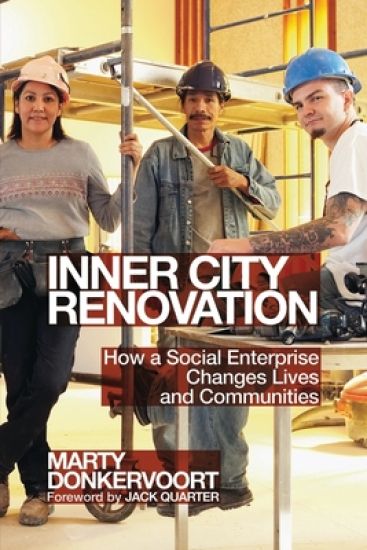
Inner City Renovation

Inner City Renovation

Marty Donkervoort; Jack Quarter

Fernwood Publishing Co Ltd
2013
nidottu
Inner City Renovation (ICR) is a much-heralded social enterprise in Winnipeg’s North End which has become an example of the potential for social enterprises to support people living on society’s margins and engage them in a productive livelihood. This book, written by former ICR general manager and board member Marty Donkervoort, documents the impacts this social enterprise has had on its employees and the community and reflects on the capacity of social enterprises as an alternative to corporate capitalist enterprises.
Businesses with a Difference

Businesses with a Difference

Laurie Mook; Jack Quarter; Sherida Ryan

University of Toronto Press
2012
sidottu
Market-based social economy firms such as social enterprises, social purpose businesses, co-operatives, credit unions, and community economic development corporations aim to meet distinct social needs while making money. Do these types of businesses have the potential for growth in the modern economy? Are they destined to function only in areas where conventional firms cannot achieve a sufficient rate of return? Or will the role of social economy organizations change as businesses begin placing more emphasis on corporate social responsibility? Building on the popular 2010 collection Researching the Social Economy, Businesses with a Difference explores the challenges and opportunities faced by firms that seek a genuine balance between their social and economic objectives. Through international case studies, including comparative analyses, this innovative collection highlights the unique issues that must be addressed when associations are accountable not to investors and shareholders, but instead to ordinary people.
Businesses with a Difference

Businesses with a Difference

Laurie Mook; Jack Quarter; Sherida Ryan

University of Toronto Press
2012
pokkari
Market-based social economy firms such as social enterprises, social purpose businesses, co-operatives, credit unions, and community economic development corporations aim to meet distinct social needs while making money. Do these types of businesses have the potential for growth in the modern economy? Are they destined to function only in areas where conventional firms cannot achieve a sufficient rate of return? Or will the role of social economy organizations change as businesses begin placing more emphasis on corporate social responsibility? Building on the popular 2010 collection Researching the Social Economy, Businesses with a Difference explores the challenges and opportunities faced by firms that seek a genuine balance between their social and economic objectives. Through international case studies, including comparative analyses, this innovative collection highlights the unique issues that must be addressed when associations are accountable not to investors and shareholders, but instead to ordinary people.
Beyond the Bottom Line

Beyond the Bottom Line

Jack Quarter

Praeger Publishers Inc
2000
sidottu
Quarter examines business owners who use their firms as laboratories for social innovation. After providing an introduction to this phenomenon in an historical perspective and discussing the 19th-century British industrialist Robert Owen, he provides ll case studies of contemporary innovators from six countries-the UK, US, the Netherlands, Germany, Canada, and New Zealand.The case studies fall into two broad groups. The first involves business people who promote innovative ownership and decision-making strategies such as donating their shares to a trust and thereby creating a company without shareholders so that employees can assume greater control; creating a worker co-operative; and transferring ownership to employees through an employee stock ownership plan. The second group of case studies involves innovative efforts at changing the relationship to the surrounding community through creating socially and environmentally responsible businesses. Quarter concludes by looking at the potential and limitations of this phenomenon for building a social movement. A provocative look at the social organization of work that will be of interest to scholars and researchers of industrial organization and to business leaders examining innovative ownership arrangements.
Crisis in the Israeli Kibbutz

Crisis in the Israeli Kibbutz

Uriel Leviatan; Hugh Oliver; Jack Quarter

Praeger Publishers Inc
1998
sidottu
Within the last decade, the kibbutzim of Israel have experienced a fundamental transformation that poses challenges to their values of collectivism and solidarity. This collection by leading scholars of the kibbutz not only updates knowledge of this innovative society, but also draws parallels to changes occurring in the West.Kibbutz society is currently experiencing major change. Economic crises that erupted ten years ago have transferred into major social and ideological crises. The underlying debate is about what values should govern kibbutzim, as collectivism and altruism clash with individual and egocentric values in offering policies and directions for the future of the kibbutz society. An important result of the changes is the irrelevance of much past research about kibbutzim. This book updates that research.With chapters by leading scholars of the kibbutz, this book not only updates knowledge of this innovative society, but also draws parallels to changes occurring in the West. This collection will be of particular interest to scholars and researchers of the kibbutz and the cooperative phenomenon, and those interested in alternative approaches to aging, education, management, and women's studies.
Building a Community-Controlled Economy

Building a Community-Controlled Economy

Jack Quarter; Paul Wilkinson

University of Toronto Press
1996
pokkari
This case study focuses on and analyses the formation of four co-operatives in the Evangeline region, a small Acadian community in the southwest part of Prince Edward Island. Defined by the authors as an 'integrated community-controlled economy,' the Evangeline community demonstrates the potential that a network of interrelated co-operatives has for community economic development. More specifically, the authors discuss why some co-operatives succeed while others fail, and propose a model that outlines the element necessary for any comprehensive community economic-development process. Wilkinson and Quarter look at the Evangeline experiment in the context of two seemingly contradictory trends today: globalization and decentralization. They argue that the initiatives undertaken by the Evangeline community fit within the trend toward decentralization and community control. The citizens of the Evangeline region have formed a community-controlled economy, refusing to accept the conventional wisdom that a small community is not viable in a modern economy. The authors suggest that the Evangeline experiment shows that communities which are being marginalized in the modern world can take matters into their own hands and succeed where externally driven development has failed.