Kirjojen hintavertailu. Mukana 12 595 353 kirjaa ja 12 kauppaa.

Kirjailija

Jacob Alex Klerman

Kirjat ja teokset yhdessä paikassa: 12 kirjaa, julkaisuja vuosilta 1997-2014, suosituimpien joukossa The Effect of Military Enlistment on Earnings and Education. Vertaile teosten hintoja ja tarkista saatavuus suomalaisista kirjakaupoista.

12 kirjaa

Kirjojen julkaisuhaarukka 1997-2014.

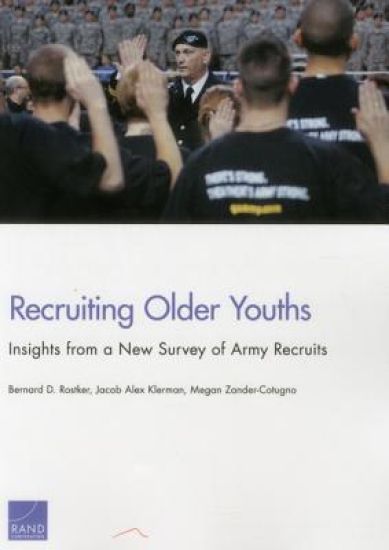
Recruiting Older Youths

Recruiting Older Youths

Bernard D. Rostker; Jacob Alex Klerman; Megan Zander-Cotugno

RAND
2014
pokkari
The group of high school graduates who did not enlist immediately after graduation but later join the Army has made up a significant and increasing portion of total enlistments. This report presents the results of a survey of 5,000 Army recruits designed to answer questions about why they did not immediately enlist and why they later chose to do so.
Data for DoD Manpower Policy Analysis
Department of Defense manpower analyses make use of both civilian and military administrative records and survey data. Klerman provides an overview of these data sources and discusses how they can be analyzed with currently underutilized data-matching strategies. Data-matching strategies have the potential for large payoffs in terms of better analysis for DoD, and DoD should work to streamline procedures for data matching before engaging in expensive new data-collection efforts.
Military Enlistment of Hispanic Youth

Military Enlistment of Hispanic Youth

Beth J Asch; Christopher Buck; Jacob Alex Klerman; Meredith Kleykamp; David S Loughran

RAND
2009
pokkari
Although polls of Hispanic youth show a strong propensity to serve in the military, Hispanics are nonetheless underrepresented among military recruits. The authors discuss the major characteristics that disproportionately disqualify Hispanic youth and explore actions that could be taken to increase Hispanic enlistments.
How Do Earnings Change When Reservists are Activated?

How Do Earnings Change When Reservists are Activated?

Francisco Martorell; Jacob Alex Klerman; David S. Loughran

RAND
2008
pokkari
Among the many hardships of military activation is the possibility of losing earnings, and though some research points to such a loss, other research suggests that reservists in fact earn substantially more when they are activated. The authors examine earnings reports from the 2004 and 2005 Status of Forces Survey of Reserve Component Members (SOFS-R) and those from administrative data, the Social Security Administration and military pay records.
Sanctions in the CalWORKs Program

Sanctions in the CalWORKs Program

Jacob Alex Klerman; P. Jane McClure Burstain

RAND
2008
pokkari
The California Department of Social Services asked RAND to study the state=B9s policy for sanctioning welfare program participants who do not comply with statutory requirements of the welfare-to-work program. Researchers found that sanctions were weak in practice and that caseworkers were reluctant to sanction clients. Making sanction swifter, stronger, and safer are possible directions for reforming sanction policy and practice.This book reports on a study of California=B9s policy for sanctioning participants who do not comply with statutory requirements of the welfare-to-work program.
The RAND SLAM Program

The RAND SLAM Program

Jacob Alex Klerman; Chris Ordowich; Arthur M Bullock; Scot Hickey

RAND
2007
pokkari
The RAND SLAM program is a software tool designed to aid analysts in exploring the trade-offs between cost, stress, and risk in military force structure decisions. The program's unique feature is that it models force requirements stochastically, allowing for analysis of requirements that vary unpredictably over time. This report serves as a user's guide, explaining the program's features and interface and detailing several example analyses.
Activation and the Earnings of Reservists

Activation and the Earnings of Reservists

David S Loughran; Jacob Alex Klerman; Craig Martin

RAND
2006
pokkari
Reports estimates of the effect of activation on the earnings of reservists and finds that earnings loss attributable to activation is less common than that suggested by survey-based analyses. However, the substantial earnings gains most reservists experience might not be sufficient to compensate reservists for the hardship of activation.
The Effect of Reserve Activations and Active-Duty Deployments on Local Employment During the Global War on Terrorism (2006)
Today, American service personnel are deploying at rates not seen since the Vietnam War. Such deployments and activations have raised concerns about their effect on the local economies. The authors of this report use econometric models to analyze the impact of activations and deployments on economic conditions, as measured by changes in employment at the county level.
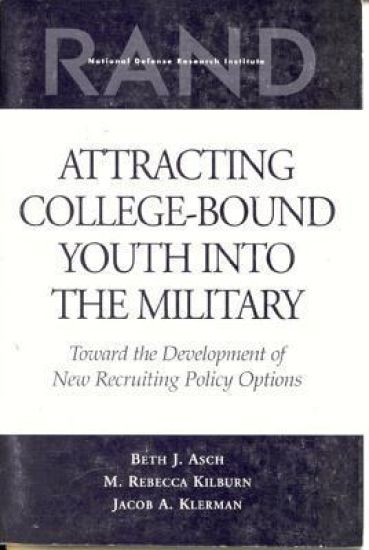
Attracting College-bound Youth into the Military

Attracting College-bound Youth into the Military

Beth J. Asch; M.Rebecca Kilburn; Jacob Alex Klerman

RAND
1999
pokkari
Although the military's need for enlisted personnel has declined by almost one-third since the end of the cold war, the armed services are finding it difficult to meet their recruiting goals. Among ongoing changes in the civilian labor market is a strong demand for skilled labor, which has prompted an increasing number of high quality youth to pursue post-secondary education and subsequent civilian employment. Because of this competition for high quality youth, the Department of Defense may want to explore new options for attracting desirable young people into the armed forces. The military, for example, offers a myriad of options for service members to take college courses while in active service. However, the programs do not in fact generate significant increases in educational attainment during time in service. One popular program, the Montgomery GI Bill, enrolls large numbers of individuals, but the vast majority of service members use their benefits after separating from service. Thus, the military does not receive the benefits of a more educated and productive workforce, unless the individuals subsequently join a reserve component. The authors suggest the Department of Defense should consider nontraditional policy options to enhance recruitment of college-bound youth. Recruiters could target more thoroughly students on two-year college campuses, or dropouts from two- or four-year colleges. Options for obtaining some college before military service could be expanded by allowing high school seniors to first attend college, paid for by the military, and then enlist. Or the student might serve in a reserve component while in college and then enter an active component after college. Alternatively, the military could create an entirely new path for combining college and military service by encouraging enlisted veterans to attend college and then reenlist (at a higher pay grade). The most promising alternatives should be evaluated in a national experiment designed to test their effectiveness and cost-effectiveness, similar to the one that led to the creation of the Army College Fund and the Navy College Fund.