Kirjojen hintavertailu. Mukana 12 116 068 kirjaa ja 12 kauppaa.

Kirjailija

Jacob Neusner

Kirjat ja teokset yhdessä paikassa: 290 kirjaa, julkaisuja vuosilta 1970-2023, suosituimpien joukossa Talmudic Anthology in Three Volumes. Vertaile teosten hintoja ja tarkista saatavuus suomalaisista kirjakaupoista.

290 kirjaa

Kirjojen julkaisuhaarukka 1970-2023.

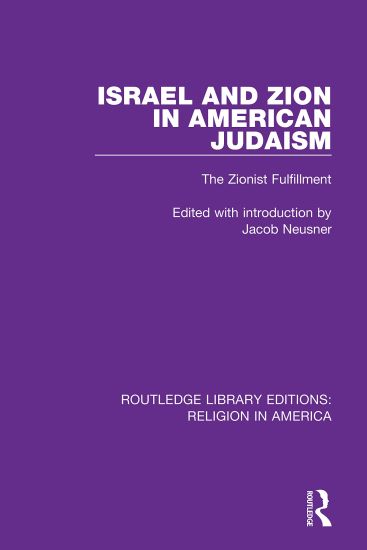
Israel and Zion in American Judaism

Israel and Zion in American Judaism

Jacob Neusner

TAYLOR FRANCIS LTD
2023
nidottu
First published in 1993, Israel and Zion in American Judaism: The Zionist Fulfillment is a collection of 24 essays exploring the concept of who or what is "Israel" following the establishment of the Jewish State in 1948 and the subsequent crisis of self-definition in American Jewry.
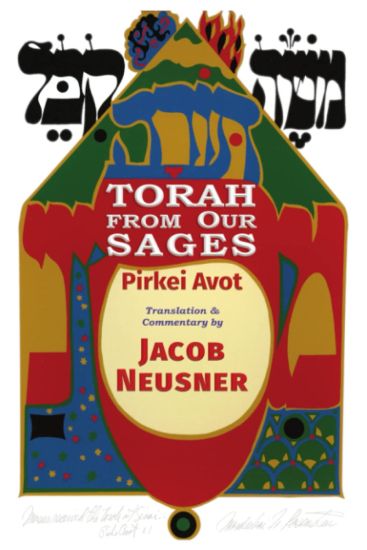
Torah from Our Sages

Torah from Our Sages

Jacob Neusner

Rossel Books
2022
pokkari
A New Approach to Pirkei Avot ...How did the Jewish national religion survive the destruction of the Jerusalem Temple and the failure of armed rebellion against Rome? A cultural reset was needed--a way of life tied to the past had to be flexible enough to adapt to virtually any time and place. The sages of the scholar class spoke of a word-of-mouth "chain of tradition" stretching back to Moses at Mount Sinai with the potential to stretch forward indefinitely. In their hands, the Torah went from being only a book recorded on a scroll to including teachings transmitted orally from one generation to the next--in proverbs, in case law, in propositions, and in debates.Now the foremost interpreter, historian, and representative of this massive rabbinic tradition, Dr. Jacob Neusner, offers a new translation, a fresh commentary, and a succinct explanation of the most studied Jewish volume outside the Bible and prayer book. Dr. Neusner explains how and why Pirkei Avot ("The Sayings of the Ancestors") stands at the head of the Mishnah--the "torah" compiled by the sages for the future.There is so much more than just commentary in Dr. Neusner's masterwork, Torah from Our Sages: Pirkei Avot, but I will not give it all away in the description. You will want to discover it for yourself. And you will want to know why this little book of wisdom has the mysterious power to speak to you directly even as it spoke to each and every one of your ancestors.From the editors of Sh'ma magazine: 'Fresh and insightful commentary that places the work in its historical setting while making it relevant to our times. ...wide ranging and helpful without becoming pedantic or obscure."
Neusner on Judaism

Neusner on Judaism

Jacob Neusner

Routledge
2022
nidottu
Jacob Neusner has published more than 1000 books and articles, scholarly and academic, popular and journalistic, and is one of the most published humanities scholars in the world. Over a period of fifty years he has made significant, insightful and challenging contributions to the study of Rabbinic Judaism, particularly in the disciplines covered in the three volumes which make up Neusner on Judaism: the study of history (volume 1), literature (volume 2), and religion and theology (volume 3). These unique volumes of selective writings by Jacob Neusner, with new introductions by the author, offer scholars an invaluable resource in the field of Judaic Studies.
Israel and Zion in American Judaism
First published in 1993, Israel and Zion in American Judaism: The Zionist Fulfillment is a collection of 24 essays exploring the concept of who or what is "Israel" following the establishment of the Jewish State in 1948 and the subsequent crisis of self-definition in American Jewry.
Neusner on Judaism

Neusner on Judaism

Jacob Neusner

CRC Press Inc
2017
sidottu
Jacob Neusner has published more than 1000 books and articles, scholarly and academic, popular and journalistic, and is one of the most published humanities scholars in the world. Over a period of fifty years he has made significant, insightful and challenging contributions to the study of Rabbinic Judaism, particularly in the disciplines covered in the three volumes which make up Neusner on Judaism: the study of history (volume 1), literature (volume 2), and religion and theology (volume 3). These unique volumes of selective writings by Jacob Neusner, with new introductions by the author, offer scholars an invaluable resource in the field of Judaic Studies.
The Routledge Dictionary of Judaism

The Routledge Dictionary of Judaism

Alan Avery-Peck; Jacob Neusner

Routledge
2017
sidottu
Compiled by two internationally renowned experts, and with over 600 wide-ranging and informative entries, The Routledge Dictionary of Judaism provides the reader with an invaluable reference aid to all areas of the religion. Topics covered include:*The religion's forms and history*Its institutions, religious practices and life cycle rites *Key texts and people, symbols and holy days*An understanding of theological terms, doctrine and philosophy.
The Tosefta

The Tosefta

Jacob Neusner

Hendrickson Publishers Inc
2014
nidottu
The importance of the Tosefta for literary, historical, and religious scholarship has long been known, and this two-volume set makes it accessible to many more readers. The work is a vital supplement to the early rabbinic oral tradition first set to writing in the Mishnah at the end of the second century of the Common Era. Dating to about 220 CE and also set in the Tannaic period, the Tosefta has the same six "orders" and essentially the same "tractates" as the Mishnah, often agreeing with it, but sometimes differing significantly in its understanding of the oral tradition. This English translation of the Mishnaic Hebrew (with some Aramaic) is not merely a paraphrase, but aims at a literal rendition into English of the formulary patterns and syntactical traits of the original text. It contains complete references to the passages in the Tosefta that cite verbatim the corresponding unit in the Mishnah, which is printed in italics. The Tosefta is crucial to the study of formative rabbinic Judaism and early Christianity.
Rabbi Moses

Rabbi Moses

Jacob Neusner

University Press of America
2013
nidottu
This book is an exercise in the systematic recourse to anachronism as a theological-exegetical mode of apologetics. Specifically, Neusner demonstrates the capacity of the Rabbinic sages to read ideas attested in their own day as authoritative testaments to — to them — ancient times. Thus, Scripture was read as integral testimony to the contemporary scene. About a millennium — 750 B.C. E. to 350 C. E. — separates Scripture’s prophets from the later sages of the Mishnah and the Talmud. It is quite natural to recognize evidence for differences over a long period of time. Yet Judaism sees itself as a continuum and overcomes difference. The latecomers portray the ancients like themselves. “In our image, after our likeness” captures the current aspiration. The sages accommodated the later documents in their canon by finding the traits of their own time in the record of the remote past. They met the challenges to perfection that the sages brought about. Of what does the process of harmonization consist? To answer that question the author surveys the presentation of the prophets by the rabbis, beginning with Moses. To overcome the gap, Rabbinic sages turn Moses into a sage like themselves. The prophet performs wonders. The sage sets forth reasonable rulings. The conclusion expands on this account of matters to show the categorical solution that the sages adopted for themselves, and that is the happy outcome of the study.
Do Jews, Christians and Muslims Worship the Same God?
Most Jews, Muslims, and Christians are devoted and faithful. Still, on any given day, it's difficult to avoid the vigorous and heated disputes between them, whether over the -Ground Zero- mosque, lobbying state legislatures against Sharia law, sharing worship space, dissecting the fallout of the Arab Spring, protecting civil rights, or challenging the authority of sacred texts. With so much rancor, can there be any common ground? Do they even worship the same God? And can religion, which often is so divisive, be any help at all? Four internationally known scholars set out to tackle these deceptively simple questions in an accessible way. Some scholars argue that while beliefs about God may differ, the object of worship is ultimately the same. However, these authors take a more pragmatic view. While they may disagree, they nevertheless assert that whatever they answers to these questions, the three faiths must find the will (politically, socially, and personally) to tolerate differences. Perhaps what can help us move forward as pluralistic people is a focus on the goal - peace with justice for all.
Chapters in the Formative History of Judaism, Eighth Series

Chapters in the Formative History of Judaism, Eighth Series

Jacob Neusner

University Press of America
2012
nidottu
This collection of essays draws on work done in 2011¬–2012. The author takes up several topics in the systemic analysis of Judaism, its literature, and its theology. The reason for periodically collecting and publishing essays and reviews is to give them a second life, after they have served as lectures or as summaries of monographs or as free-standing articles or as expositions of Judaism in collections of comparative religions. This re-presentation serves a readership to whom the initial presentation in lectures or specialized journals or short-run monographs is inaccessible. Some of the essays furthermore provide a précis, for colleagues in kindred fields, of fully worked out monographs.
Rabbi David

Rabbi David

Jacob Neusner

University Press of America
2012
nidottu
Rabbinic documents of David, progenitor of the Messiah, carry forward the scriptural narrative of David the king. But he also is turned by Rabbinic writings of late antiquity—from the Mishnah through the Yerushalmi and the Bavli—into a sage. Consequently, the Rabbis’ Messiah is a rabbi. How did this transformation come about? Of what kinds of writings does it consist? What sequence of writings conveyed the transformation? And most important: what do we learn about the movement from one set of Israelite writings to take over, or submit to the values of, another set of writings? These are the questions answered here for David, king of Israel. Rabbi David proves that the first exposition of the figure of Rabbi David in a program of elaboration and of protracted exposition of law and Scripture is found in the Bavli. Prior to the closure of that document, that is, in the Rabbinic documents that came to closure before the Bavli, we do not find an elaborate exposition of the figure of David as a rabbi. By contrast, in the Bavli, ample canonical evidence attests to the sages’ transformation of David, king of Israel, into a rabbi. So while bits and pieces of Rabbi David find their way into most of the canonical documents, we find the elaborately spelled out Rabbi David to begin with in the Bavli, now represented as a disciple of sages and a devotee of study of the Torah. That usage attracts attention because when we encounter David in Rabbinic literature—as in all other Judaic canons, not only Rabbinic—this signals we are meeting the embodiment of the Messiah. The representation of the kings of Israel in the Davidic line as heirs of David forms a chapter in exposing the Messianic message of Rabbinic Judaism.
Chapters in the Formative History of Judaism: Seventh Series

Chapters in the Formative History of Judaism: Seventh Series

Jacob Neusner

University Press of America
2011
nidottu
This collection of essays draws on work done in 2010–2011. The author takes up several topics in the systemic analysis of Judaism, its literature, and its theology. The reason for periodically collecting and publishing essays and reviews is to give them a second life, after they have served as lectures or as summaries of monographs or as free-standing articles or as expositions of Judaism in collections of comparative religions. This re-presentation serves a readership to whom the initial presentation in lectures or specialized journals or short-run monographs is inaccessible. Some of the essays furthermore provide a précis, for colleagues in kindred fields, of fully worked out monographs.
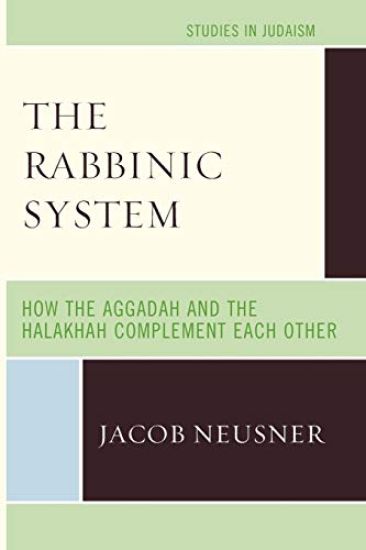
The Rabbinic System

The Rabbinic System

Jacob Neusner

University Press of America
2011
nidottu
This book recapitulates chapters in two comprehensive accounts of the theology of Rabbinic Judaism, which deal with the two principal components of the native categories of the Rabbinic canon—Aggadah, lore, and Halakhah law. Jacob Neusner abbreviates some chapters in the two systematic accounts, The Theology of the Oral Torah: Revealing the Justice of God (1999) and The Theology of the Halakhah (2001). In this book, Neusner supplies a précis of the principal theological topics that have occupied him for the past two decades. In this way, he gains an audience of colleagues with an interest in the theology of Rabbinic Judaism who are unlikely to read the long books with their elaborate repertoire of sources that set forth Neusner’s principal results. The systematic Theology of the Halakhah and its equally systematic companion for the Aggadah, The Theology of the Oral Torah: Revealing the Justice of God, tell a single, continuous story. Seen together, the two large and distinct realms of discourse portray one Judaism: an integrated world-view (Aggadah), way of life (Halakhah), and account of the social entity, Israel. All together, these represent Neusner’s answer to the critical question of defining Rabbinic Judaism: how do the diverse, autonomous documents of Rabbinic Judaism in its formative age coalesce, like the Mishnah, which transcends documentary limits and joins the Halakhah to the Aggadah in a single coherent formulation, and of what does that statement consist? In The Rabbinic System, he conveys, as a single continuous narrative, the tale that the Halakhah and the Aggadah as theological constructions jointly tell.
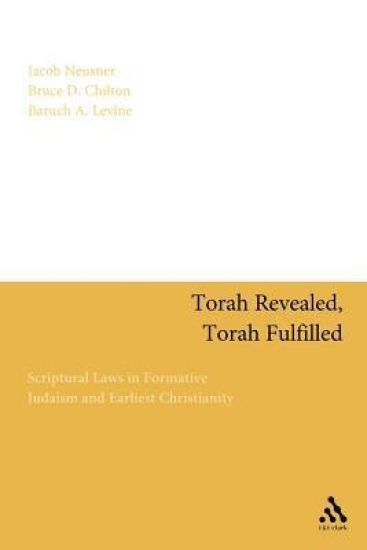
Torah Revealed, Torah Fulfilled

Torah Revealed, Torah Fulfilled

Jacob Neusner; Bruce D. Chilton; Baruch A. Levine

T. T.Clark Ltd
2011
nidottu
The authors seek to identify the recurrent tensions, the blatant points of emphasis, the recurring indications of conflict and polemic. Framing the issue of the disposition of the Scriptural heritage in broad terms, they describe what characterizes the Gospels and the Mishnah, the letters of Paul and the Tosefta. In other words, if they take whole and complete the writings of first and second century people claiming to form the contemporary embodiment of Scripture's Israel and ask what they all stress as a single point of insistence, the answer is self-evident. Nearly every Christianity and nearly all known Judaisms appeal for validation to the Scriptures of ancient Israel, their laws and narratives, their prophecies and visions. To Scripture all parties appeal GCo but not to the same verses of Scripture. In Scripture, all participants to the common Israelite culture propose to find validation GCo but not to a common theological program subject to diverse interpretation. From Scripture, every community of Judaism and Christianity takes away what it will, but not with the assent of all the others.
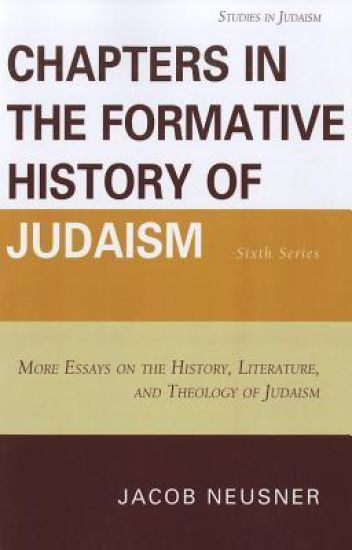
Chapters in the Formative History of Judaism: Sixth Series

Chapters in the Formative History of Judaism: Sixth Series

Jacob Neusner

University Press of America
2011
nidottu
This collection of seven essays draws on work done in 2010. The author takes up several topics in the systemic analysis of Judaisms and deals with comparisons of Judaisms. The papers include two commentaries on the current state of the academic study of Judaism. The reason for periodically collecting and publishing essays and reviews is to give them a second life, after they have served as lectures or as summaries of monographs or as free-standing articles or as expositions of Judaism in collections of comparative religions. This re-presentation serves a readership to whom the initial presentation in lectures or specialized journals or short-run monographs is inaccessible. Some of the essays furthermore provide a précis, for colleagues in kindred fields, of fully worked out monographs.
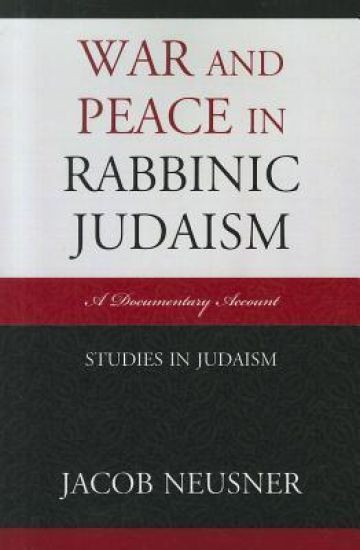
War and Peace in Rabbinic Judaism

War and Peace in Rabbinic Judaism

Jacob Neusner

University Press of America
2011
nidottu
This book surveys the treatment of war and peace in the canon of Rabbinic Judaism in late antiquity: to what does Judaism refer when it speaks of war and peace in the context of the Hebrew words "milhamah" (war) and "shalom" (peace)? But this study is not lexical. It is categorical. "War" represents a commanding, coherent category-formation, while "peace" covers a variety of circumstances and transactions. "War" is specifically a Halakhic category and "Peace" an Aggadic taxon. Do "war" and "peace" present us with a lexical or a categorical phenomenon? War forms a category-formation and peace is a substantive - a word bearing diffuse references. With what consequence? When we come across the word "war" without further data, we know the context and intent, but "peace" covers a mass of miscellaneous, free-standing facts and diverse implications.