

Kirjailija
Jacob S. Hacker
Kirjat ja teokset yhdessä paikassa: 8 kirjaa, julkaisuja vuosilta 1999-2024, suosituimpien joukossa American Amnesia: How the War on Government Led Us to Forget What Made America Prosper. Vertaile teosten hintoja ja tarkista saatavuus suomalaisista kirjakaupoista.
8 kirjaa
Kirjojen julkaisuhaarukka 1999-2024.

Let Them Eat Tweets: How the Right Rules in an Age of Extreme Inequality
Jacob S. Hacker; Paul Pierson
Liveright Publishing Corporation
2021
nidottu
In Let Them Eat Tweets, best-selling political scientists Jacob S. Hacker and Paul Pierson argue that despite the rhetoric of Donald Trump, Josh Hawley, and other right-wing "populists," the Republican Party came to serve its plutocratic masters to a degree without precedent in modern global history. To maintain power while serving the 0.1 percent, the GOP has relied on increasingly incendiary racial and cultural appeals to its almost entirely white base. Calling this dangerous hybrid "plutocratic populism," Hacker and Pierson show how, over the last forty years, reactionary plutocrats and right-wing populists have become the two faces of a party that now actively undermines democracy to achieve its goals against the will of the majority of Americans. Based on decades of research and featuring a new epilogue about the intensification of GOP radicalism after the 2020 election, Let Them Eat Tweets authoritatively explains the doom loop of tax cutting and fearmongering that defines the Republican Party--and reveals how the rest of us can fight back.
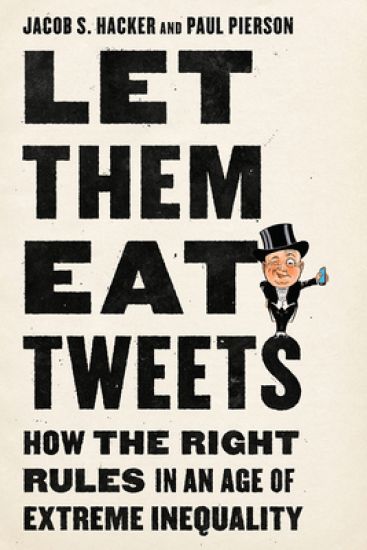
Let Them Eat Tweets: How the Right Rules in an Age of Extreme Inequality
Jacob S. Hacker; Paul Pierson
Liveright Publishing Corporation
2020
sidottu
The Republican Party appears to be divided between a tax-cutting old guard and a white-nationalist vanguard--and with Donald Trump's ascendance, the upstarts seem to be winning. Yet how are we to explain that, under Trump, the plutocrats have gotten almost everything they want, including a huge tax cut for corporations and the wealthy, regulation-killing executive actions, and a legion of business-friendly federal judges? Does the GOP represent "forgotten" Americans? Or does it represent the superrich?In Let Them Eat Tweets, best-selling political scientists Jacob S. Hacker and Paul Pierson offer a definitive answer: the Republican Party serves its plutocratic masters to a degree without precedent in modern global history. Conservative parties, by their nature, almost always side with the rich. But when faced with popular resistance, they usually make concessions, allowing some policies that benefit the working and middle classes. After all, how can a political party maintain power in a democracy if it serves only the interests of a narrow and wealthy slice of society?Today's Republicans have shown the way, doubling down on a truly radical, elite-benefiting economic agenda while at the same time making increasingly incendiary racial and cultural appeals to their almost entirely white base. Telling a forty-year story, Hacker and Pierson demonstrate that since the early 1980s, when inequality started spiking, extreme tax cutting, union busting, and deregulation have gone hand in hand with extreme race-baiting, outrage stoking, and disinformation. Instead of responding to the real challenges facing voters, the Republican Party offers division and distraction--most prominently, in the racist, nativist bile of the president's Twitter feed.As Hacker and Pierson argue, Trump isn't a break with the GOP's recent past. On the contrary, he embodies its tightening embrace of plutocracy and right-wing extremism--a dynamic Hacker and Pierson call "plutocratic populism." As Trump and his far-right allies spew hatred and lies, Republicans in Congress and in statehouses attack social programs and funnel more and more money to the top 0.1 percent of Americans. Far from being at war with each other, reactionary plutocrats and right-wing populists have become the two faces of a party that now actively undermines democracy to achieve its goals against the will of the majority of Americans.Drawing on decades of research, Hacker and Pierson authoritatively explain the doom loop of tax cutting and fearmongering that characterizes our era--and reveal how we can fight back.
American Amnesia: How the War on Government Led Us to Forget What Made America Prosper
Jacob S. Hacker; Paul Pierson
SIMON SCHUSTER
2017
nidottu
A "provocative" (Kirkus Reviews), timely, and topical work that examines what's good for American business and what's good for Americans--and why those interests are misaligned. In American Amnesia, bestselling political scientists Jacob S. Hacker and Paul Pierson trace the economic and political history of the United States over the last century and show how a viable mixed economy has long been the dominant engine of America's prosperity. We have largely forgotten this reliance, as many political circles and corporate actors have come to mistakenly see government as a hindrance rather than the propeller it once was. "American Amnesia" is more than a rhetorical phrase; elites have literally forgotten, or at least forgotten to talk about, the essential role of public authority in achieving big positive-sum bargains in advanced societies. The mixed economy was the most important social innovation of the twentieth century. It spread a previously unimaginable level of broad prosperity. It enabled steep increases in education, health, longevity, and economic security. And yet, extraordinarily, it is anathema to many current economic and political elites. Looking at this record of remarkable accomplishment, they recoil in horror. And as the advocates of anti-government free market fundamentalist have gained power, they are hell-bent on scrapping the instrument of nearly a century of unprecedented economic and social progress. In the American Amnesia, Hacker and Pierson explain the full "story of how government helped make America great, how the enthusiasm for bashing government is behind its current malaise, and how a return to effective government is the answer the nation is looking for" (The New York Times).
Winner-Take-All Politics: How Washington Made the Rich Richer--And Turned Its Back on the Middle Class
Jacob S. Hacker; Paul Pierson
SIMON SCHUSTER
2011
nidottu
This acclaimed paradigm-shifting work identifies the real culprit behind one of the great economic crises of our time--the growing inequality of incomes between the vast majority of Americans and the richest of the rich. A groundbreaking work that identifies the real culprit behind one of the great economic crimes of our time-- the growing inequality of incomes between the vast majority of Americans and the richest of the rich. We all know that the very rich have gotten a lot richer these past few decades while most Americans haven't. In fact, the exorbitantly paid have continued to thrive during the current economic crisis, even as the rest of Americans have continued to fall behind. Why do the "haveit- alls" have so much more? And how have they managed to restructure the economy to reap the lion's share of the gains and shift the costs of their new economic playground downward, tearing new holes in the safety net and saddling all of us with increased debt and risk? Lots of so-called experts claim to have solved this great mystery, but no one has really gotten to the bottom of it--until now. In their lively and provocative Winner-Take-All Politics, renowned political scientists Jacob S. Hacker and Paul Pierson demonstrate convincingly that the usual suspects--foreign trade and financial globalization, technological changes in the workplace, increased education at the top--are largely innocent of the charges against them. Instead, they indict an unlikely suspect and take us on an entertaining tour of the mountain of evidence against the culprit. The guilty party is American politics. Runaway inequality and the present economic crisis reflect what government has done to aid the rich and what it has not done to safeguard the interests of the middle class. The winner-take-all economy is primarily a result of winner-take-all politics. In an innovative historical departure, Hacker and Pierson trace the rise of the winner-take-all economy back to the late 1970s when, under a Democratic president and a Democratic Congress, a major transformation of American politics occurred. With big business and conservative ideologues organizing themselves to undo the regulations and progressive tax policies that had helped ensure a fair distribution of economic rewards, deregulation got under way, taxes were cut for the wealthiest, and business decisively defeated labor in Washington. And this transformation continued under Reagan and the Bushes as well as under Clinton, with both parties catering to the interests of those at the very top. Hacker and Pierson's gripping narration of the epic battles waged during President Obama's first two years in office reveals an unpleasant but catalyzing truth: winner-take-all politics, while under challenge, is still very much with us. Winner-Take-All Politics--part revelatory history, part political analysis, part intellectual journey-- shows how a political system that traditionally has been responsive to the interests of the middle class has been hijacked by the superrich. In doing so, it not only changes how we think about American politics, but also points the way to rebuilding a democracy that serves the interests of the many rather than just those of the wealthy few.
A timely investigation of the most innovative recent urban housing constructionsThe Republicans who run American government today have defied the normal laws of political gravity. They have ruled with the slimmest of majorities and yet have transformed the nation’s governing priorities. They have strayed dramatically from the moderate middle of public opinion and yet have faced little public backlash. Again and again, they have sided with the affluent and ideologically extreme while paying little heed to the broad majority of Americans. And much more often than not, they have come out on top. This book shows why—and why this troubling state of affairs can and must be changed.Written in a highly accessible style by two professional political scientists, Off Center tells the story of a deliberative process restricted and distorted by party chieftains, of unresponsive power brokers subverting the popular will, and of legislation written by and for powerful interests and deliberately designed to mute popular discontent. In the best tradition of engaged social science, Off Center is a powerful and informed critique that points the way toward a stronger foundation for American democracy.

The Divided Welfare State is the first comprehensive political analysis of America’s system of public and private social benefits. Everyone knows that the American welfare state is less expensive and extensive, later to develop and slower to grow, than comparable programs abroad. American social spending is as high as spending in many European nations. What is distinctive is that so many social welfare duties are handled by the private sector with government support. With historical reach and statistical and cross-national evidence, The Divided Welfare State demonstrates that private social benefits have not been shaped by public policy, but have deeply influenced the politics of public social programs - to produce a social policy framework whose political and social effects are strikingly different than often assumed. At a time of fierce new debates about social policy, this book is essential to understanding the roots of America’s distinctive model and its future possibilities.
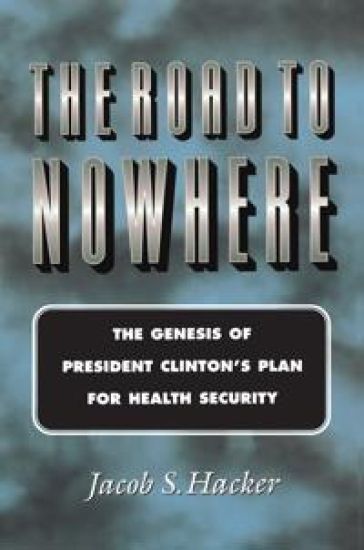
During the 1992 presidential campaign, health care reform became a hot issue, paving the way for one of the most important yet ill-fated social policy initiatives in American history: Bill Clinton's 1993 proposal for comprehensive coverage under "managed competition." Here Jacob Hacker not only investigates for the first time how managed competition became the president's reform framework, but also illuminates how issues and policies emerge. He follows Clinton's policy ideas from their initial formulation by policy experts through their endorsement by medical industry leaders and politicians to their inclusion--in a new and unexpected form--in the proposal itself. Throughout he explores key questions: Why did health reform become a national issue in the 1990s? Why did Clinton choose managed competition over more familiar options during the 1992 presidential campaign? What effect did this have on the fate of his proposal? Drawing on records of the President's task force, interviews with a wide range of key policy players, and many other sources, Hacker locates his analysis within the context of current political theories on agenda setting. He concludes that Clinton chose managed competition partly because advocates inside and outside the campaign convinced him that it represented a unique middle road to health care reform. This conviction, Hacker maintains, blinded the president and his allies to the political risks of the approach and hindered the development of an effective strategy for enacting it.