Kirjojen hintavertailu. Mukana 12 595 353 kirjaa ja 12 kauppaa.

Kirjailija

Jagdeep Singh

Kirjat ja teokset yhdessä paikassa: 42 kirjaa, julkaisuja vuosilta 2010-2026, suosituimpien joukossa Impacto de SMED en la Unidad de fabricación - Un estudio de caso. Vertaile teosten hintoja ja tarkista saatavuus suomalaisista kirjakaupoista.

42 kirjaa

Kirjojen julkaisuhaarukka 2010-2026.

Tecnica ibrida per la classificazione associativa delle malattie cardiache
Negli ultimi anni l'industria della sanit raccoglie enormi quantit di dati sanitari che, purtroppo, non vengono estratti per scoprire informazioni nascoste per un processo decisionale efficace. Oggi i servizi medici hanno fatto molta strada per curare i pazienti affetti da varie malattie. Tra le pi fatali c' la cardiopatia, che non pu essere vista a occhio nudo e si manifesta all'istante. Il tasso di mortalit aumentato a causa di decisioni cliniche sbagliate. Per ottenere un trattamento affidabile e conveniente si possono sviluppare sistemi di informazione o di supporto alle decisioni basati su computer. Il data mining fornisce la soluzione per la scoperta della conoscenza da questi grandi e complessi database. Il lavoro dell'autore prevede lo sviluppo di un framework basato su tecniche di classificazione associativa su dataset cardiaci. L'implementazione del lavoro stata effettuata su un set di dati cardiaci provenienti dall'UCI Machine Learning Repository per testare e valutare i diversi risultati. I risultati sperimentali mostrano che la maggior parte delle regole di classificazione associativa aiutano a prevedere meglio le malattie cardiache e a creare un sistema di supporto decisionale affidabile.
Técnica híbrida para a classificação associativa de doenças cardíacas
Nos ltimos anos, o sector da sa de tem recolhido enormes quantidades de dados sobre cuidados de sa de que, infelizmente, n o s o extra dos para descobrir informa es ocultas que permitam uma tomada de decis o eficaz. Atualmente, os servi os m dicos percorreram um longo caminho para tratar doentes com v rias doen as. Uma das mais fatais a doen a card aca, que n o pode ser vista a olho nu e surge instantaneamente. As taxas de mortalidade aumentaram devido a m s decis es cl nicas. Para conseguir um tratamento fi vel e rent vel, podem ser desenvolvidos sistemas de informa o ou de apoio decis o baseados em computador. A extra o de dados fornece a solu o para a descoberta de conhecimentos a partir destas grandes e complexas bases de dados. O trabalho do autor envolve o desenvolvimento de uma estrutura baseada em t cnicas de classifica o associativa no conjunto de dados do cora o. A implementa o do trabalho efectuada no conjunto de dados sobre o cora o do Reposit rio de Aprendizagem Autom tica da UCI para testar e avaliar diferentes para obter melhores resultados. Os resultados experimentais mostram que a maioria das regras de classifica o associativa ajuda a prever melhor as doen as card acas e a criar um sistema fi vel de apoio decis o.
Technique hybride pour la classification associative des maladies cardiaques
Au cours des derni res ann es, le secteur des soins de sant a collect d' normes quantit s de donn es qui, malheureusement, ne sont pas extraites pour d couvrir des informations cach es permettant une prise de d cision efficace. Aujourd'hui, les services m dicaux ont parcouru un long chemin pour traiter les patients atteints de diverses maladies. L'une des plus mortelles est la maladie cardiaque, qui ne peut tre vue l'oeil nu et survient instantan ment. Le taux de mortalit a augment en raison de mauvaises d cisions cliniques. Pour parvenir un traitement fiable et rentable, des syst mes d'information ou d'aide la d cision bas s sur l'informatique peuvent tre d velopp s pour accomplir cette t che. L'exploration de donn es fournit la solution pour la d couverte de connaissances partir de ces bases de donn es vastes et complexes. Le travail de l'auteur implique le d veloppement d'un cadre bas sur des techniques de classification associative sur un ensemble de donn es cardiaques. La mise en oeuvre du travail est effectu e sur l'ensemble de donn es cardiaques de l'UCI Machine Learning Repository afin de tester et d' valuer diff rentes m thodes pour obtenir de meilleurs r sultats. Les r sultats exp rimentaux montrent que la plupart des r gles de classification associative aident la meilleure pr diction des maladies cardiaques et la cr ation d'un syst me d'aide la d cision fiable.
Hybride Technik zur assoziativen Klassifizierung von Herzkrankheiten
In den letzten Jahren hat die Gesundheitsbranche riesige Mengen von Gesundheitsdaten gesammelt, die leider nicht extrahiert werden, um verborgene Informationen f r eine effektive Entscheidungsfindung zu entdecken. Die medizinischen Dienste haben heute einen langen Weg zur ckgelegt, um Patienten mit verschiedenen Krankheiten zu behandeln. Eine der t dlichsten ist die Herzerkrankung, die mit blo em Auge nicht zu erkennen ist und sofort auftritt. Die Sterblichkeitsrate ist aufgrund schlechter klinischer Entscheidungen gestiegen. Um eine zuverl ssige und kosteneffiziente Behandlung zu erreichen, k nnen computergest tzte Informations- oder Entscheidungshilfesysteme entwickelt werden, die diese Aufgabe bernehmen. Data Mining bietet die L sung f r die Entdeckung von Wissen aus diesen gro en und komplexen Datenbanken. Die Arbeit des Autors umfasst die Entwicklung eines Rahmens, der auf assoziativen Klassifizierungstechniken f r Herzdaten basiert. Die Implementierung der Arbeit erfolgt auf dem Herzdatensatz aus dem UCI Machine Learning Repository, um verschiedene Methoden zu testen und zu bewerten, um bessere Ergebnisse zu erzielen. Die experimentellen Ergebnisse zeigen, dass die meisten assoziativen Klassifizierungsregeln die beste Vorhersage von Herzerkrankungen erm glichen und zu einem zuverl ssigen Entscheidungshilfesystem beitragen.
Prioritization of Failure Modes in Manufacturing Processes

Prioritization of Failure Modes in Manufacturing Processes

Jagdeep Singh; Harwinder Singh; Bhupinder Singh

Emerald Publishing Limited
2020
sidottu
In the contemporary automotive manufacturing industry, service providers are continuously working to improve system optimization in order to remain competitive in the market and deliver quality products to satisfy their customers. With this comes the possibility of failure, rejection and reworking of the components or services in the system, which can incur high costs and impact the reputation of an organization. This book uses Failure Mode and Effect Analysis (FMEA) to assess, investigate and predict the Risk Priority Number (RPN) of potential failures for three companies within the manufacturing industry: A metal component supplier in the automotive sectorPart manufacturer for the automobile and engineering industriesManufacturer of suspension components for commercial vehicles Integrating human expertise and artificial intelligence on a single platform, the authors use fuzzy logic as a tool to overcome the vagueness associated with traditional methods of assessing potential failures. The book also details the procedure and scales of how to conduct FMEA, offering guidance on how to input and rank each risk within manufacturing processes across a range of sectors's. Each of the three real-world cases offer suggested improvements for the companies themselves, alongside takeaways for researchers and professionals within the fields of manufacturing and supply chain management.
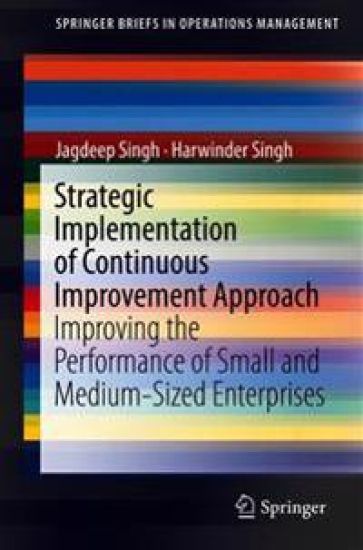
Strategic Implementation of Continuous Improvement Approach

Strategic Implementation of Continuous Improvement Approach

Jagdeep Singh; Harwinder Singh

Springer International Publishing AG
2018
nidottu
This book covers the strategic use of continuous improvement (CI) techniques for manufacturing performance improvement. It focuses primarily on strategies that can be adopted by small and middle-sized enterprises in manufacturing in order to meet the global challenges and competition. The book begins with an introduction to CI (or Kaizen), explaining different CI approaches and strategies. Chapter 2 offers a literature review of CI, examining conceptual frameworks, case studies, and surveys. Next, the book deals with the design of the study, detailing the work done in each phase along with the tools, techniques and models. Chapter 4 presents a detailed survey to determine the present status of continuous improvement strategies in the Indian manufacturing industry, to assess the important barriers that effect the implementation of CI strategies, and to also assess the role of key enablers leading to improve the performance of manufacturing operations. Chapter 5 is comprised of detailedcase studies to further analyze the application of the discussed CI strategies. The purpose of Chapter 6 is to develop the relationship among the different identified most important barriers in implementing CI approach using interpretive structural modeling (ISM) and classify these barriers depending upon their driving and dependence power. Finally Chapter 7 provides conclusions, addresses potential limitations, and also looks to the future.