Kirjojen hintavertailu. Mukana 12 657 676 kirjaa ja 12 kauppaa.

Kirjailija

Jaime Saavedra-Chanduvi

Kirjat ja teokset yhdessä paikassa: 3 kirjaa, julkaisuja vuosilta 2007-2014, suosituimpien joukossa Do Our Children Have a Chance?. Vertaile teosten hintoja ja tarkista saatavuus suomalaisista kirjakaupoista.

Mukana myös kirjoitusasut: Jaime Saavedra Chanduvi

3 kirjaa

Kirjojen julkaisuhaarukka 2007-2014.

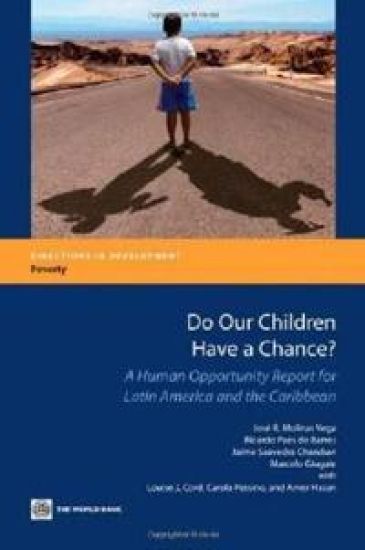
Do Our Children Have a Chance?

Do Our Children Have a Chance?

José R. Molinas Vega; Ricardo Paes de Barros; Jaime Saavedra Chanduvi; Marcelo Giugale

World Bank Publications
2011
nidottu
The Latin America and Caribbean (LAC) region is making progress in opening the doors of development to all. But it still has a long way to go. At the current pace, it would take, on average, a generation for the region to achieve universal access to the basic services that make for human opportunity. Intra-county regional disparities are large, and barely converging.This book assesses the status and evolution of human opportunity in LAC. It builds on the 2008 publication, Measuring Inequality of Opportunity, in several directions. First, it uses newly-available data to expand the set of opportunities and personal circumstances under analysis. The data is representative of some 200 million children living in 19 countries over the last 15 years. Second, it compares human opportunity in LAC with that of developed countries, among them the U.S. and France, two very different models of social policy. This allows for illuminating exercises in benchmarking and extrapolation. And third, it looks at human opportunity within countries - across regions, states and cities. This gives us a preliminary glimpse at the geographic dimension of equity, and at the role that different federal structures play.
Do African Children Have an Equal Chance?

Do African Children Have an Equal Chance?

Andrew Dabalen; Ambar Narayan; Jaime Saavedra-Chanduvi; Alejandro Hoyos Suarez

World Bank Publications
2014
nidottu
We have long known that a person's chance of success in life is deeply influenced by early access to education, health services, safe water, and nutritious food. This in turn improves the likelihood that a child can live up to his or her human potential and pursue a rewarding life. As Sub-Saharan Africa (SSA) enters its 20th year of unprecedented high economic growth and hopes continue to rise, its citizens increasingly wonder if these more hopeful economic times will translate into a better future for themselves and their families.This book - the first of its kind in SSA - documents and analyses how opportunities have changed over the past decade in 20 countries that are home to at least 7 in 10 African children. It finds that improving children's access to key services appears to be possible even in the poorest countries. And in most cases where progress has been rapid, policy initiatives have made a difference, bringing services to citizens and compensating for the inherent disadvantages they would otherwise have faced. The findings in this book remind us of the significant progress Sub-Saharan African countries have made in the last several decades, as well as the challenges that remain in ending extreme poverty and laying the foundations for shared prosperity.
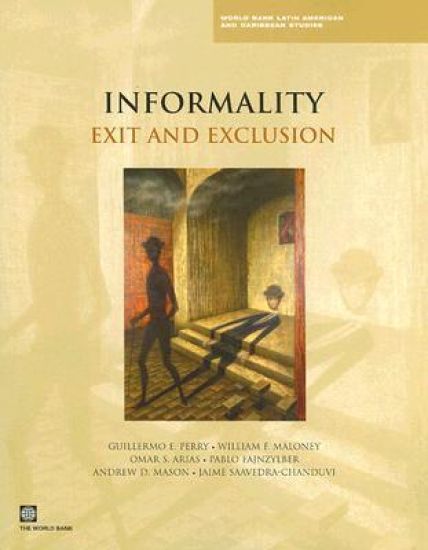
Informality

Informality

Guillermo Perry; Omar S. Arias; Pablo Fajnzylber; William F. Maloney; Andrew Mason; Jaime Saavedra-Chanduvi

World Bank Publications
2007
nidottu
Informality: Exit and Exclusion analyzes informality in Latin America, exploring root causes and reasons for and implications of its growth. The authors use two distinct but complementary lenses: informality driven by ""exclusion"" from state benefits or the circuits of the modern economy, and driven by voluntary ""exit"" decisions resulting from private cost-benefit calculations that lead workers and firms to opt out of formal institutions. They find both lenses have considerable explanatory power to understand the causes and consequences of informality in the region.""Informality: Exit and Exclusion"" concludes that reducing informality levels and overcoming the ""culture of informality"" will require actions to increase aggregate productivity in the economy, reform poorly designed regulations and social policies, and increase the legitimacy of the state by improving the quality and fairness of state institutions and policies. Although the study focuses on Latin America, its analysis, approach, and conclusions are relevant for all developing countries."" Informality: Exit and Exclusion"" will be of value to professionals and academics studying labor market, social protection, tax, microenterprise development, and urban public policies, and to those working in government, international organizations, research institutions, and universities.