Kirjojen hintavertailu. Mukana 12 294 744 kirjaa ja 12 kauppaa.

Kirjailija

Jak P Mallmann Showell

Kirjat ja teokset yhdessä paikassa: 10 kirjaa, julkaisuja vuosilta 2002-2025, suosituimpien joukossa Hitler's Attack U-Boats. Vertaile teosten hintoja ja tarkista saatavuus suomalaisista kirjakaupoista.

Mukana myös kirjoitusasut: Jak P. Mallmann Showell, Jak P. Mallmann-Showell

10 kirjaa

Kirjojen julkaisuhaarukka 2002-2025.

The Destruction of Hitler's U-boats

The Destruction of Hitler's U-boats

Jak P Mallmann Showell

PEN SWORD BOOKS LTD
2025
sidottu
Hitler’s U-boats posed a severe threat to Britain during the Second World War, endangering both its survival and the possibility of defeating Germany. Britain needed over a million tons of imports weekly to support the war effort, but Allied shipping losses were devastating. In June 1940, enemy submarines sank 284,113 tons of Allied shipping, a number that rose to 352,407 tons by October, while the Kriegsmarine lost only eight U-boats during the same period. Losses peaked in mid-1942, with 124 ships sunk in June, yet German U-boat casualties remained minimal. Replacement ships could not keep up with the mounting losses, and the Allies’ position grew increasingly precarious. The struggle against U-boats became a monumental effort. Jak P. Mallmann Showell’s book examines this battle in detail, focusing on Allied tactics, technologies, and innovations. Key strategies included radar, Enigma codebreaking, and the convoy system to combat German “wolfpacks.” Allied aircraft successfully drove U-boats from the British coast, while advances in sonar and weaponry, such as sonic torpedoes and rockets, gradually turned the tide of the battle.
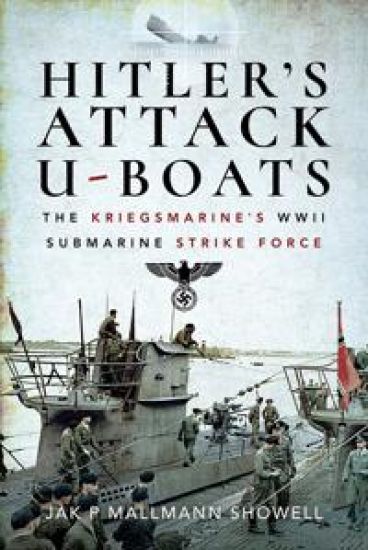
Hitler's Attack U-Boats

Hitler's Attack U-Boats

Jak P Mallmann Showell

Frontline Books
2020
sidottu
The success of German submarines during the First World War in almost cutting off Britain's vital imports had not been forgotten by Adolf Hitler and when, in March 1935, he repudiated the Treaty of Versailles, Britain, magnanimously, signed up to an Anglo-German Naval Agreement. This allowed the Germans to build their submarine strength up to one third of the British Royal Navy's tonnage. When war broke out in 1939, German U-boats went quickly into action, but with only four years of production and development, the main armament of these submarines was considerably weaker than equivalent boats in other navies and many of the other main features, such as living and the fighting conditions, were also significantly inferior. Nevertheless, the German U-boat onslaught against British merchant ships during the autumn of 1940 was highly successful because the attacks were made on the surface at night and from such close range that a single torpedo would sink a ship. Soon, though, Allied technology was able to detect U-boats at night, and new convoy techniques, combined with powerfully-armed, fast modern aircraft searching the seas, meant that by 1941 it was clear that Germany was losing the war at sea. Something had to be done. The new generation of attack U-boats that had been introduced since Hitler came to power needed urgent improvement. This is the story of the Types II, VII and IX that had already become the workhorse' of the Kriegsmarine's submarine fleet and continued to put out to sea to attack Allied shipping right up to the end of the war. The Type II was a small coastal boat that struggled to reach the Atlantic; the Type VII was perfectly at home there, but lacked the technology to tackle well protected convoys; whilst the Type IX was a long-range variety that was modified so that it could operate in the Indian Ocean. In this latest book by the renowned Kriegsmarine historian Jak Mallmann Showell, these attack U-boats are explored at length. This includes details of their armament, capabilities, crew facilities, and just what is was like to operate such a vessel, and of course the story of their development and operational history.
U Boats of the Second World War

U Boats of the Second World War

Jak P. Mallmann Showell

Fonthill Media
2017
nidottu
Ocean-going U-boats, each one not much longer than four European articulated lorries with up to sixty men inside them, sailed the far-off seas to reap havoc in hot inhospitable waters. The air forces and navies from Britain, the United States and other colonial countries followed to make this a daring and death-threatening venture. The facts of what the U-boats achieved against massive odds have been told before, but 'U-Boats of the Second World War: Their Longest Voyages' is different. It concentrates more on how it was done. How the men survived, how they lived and died and how they still found time to carry out their orders. The book is based on masses of previously unpublished documents from the German U-boat Museum, many of them written during or shortly after the war by men who survived this bitter conflict. This is the story of how specially built long-range ocean-going U-boats started out one step ahead of the Allied navies and air power, how they fell one step behind and how they finally vanished into the depths of the biggest and deepest oceans.This is a remarkable story of endurance, courage and comradeship that terrified the world for the most critical period of the Second World War. The author, Jak P. Mallmann Showell, is the son of a U-boat diesel mechanic who disappeared in those warm waters two months before the author was born.
U-Boats of the Second World War

U-Boats of the Second World War

Jak P Mallmann Showell

Fonthill Media
2013
sidottu
Ocean-going U-boats, each one not much longer than four European articulated lorries with up to sixty men inside them, sailed the far-off seas to reap havoc in hot inhospitable waters. The air forces and navies from Britain, the United States and other colonial countries followed to make this a daring and death-threatening venture. The facts of what the U-boats achieved against massive odds have been told before, but U-Boats of the Second World War: Their Longest Voyages is different. It concentrates more on how it was done. How the men survived, how they lived and died and how they still found time to carry out their orders. The book is based on masses of previously unpublished documents from the German U-boat Museum, many of them written during or shortly after the war by men who survived this bitter conflict. This is the story of how specially built long-range ocean-going U-boats started out one step ahead of the Allied navies and air power, how they fell one step behind and how they finally vanished into the depths of the biggest and deepest oceans. This is a remarkable story of endurance, courage and comradeship that terrified the world for the most critical period of the Second World War. The author, Jak P. Mallmann Showell, is the son of a U-boat diesel mechanic who disappeared in those warm waters two months before the author was born.
Hitler's Naval Bases

Hitler's Naval Bases

Jak P. Mallmann Showell

Fonthill Media
2012
sidottu
Hitler's U-boats and his dreaded pocket battleships such as Bismarck and Tirpitz - Churchill dubbed the latter as 'The Beast' - continue to fascinate an ever-growing interest in the Second World War. Despite a numerical disadvantage when compared the Royal Navy, Hitler's U-boats wrecked havoc in the Atlantic against vulnerable convoys and the doomed Bismarck took on the might of Britain's battleships in a mighty clash of the titans. Hitler's Naval Bases, a work of love that took the author over forty years to research and write, is the most comprehensive and dedicated book on the subject matter. A world's first, it covers bases in remarkable detail from the smallest and unmanned locations to the largest dedicated bases in Lorient, Kiel and Wilhemshaven. The book covers the different types of naval base from isolated and forgotten bases, escape and survival bases, to the extremities of the main naval bases. The functions and various departments - artillery, ship construction to dockyard medical service - are explained as are North Sea naval bases in Emden, The Weser Ports and Cuxhaven, Baltic ports, the major bases that never were ('The Lobster's Claw on Heligoland') to France, Asia and German colonies, including re-fuelling in Spain and bases located in Russia and in the 'Heart of England'. Also covered are naval artillery and naval infantry as well as the anatomy of coastal artillery batteries, the shipping yards and even rules for living in such conditions. A most lavish and phenomenal book, it is beautifully illustrated with over 200 unpublished photographs complemented with thousands of unique interviews with veterans during the war as well as survivors. A labour of love, Hitler's Naval Bases is written by a world's leading authoritarian figure and is an essential book for those interested in the armed forces of the Third Reich.
Modern Witchcraft:

Modern Witchcraft:

Jak P. Mallmann Showell

Fonthill Media
2012
sidottu
It is remarkable that a technically-minded Roman Catholic RAF fighter pilot, who studied physics at Scotland's oldest university and became a physical education teacher after the war, should find himself in close contact with a traditional witchcraft coven as early as 1942. This was outrageous and dangerous. The Witchcraft Act was not repealed until almost ten years later and the Old Religion, the pre-Christian religion of North-West Europe, was still banned. Yet, Bill Love (that's his real name) remained firmly attached to the concept of living in harmony with nature, and in 1953, he asked to join such a coven. The High Priestess, who initiated him, had herself been drawn into The Craft during the 1920s and often told stories of older members with memories going back to the end of the 19th century. So, Love's story has ancient roots with passed-on memories from a time when everything connected to this way of life was very much against the law. Love learned to live in harmony with nature from the experience of doing what these elders taught him and, in addition to this, during the 1950s, he met many of the famous people who first brought this innate way of life to the public's attention. This provided him with unique opportunities of following roots into spheres, which many modern practitioners of Wicca can only dream about.
Companion to the German Navy 1939-1945

Companion to the German Navy 1939-1945

Jak P Mallmann Showell

The History Press Ltd
2009
nidottu
Synonymous with such infamous battleships as the 'Bismarck', 'Scharnhorst' and 'Tirpitz', the German Navy (or Reichsmarine) was renamed the Kriegsmarine in 1935, shortly after the emergence of the Nazi State, and went through a major re-organization in 1939. During the Second World War, it became a much-feared adversary both on and beneath the high seas, with its marauding U-boat 'wolf packs' coming close to defeating Britain in the Battle of the Atlantic. Jak Showell examines the different roles of the Fleet, and its organization and training activities during the war years. Incidents and operations are described, together with technical data for ships, U-boats and their weaponry. A guide to German Navy uniforms and insignia is included, together with full details of rank structure and specialist trades.
Hitler's U-Boat Bunkers

Hitler's U-Boat Bunkers

Jak P Mallmann Showell

The History Press Ltd
2007
nidottu
Hitler’s submarines – the dreaded U-boats – played a vital role in Germany’s offensive operations across the world’s oceans during the Second World War and could have brought Britain to the brink of capitulation. To support his deadly undersea fleet, Hitler ordered monolithic bunkers to be constructed at strategically crucial sites, designed to withstand the most aggressive attack from the Allied forces. The author has uncovered previously unpublished accounts and visited many of the sites in France and Germany to detail the exact purpose of each base and reveal important new information about what remains at some of the most closely guarded sites.
Hitler's U-boat Bases

Hitler's U-boat Bases

Jak P Mallmann Showell

The History Press Ltd
2002
nidottu
This title provides a concise historical background to the rise of the Nazi U-boat fleet, and the part it played in World War II. The author examines in detail how and why each of the bases in France, Germany and Norway were designed and built, and how they were defended against attack.