Kirjojen hintavertailu. Mukana 12 390 323 kirjaa ja 12 kauppaa.

Kirjailija

James A. Robinson

Kirjat ja teokset yhdessä paikassa: 15 kirjaa, julkaisuja vuosilta 2010-2025, suosituimpien joukossa Narrow Corridor. Vertaile teosten hintoja ja tarkista saatavuus suomalaisista kirjakaupoista.

15 kirjaa

Kirjojen julkaisuhaarukka 2010-2025.

Varför är inte hela världen rik?  Om makt, tillväxt och teknik

Varför är inte hela världen rik? Om makt, tillväxt och teknik

Simon Johnson; James A. Robinson; Daron Acemoglu

Volante
2025
sidottu
Varför misslyckas vissa länder? Varför blomstrar andra? Hur påverkar maktbalans, teknologiska framsteg och historiska vägval utvecklingen i våra samhällen och nationer? I Varför är inte hela världen rik? presenteras utdrag från tre banbrytande verk skrivna av Daron Acemo lu, James A. Robinson och Simon Johnson mottagare av Sveriges Riksbanks pris i ekonomisk vetenskap till Alfred Nobels minne 2024. Här undersöks hur institutioner, makt och teknik formar världen. Why nations fail förklarar hur inkluderande institutioner bygger välstånd medan exploaterande institutioner leder till stagnation. The narrow corridor utforskar balansen mellan statlig makt och samhällsfrihet och varför vissa nationer lyckas skapa demokratiskt välstånd. Power and progress visar hur teknologi, från den industriella revolutionen till dagens AI, kan driva utveckling eller fördjupa klyftor. Boken kompletteras med analyser och introduktioner av ledande svenska forskare, som sätter texterna i både en svensk och global kontext. För alla som är nyfikna på världens ekonomiska och politiska utveckling är detta en inspirerande och tankeväckande läsning ett måste för alla som vill förstå de krafter som inte bara format vår historia utan också formar vår framtid.

JSA: the Golden Age (New Edition)

JSA: the Golden Age (New Edition)

James A. Robinson; Paul Smith

DC Comics
2024
nidottu
Critically acclaimed author James Robinson's book JSA: THE GOLDEN AGE is printed in a new edition! Presenting the thought-provoking alternate comic book-history tale of the Justice Society of America in a new edition. The JSA, the heroes of WWII, find themselves face to face with a new kind of oppression in McCarthy Era America! Some of the greatest heroes of the 1940s, including the original Green Lantern, Atom, Hawkman and Starman, among others, return in this epic tale. The story follows their postwar adventures as they battle evil in a world they fear may no longer need them. And as their importance wanes, a new hero, Dynaman, rallies the nation behind a fascist agenda... Collects JSA: THE GOLDEN AGE #1-4.
Por Qué Fracasan Los Países: Los Orígenes del Poder, La Prosperidad Y La Pobreza / Why Nations Fail: Los Orígenes del Poder, La Prosperidad Y La Pobre
BESTSELLER DEL NEW YORK TIMES Y WALL STREET JOURNAL. De dos ganadores del Premio Nobel de Ciencias Econ micas 2024, "que han demostrado la importancia de las instituciones sociales para la prosperidad de un pa s". Qu determina que un pa s sea rico o pobre? C mo se explica que, en condiciones similares, en algunos pa ses haya hambrunas y en otros no? Qu papel juega la pol tica en estas cuestiones?Que algunas naciones sean m s pr speras que otras, se debe a cuestiones culturales?, a los efectos de la climatolog a?, a su ubicaci n geogr fica? No, en absoluto.Ninguna cuesti n relativa a la prosperidad de un pa s est relacionada con estos factores, sino proviene de otro mucho m s tangible: la pol tica econ mica que dictaminan sus dirigentes.Son los l deres de cada pa s, afirman los reconocidos profesores Daron Acemoglu y James A. Robinson en este libro, quienes determinan con sus pol ticas la prosperidad de su territorio, y as ha ocurrido en todos los per odos de la historia, como demuestran en este apasionante estudio.ENGLISH DESCRIPTIONNEW YORK TIMES AND WALL STREET JOURNAL BESTSELLER From two winners of the 2024 Nobel Prize in Economic Sciences, "who have demonstrated the importance of societal institutions for a country's prosperity. Brilliant and engagingly written, Why Nations Fail answers the question that has stumped the experts for centuries: Why are some nations rich and others poor, divided by wealth and poverty, health and sickness, food and famine?Is it culture, the weather, geography? Perhaps ignorance of what the right policies are? Simply, no. None of these factors is either definitive or destiny. Otherwise, how to explain why Botswana has become one of the fastest growing countries in the world, while other African nations, such as Zimbabwe, the Congo, and Sierra Leone, are mired in poverty and violence? Daron Acemoglu and James Robinson conclusively show that it is man-made political and economic institutions that underlie economic success (or lack of it). Korea, to take just one of their fascinating examples, is a remarkably homogeneous nation, yet the people of North Korea are among the poorest on earth while their brothers and sisters in South Korea are among the richest. The south forged a society that created incentives, rewarded innovation, and allowed everyone to participate in economic opportunities.Why Nations Fail will change the way you look at--and understand--the world.
Narrow Corridor

Narrow Corridor

Daron Acemoglu; James A. Robinson

Penguin
2020
pokkari
By the authors of the international bestseller Why Nations Fail, based on decades of research, this powerful new big-picture framework explains how some countries develop towards and provide liberty while others fall to despotism, anarchy or asphyxiating norms - and explains how liberty can thrive despite new threats. Liberty is hardly the 'natural' order of things; usually states have been either too weak to protect individuals or too strong for people to protect themselves from despotism. There is also a happy Western myth that where liberty exists, it's a steady state, arrived at by 'enlightenment'. But liberty emerges only when a delicate and incessant balance is struck between state and society - between elites and citizens. This struggle becomes self-reinforcing, inducing both state and society to develop a richer array of capacities, thus affecting the peacefulness of societies, the success of economies and how people experience their daily lives. Explaining this new framework through compelling stories from around the world, in history and from today - and through a single diagram on which the development of any state can be plotted - this masterpiece helps us understand the past and present, and analyse the future. 'In this highly original and gratifying fresco, Daron Acemoglu and Jim Robinson take us on a journey through civilizations, time and locations. Their narrow corridor depicts the constant and often unstable struggle of society to keep the Leviathan in check and of the Leviathan to weaken the cage of norms. A remarkable achievement that only they could pull off and that seems destined to repeat the stellar performance of Why Nations Fail' Jean Tirole, Nobel Laureate in Economics, 2014 'Another outstanding, insightful book by Acemoglu and Robinson on the importance and difficulty of getting and maintaining a successful democratic state. Packed with examples and analysis, it is a pleasure to read' Peter Diamond, Nobel Laureate in Economics, 2010 'The Narrow Corridor takes us on a fascinating journey, across continents and through human history, to discover the critical ingredient of liberty. It finds that it's up to each of us: that ingredient is our own commitments, as citizens, to support democratic values. In these times, there can be no more important message - nor any more important book' George Akerlof, Nobel Laureate in Economics, 2001 'How should we view the current challenges facing our democracies? This brilliant, timely book offers a simple, powerful framework for assessing alternative forms of social governance. The analysis is a reminder that it takes vigilance to maintain a proper balance between the state and society - to stay in the 'narrow corridor' - and avoid falling either into statelessness or dictatorship' Bengt Holmstrom, Nobel Laureate in Economics, 2016.
The Narrow Corridor: States, Societies, and the Fate of Liberty

The Narrow Corridor: States, Societies, and the Fate of Liberty

Daron Acemoglu; James a. Robinson

PENGUIN BOOKS
2020
nidottu
From the winners of the 2024 Nobel Prize for Economics and the authors of the international bestseller Why Nations Fail "Why is it so difficult to develop and sustain liberal democracy? The best recent work on this subject comes from a remarkable pair of scholars, Daron Acemoglu and James A. Robinson. In their latest book, The Narrow Corridor, they have answered this question with great insight." --Fareed Zakaria, The Washington Post In Why Nations Fail, Daron Acemoglu and James A. Robinson argued that countries rise and fall based not on culture, geography, or chance, but on the power of their institutions. In their new book, they build a new theory about liberty and how to achieve it, drawing a wealth of evidence from both current affairs and disparate threads of world history. Liberty is hardly the "natural" order of things. In most places and at most times, the strong have dominated the weak and human freedom has been quashed by force or by customs and norms. Either states have been too weak to protect individuals from these threats, or states have been too strong for people to protect themselves from despotism. Liberty emerges only when a delicate and precarious balance is struck between state and society. There is a Western myth that political liberty is a durable construct, arrived at by a process of "enlightenment." This static view is a fantasy, the authors argue. In reality, the corridor to liberty is narrow and stays open only via a fundamental and incessant struggle between state and society: The authors look to the American Civil Rights Movement, Europe's early and recent history, the Zapotec civilization circa 500 BCE, and Lagos's efforts to uproot corruption and institute government accountability to illustrate what it takes to get and stay in the corridor. But they also examine Chinese imperial history, colonialism in the Pacific, India's caste system, Saudi Arabia's suffocating cage of norms, and the "Paper Leviathan" of many Latin American and African nations to show how countries can drift away from it, and explain the feedback loops that make liberty harder to achieve. Today we are in the midst of a time of wrenching destabilization. We need liberty more than ever, and yet the corridor to liberty is becoming narrower and more treacherous. The danger on the horizon is not "just" the loss of our political freedom, however grim that is in itself; it is also the disintegration of the prosperity and safety that critically depend on liberty. The opposite of the corridor of liberty is the road to ruin.
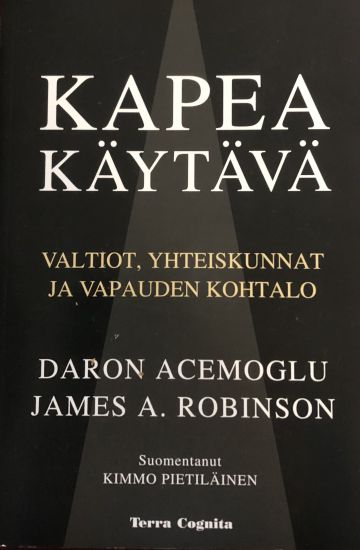
Kapea käytävä

Kapea käytävä

Daron Acemoglu; James A. Robinson

Terra Cognita
2020
nidottu
Miksi maat kaatuvat? -teoksen tekijät esittelevät tässä teoksessa uuden tavan tarkastella, miksi vapaus kukoistaa joissakin valtioissa, mutta jää muissa itsevaltiuden tai anarkian jalkoihin, ja miten vapaus voi kukoistaa uusista uhista huolimatta.Vapaus ei ole asioiden “luonnollinen” tila. Miltei aina vahvat ovat alistaneet heikot ja voima ja normit ovat murskanneet ihmisen vapauden. Valtio on ollut niin heikko, että se ei ole kyennyt suojelemaan yksilöitä alistavilta normeilta tai niin vahva, että ihmiset eivät ole kyennet suojautumaan despooteilta.Vapaus ilmaantuu vain, kun yhteiskunta mobilisoituu, osallistuu aktiivisesti politiikkaan ja pitää puolensa valtiota ja eliittejä vastaan. Samalla valtion on oltava riittävän vahva suojatakseen ihmisiä anarkialta ja yhteisön mielivaltaiselta normistolta.Vapaus ei ole vakiintunut tila, vaan pikemmin valtion ja yhteiskunnan välissä jatkuvasti elävä kapea käytävä, jonka säilyttäminen edellyttää valtion ja yhteiskunnan jatkuvaa kamppailua. Ilman sitä vapaus katoaa joko despotismiin tai anarkiaan.Acemoglu ja Robinson kertovat tässä teoksessa, miten valtion ja yhteiskunnan kamppailusta voi tulla itseään vahvistava ja vapauden säilyttävä.
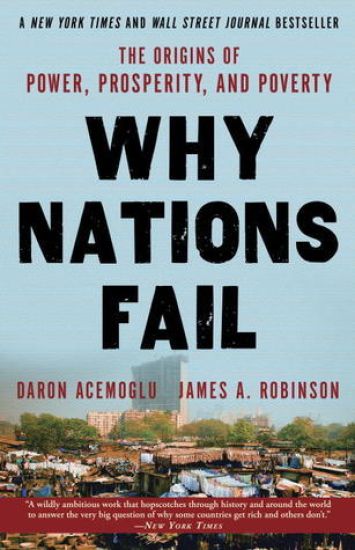
Why Nations Fail: The Origins of Power, Prosperity, and Poverty

Why Nations Fail: The Origins of Power, Prosperity, and Poverty

Daron Acemoglu; James a. Robinson

Crown Currency
2013
nidottu
NEW YORK TIMES AND WALL STREET JOURNAL BESTSELLER - From two winners of the 2024 Nobel Prize in Economic Sciences, "who have demonstrated the importance of societal institutions for a country's prosperity" "A wildly ambitious work that hopscotches through history and around the world to answer the very big question of why some countries get rich and others don't."--The New York Times FINALIST: Financial Times and Goldman Sachs Business Book of the Year Award - ONE OF THE BEST BOOKS OF THE YEAR: The Washington Post, Financial Times, The Economist, BusinessWeek, Bloomberg, The Christian Science Monitor, The Plain Dealer Why are some nations rich and others poor, divided by wealth and poverty, health and sickness, food and famine? Is it culture, the weather, or geography that determines prosperity or poverty? As Why Nations Fail shows, none of these factors is either definitive or destiny. Drawing on fifteen years of original research, Daron Acemoglu and James Robinson conclusively show that it is our man-made political and economic institutions that underlie economic success (or the lack of it). Korea, to take just one example, is a remarkably homogenous nation, yet the people of North Korea are among the poorest on earth while their brothers and sisters in South Korea are among the richest. The differences between the Koreas is due to the politics that created those two different institutional trajectories. Acemoglu and Robinson marshal extraordinary historical evidence from the Roman Empire, the Mayan city-states, the Soviet Union, the United States, and Africa to build a new theory of political economy with great relevance for the big questions of today, among them: - Will China's economy continue to grow at such a high speed and ultimately overwhelm the West? - Are America's best days behind it? Are we creating a vicious cycle that enriches and empowers a small minority? "This book will change the way people think about the wealth and poverty of nations . . . as ambitious as Jared Diamond's Guns, Germs, and Steel."--BusinessWeek
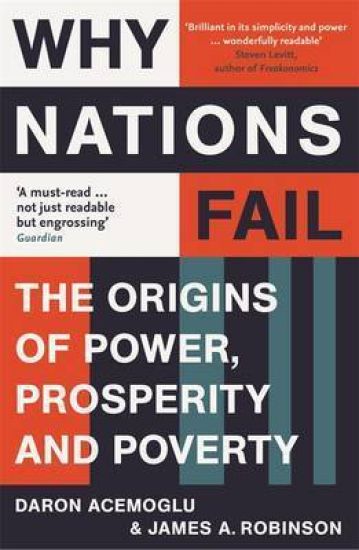
Why Nations Fail

Why Nations Fail

Daron Acemoglu; James A. Robinson

Profile Books Ltd
2013
pokkari
BY THE NOBEL PRIZE-WINNING ECONOMISTS DARON ACEMOGLU & JAMES A. ROBINSON Shortlisted for the Financial Times Business Book of the Year Award Why are some nations more prosperous than others? Why Nations Fail sets out to answer this question, with a compelling and elegantly argued new theory: that it is not down to climate, geography or culture, but because of institutions. Drawing on an extraordinary range of contemporary and historical examples, from ancient Rome through the Tudors to modern-day China, leading academics Daron Acemoglu and James A. Robinson show that to invest and prosper, people need to know that if they work hard, they can make money and actually keep it - and this means sound institutions that allow virtuous circles of innovation, expansion and peace. Based on fifteen years of research, and answering the competing arguments of authors ranging from Max Weber to Jeffrey Sachs and Jared Diamond, Acemoglu and Robinson step boldly into the territory of Francis Fukuyama and Ian Morris. They blend economics, politics, history and current affairs to provide a new, powerful and persuasive way of understanding wealth and poverty.
Miksi maat kaatuvat

Miksi maat kaatuvat

Daron Acemoglu; James A. Robinson

Terra Cognita
2013
nidottu
Kaatavatko kulttuuri, ilmasto vai maantiede maat? Vai kenties tietämättömyys oikeista toimenpiteistä?Ei. Yksikään näistä tekijöistä ei ole ratkaiseva tai kohtalo. Miten siis selitetään se, että Botswanasta on tullut yksi maailman nopeimmin kasvatista maista, mutta Zimbabwen, Kongon tai Sierra Leonen kaltaiset Afrikan valtiot ovat juuttuneet köyhyyteen ja väkivaltaan?Daron Acemoglu ja James A. Robinson osoittavat kiistatta ja monin modernein ja historiasta otetuin esimerkein, että ihmisen itsensä rakentamat poliittiset ja taloudelliset instituutiot ovat taloudellisen menestyksen (tai sen puuttumisen) perusta.Viisitoista vuotta kestäneen tutkimustyönsä perusteella Acemoglu ja Robinson jakavat instituutiot kahteen luokkaan: inklusiivisiin ja ekstraktiivisiin. Inklusiiviset ottavat kaikki kansalaiset yhteiskunnan toimintaan ja luovat heille kannustimet omatoimisuudelle ja menestykselle. Ekstraktiiviset instituutiot taas vievät kansalaisten työn tulokset ja käytännössä tukahduttavat kehityksen.Ja inklusiiviset instituutiot ovat normina vauraissa maissa.Teoriansa pohjalta Acemoglu ja Robinson tarttuvat muun muassa seuraaviin ongelmiin: Kiina on rakentanut auktoritaarisuuteen perustuvan kasvun. Jatkaako se samalla uralla ja ottaa lännen kiinni?Ovatko Yhdysvaltain parhaat päivät takana? Onko se siirtymässä eliittien valtaa vastustavasta hyvästä kierteestä noidankehään, joka rikastuttaa pientä vähemmistöä ja antaa sille kaiken vallan?Mikä on tehokkain tapa auttaa köyhyyteen juuttuneet miljardit vaurauteen johtavalle tielle?
Survey Research

Survey Research

Charles Herbert Backstrom; Gerald D. Hursh-Cesar; James A. Robinson

Literary Licensing, LLC
2012
sidottu
Survey Research by Charles Herbert Backstrom is a comprehensive guide to conducting surveys in social science research. The book covers all aspects of survey research, from designing and implementing surveys to analyzing and presenting survey data. It begins by discussing the basics of survey research, including the different types of surveys and the advantages and disadvantages of each. It then delves into the process of designing a survey, including selecting a sample, creating survey questions, and pretesting the survey. The book also covers the various modes of survey administration, such as mail, phone, and online surveys, and provides advice on how to choose the best mode for a particular study. The next section of the book focuses on data collection and management, including techniques for maximizing response rates, minimizing nonresponse bias, and ensuring data quality. It also covers the use of computer-assisted survey methods and the importance of data confidentiality and ethical considerations in survey research. The final section of the book is devoted to data analysis and reporting, including techniques for analyzing survey data, such as descriptive statistics, correlation, and regression analysis. It also covers how to present survey findings in a clear and concise manner, including the use of tables, graphs, and charts. Throughout the book, Backstrom provides numerous examples and practical advice based on his extensive experience in survey research. Overall, Survey Research is an essential resource for anyone involved in conducting surveys in social science research, including students, researchers, and practitioners. It provides a thorough and accessible guide to all aspects of survey research, from designing and implementing surveys to analyzing and presenting survey data, and is an invaluable reference for anyone seeking to conduct high-quality survey research.This scarce antiquarian book is a facsimile reprint of the old original and may contain some imperfections such as library marks and notations. Because we believe this work is culturally important, we have made it available as part of our commitment for protecting, preserving, and promoting the world's literature in affordable, high quality, modern editions, that are true to their original work.
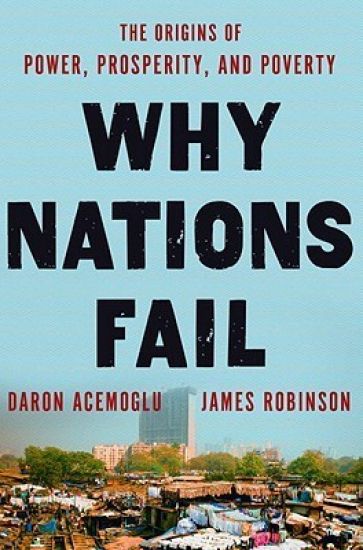
Why Nations Fail: The Origins of Power, Prosperity, and Poverty

Why Nations Fail: The Origins of Power, Prosperity, and Poverty

Daron Acemoglu; James a. Robinson

Crown Currency
2012
sidottu
NEW YORK TIMES AND WALL STREET JOURNAL BESTSELLER - From two winners of the 2024 Nobel Prize in Economic Sciences, "who have demonstrated the importance of societal institutions for a country's prosperity" "A wildly ambitious work that hopscotches through history and around the world to answer the very big question of why some countries get rich and others don't."--The New York Times FINALIST: Financial Times and Goldman Sachs Business Book of the Year Award - ONE OF THE BEST BOOKS OF THE YEAR: The Washington Post, Financial Times, The Economist, BusinessWeek, Bloomberg, The Christian Science Monitor, The Plain Dealer Why are some nations rich and others poor, divided by wealth and poverty, health and sickness, food and famine? Is it culture, the weather, or geography that determines prosperity or poverty? As Why Nations Fail shows, none of these factors is either definitive or destiny. Drawing on fifteen years of original research, Daron Acemoglu and James Robinson conclusively show that it is our man-made political and economic institutions that underlie economic success (or the lack of it). Korea, to take just one example, is a remarkably homogenous nation, yet the people of North Korea are among the poorest on earth while their brothers and sisters in South Korea are among the richest. The differences between the Koreas is due to the politics that created those two different institutional trajectories. Acemoglu and Robinson marshal extraordinary historical evidence from the Roman Empire, the Mayan city-states, the Soviet Union, the United States, and Africa to build a new theory of political economy with great relevance for the big questions of today, among them: - Will China's economy continue to grow at such a high speed and ultimately overwhelm the West? - Are America's best days behind it? Are we creating a vicious cycle that enriches and empowers a small minority? "This book will change the way people think about the wealth and poverty of nations . . . as ambitious as Jared Diamond's Guns, Germs, and Steel."--BusinessWeek