Kirjojen hintavertailu. Mukana 12 390 323 kirjaa ja 12 kauppaa.

Kirjailija

James A. Stimson

Kirjat ja teokset yhdessä paikassa: 12 kirjaa, julkaisuja vuosilta 1990-2021, suosituimpien joukossa Ideology in America. Vertaile teosten hintoja ja tarkista saatavuus suomalaisista kirjakaupoista.

12 kirjaa

Kirjojen julkaisuhaarukka 1990-2021.

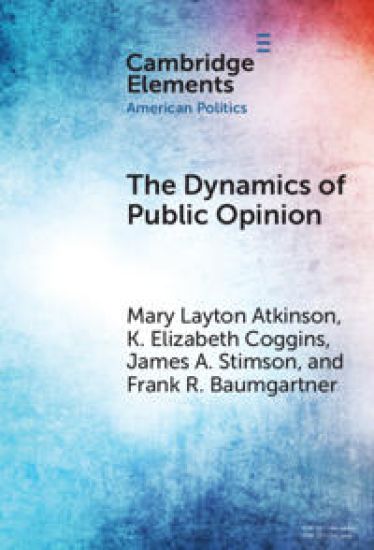
The Dynamics of Public Opinion

The Dynamics of Public Opinion

Mary Layton Atkinson; K. Elizabeth Coggins; James A. Stimson; Frank R. Baumgartner

Cambridge University Press
2021
sidottu
A central question in political representation is whether government responds to the people. To understand that, we need to know what the government is doing, and what the people think of it. We seek to understand a key question necessary to answer those bigger questions: How does American public opinion move over time? We posit three patterns of change over time in public opinion, depending on the type of issue. Issues on which the two parties regularly disagree provide clear partisan cues to the public. For these party-cue issues we present a slight variation on the thermostatic theory from (Soroka and Wlezien (2010); Wlezien (1995)); our “implied thermostatic model.” A smaller number of issues divide the public along lines unrelated to partisanship, and so partisan control of government provides no relevant clue. Finally, we note a small but important class of issues which capture response to cultural shifts.
The Dynamics of Public Opinion

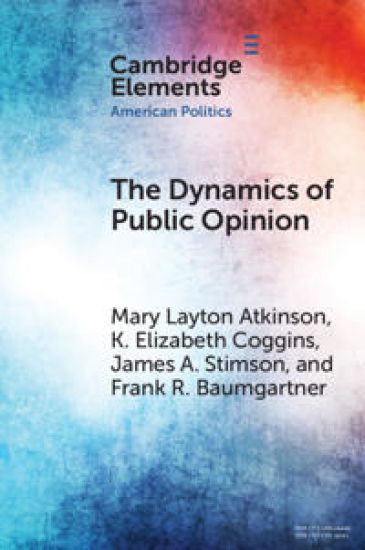
The Dynamics of Public Opinion

Mary Layton Atkinson; K. Elizabeth Coggins; James A. Stimson; Frank R. Baumgartner

Cambridge University Press
2021
pokkari
A central question in political representation is whether government responds to the people. To understand that, we need to know what the government is doing, and what the people think of it. We seek to understand a key question necessary to answer those bigger questions: How does American public opinion move over time? We posit three patterns of change over time in public opinion, depending on the type of issue. Issues on which the two parties regularly disagree provide clear partisan cues to the public. For these party-cue issues we present a slight variation on the thermostatic theory from (Soroka and Wlezien (2010); Wlezien (1995)); our “implied thermostatic model.” A smaller number of issues divide the public along lines unrelated to partisanship, and so partisan control of government provides no relevant clue. Finally, we note a small but important class of issues which capture response to cultural shifts.
Converging on Truth

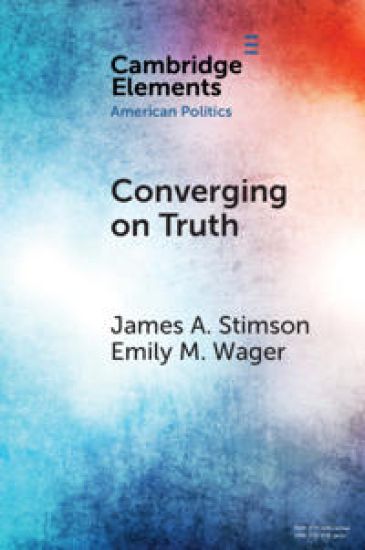
Converging on Truth

James A. Stimson; Emily M. Wager

Cambridge University Press
2020
pokkari
Much of the science of public opinion focuses on individuals, asking if they perceive or misperceive and why. Often this science will emphasize misperceptions and the psychological processes that produce them. But political debates have outcomes in the aggregate. This Element turns to a more systematic approach, emphasizing whole electorates and examining facts through a dynamic lens. It argues public opinion will converge toward truth over time and frequently finds correct views of facts grow stronger under information flow, while misperception recedes.
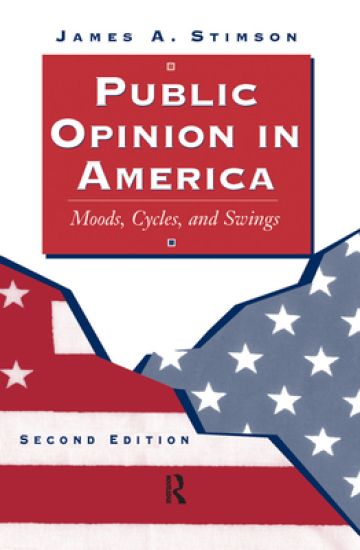
Public Opinion In America

Public Opinion In America

James A. Stimson

Routledge
2019
sidottu
Public opinion matters. It registers itself on the public consciousness, translates into politics and policy, and impels politicians to run for office and, once elected, to serve in particular ways.This is a book about opinion?not opinions. James Stimson takes the incremental, vacillating, time-trapped data points of public opinion surveys and tran
Tides of Consent

Tides of Consent

James A. Stimson

Cambridge University Press
2015
sidottu
Politics is a trial in which those in government - and those who aspire to serve - make proposals, debate alternatives, and pass laws. Then the jury of public opinion decides. It likes the proposals or actions or it does not. It trusts the actors or it does not. It moves, always at the margin, and then those who benefit from the movement are declared winners. This book is about that public opinion response. Its most basic premise is that although public opinion rarely matters in a democracy, public opinion change is the exception. Public opinion rarely matters because the public rarely cares enough to act on its concerns or preferences. Change happens only when the threshold of normal public inattention is crossed. When public opinion changes, governments rise or fall, elections are won or lost, and old realities give way to new demands.
Mandate Politics

Mandate Politics

Lawrence J. Grossback; David A. M. Peterson; James A. Stimson

Cambridge University Press
2012
pokkari
Whether or not voters consciously use their votes to send messages about their preferences for public policy, the Washington community sometimes comes to believe that it has heard such a message. In this 2006 book the authors ask 'What then happens?' They focus on these perceived mandates - where they come from and how they alter the behaviors of members of Congress, the media, and voters. These events are rare. Only three elections in post-war America (1964, 1980 and 1994) were declared mandates by the media consensus. These declarations, however, had a profound if ephemeral impact on members of Congress. They altered the fundamental gridlock that prevents Congress from adopting major policy changes. The responses by members of Congress to these three elections are responsible for many of the defining policies of this era. Despite their infrequency, then, mandates are important to the face of public policy.
Ideology in America

Ideology in America

Christopher Ellis; James A. Stimson

Cambridge University Press
2012
pokkari
Public opinion in the United States contains a paradox. The American public is symbolically conservative: it cherishes the symbols of conservatism and is more likely to identify as conservative than as liberal. Yet at the same time, it is operationally liberal, wanting government to do and spend more to solve a variety of social problems. This book focuses on understanding this contradiction. It argues that both facets of public opinion are real and lasting, not artifacts of the survey context or isolated to particular points in time. By exploring the ideological attitudes of the American public as a whole, and the seemingly conflicted choices of individual citizens, it explains the foundations of this paradox. The keys to understanding this large-scale contradiction, and to thinking about its consequences, are found in Americans' attitudes with respect to religion and culture and in the frames in which elite actors describe policy issues.
Ideology in America

Ideology in America

Christopher Ellis; James A. Stimson

Cambridge University Press
2012
sidottu
Public opinion in the United States contains a paradox. The American public is symbolically conservative: it cherishes the symbols of conservatism and is more likely to identify as conservative than as liberal. Yet at the same time, it is operationally liberal, wanting government to do and spend more to solve a variety of social problems. This book focuses on understanding this contradiction. It argues that both facets of public opinion are real and lasting, not artifacts of the survey context or isolated to particular points in time. By exploring the ideological attitudes of the American public as a whole, and the seemingly conflicted choices of individual citizens, it explains the foundations of this paradox. The keys to understanding this large-scale contradiction, and to thinking about its consequences, are found in Americans' attitudes with respect to religion and culture and in the frames in which elite actors describe policy issues.
Mandate Politics

Mandate Politics

Lawrence J. Grossback; David A. M. Peterson; James A. Stimson

Cambridge University Press
2006
sidottu
Whether or not voters consciously use their votes to send messages about their preferences for public policy, the Washington community sometimes comes to believe that it has heard such a message. In this 2006 book the authors ask 'What then happens?' They focus on these perceived mandates - where they come from and how they alter the behaviors of members of Congress, the media, and voters. These events are rare. Only three elections in post-war America (1964, 1980 and 1994) were declared mandates by the media consensus. These declarations, however, had a profound if ephemeral impact on members of Congress. They altered the fundamental gridlock that prevents Congress from adopting major policy changes. The responses by members of Congress to these three elections are responsible for many of the defining policies of this era. Despite their infrequency, then, mandates are important to the face of public policy.
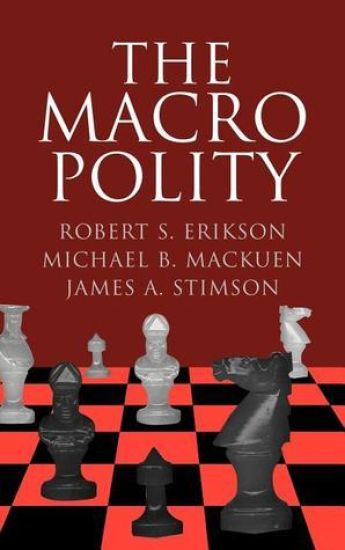
The Macro Polity

The Macro Polity

Robert S. Erikson; Michael B. Mackuen; James A. Stimson

Cambridge University Press
2002
pokkari
The Macro Polity provides the first comprehensive model of American politics at the system level. Focusing on the interactions between citizen evaluations and preferences, government activity and policy, and how the combined acts of citizens and governments influence one another over time, it integrates understandings of matters such as economic outcomes, presidential approval, partisanship, elections, and government policy-making into a single model. Borrowing from the perspective of macroeconomics, it treats electorates, politicians, and governments as unitary actors, making decisions in response to the behavior of other actors. The macro and longitudinal focus makes it possible to directly connect the behaviors of electorate and government. The surprise of macro-level analysis, emerging anew in every chapter, is that order and rationality dominate explanations. This book argues that the electorates and governments that emerge from these analyses respond to one another in orderly and predictable ways.
The Macro Polity

The Macro Polity

Robert S. Erikson; Michael B. Mackuen; James A. Stimson

Cambridge University Press
2001
sidottu
The Macro Polity, first published in 2002, provides a comprehensive model of American politics at the system level. Focusing on the interactions between citizen evaluations and preferences, government activity and policy, and how the combined acts of citizens and governments influence one another over time, it integrates understandings of matters such as economic outcomes, presidential approval, partisanship, elections, and government policy-making into a single model. Borrowing from the perspective of macroeconomics, it treats electorates, politicians, and governments as unitary actors, making decisions in response to the behavior of other actors. The macro and longitudinal focus makes it possible to directly connect the behaviors of electorate and government. The surprise of macro-level analysis, emerging anew in every chapter, is that order and rationality dominate explanations. This book argues that the electorates and governments that emerge from these analyses respond to one another in orderly and predictable ways.