Kirjailija
James Allan
Kirjat ja teokset yhdessä paikassa: 26 kirjaa, julkaisuja vuosilta 1973-2025, suosituimpien joukossa Under the Dragon Flag. Vertaile teosten hintoja ja tarkista saatavuus suomalaisista kirjakaupoista.
26 kirjaa
Kirjojen julkaisuhaarukka 1973-2025.
Neil Denton, a psychology researcher, has reached a crisis in his career: he no longer believes in research, despite its claim to control variables. Everything seems pointless; nothing is proved. No matter how meticulous the research design, there is no way of knowing if there is some overlooked variable. Every study is challenged by a counter study. Dubbed his Hamlet Complex by Rachel Probender, he can't move forward, languishes in a state of inertia, his own PhD research into research at a standstill.Neil works in a department that specialises in replicating classic studies, led by Professor Matlock, famed for replicating Milgram's obedience research in England. Matlock has no doubts. For him, control of variables defines psychology as a science.Ironically, an uncontrolled variable has begun sabotaging the replications, making the department a target of media ridicule. But who and why? The saboteur is remarkably well informed, but who is the informer - a disgruntled insider perhaps?Rachel Probender, colleague and close friend of Neil, is researching the novel Frankenstein. Unknown to both, there is a connection between Frankenstein, the Psychology Department's celebrated research into obedience, and the sabotage. Suspected of being the informer, Neil, helped by Rachel, sets out to identify the informer and along the way resolves his own crisis. Set in the 1990s, the novel is a satire on the pitfalls of separate disciplines and the limitations of psychology as a science, and asks, what is science?
A Principled Constitution?
Steven D. Smith; Larry Alexander; James Allan; Maimon Schwarzschild
BLOOMSBURY PUBLISHING PLC
2024
nidottu
Is the United States Constitution the embodiment of certain principles? The four authors of this book for a variety of reasons, and with somewhat different emphases, believe the answer is no. Those who authored the Constitution no doubt all believed in liberty, equality, and, with caveats, republican self-government values, or if you will, principles. But they had different conceptions of those principles and what those principles entailed for constituting a government. Although the Constitution they created reflected, in some sense, their principles, the Constitution itself was a specific list of do’s and don’ts that its creators hoped would gain the allegiance of the newly independent and sovereign states. And, for somewhat different reasons, the authors of this book believe that was a good thing.
Mysteries of the Libyan Desert; A record of three years of exploration in the heart of that vast & waterless region (Edition1)
James Allan
Alpha Editions
2024
nidottu
Under the Dragon Flag; My Experiences in the Chino-Japanese War, a classical book, has been considered important throughout the human history, and so that this work is never forgotten we at Alpha Editions have made efforts in its preservation by republishing this book in a modern format for present and future generations. This whole book has been reformatted, retyped and designed. These books are not made of scanned copies of their original work and hence the text is clear and readable.
A Principled Constitution?
Steven D. Smith; Larry Alexander; James Allan; Maimon Schwarzschild
BLOOMSBURY PUBLISHING PLC
2022
sidottu
Is the United States Constitution the embodiment of certain principles? The four authors of this book for a variety of reasons, and with somewhat different emphases, believe the answer is no. Those who authored the Constitution no doubt all believed in liberty, equality, and, with caveats, republican self-government values, or if you will, principles. But they had different conceptions of those principles and what those principles entailed for constituting a government. Although the Constitution they created reflected, in some sense, their principles, the Constitution itself was a specific list of do’s and don’ts that its creators hoped would gain the allegiance of the newly independent and sovereign states. And, for somewhat different reasons, the authors of this book believe that was a good thing.
The Age of Foolishness is a doubter's guide to current lawyerly thinking about all things related to constitutionalism in a democracy. This book offers a thorough-going skeptical critique of the views that dominate our legal caste, including in law schools and among judges, and place too much weight on judges to resolve important social policy disputes and too little on democratic politics. The author argues that politics matters in a way that our legal orthodoxy often downplays.
Learn Ruth Bader Ginsburg 15 Mins Biography BookRead All About RBG from Birth to Death in 15 Minutes This is an unofficial tribute book to Ruth Bader Ginsburg from a fan for a fan to support his legacy. Here's a Short Sample What You'll See Inside the Book: On September 5, 2020, a flag-draped casket of Supreme Court Justice Ruth Bader Ginsburg was carried up the steps of the U.S. Capitol for her lying in state. With this, Ginsburg became the first woman to lie in state at the U.S. Capitol. Only 12 United States presidents have had the honor, and Ginsburg is only the second Supreme Court Justice to enter the reserved group. Chief Justice William Howard Taft, who was the first to get the honor, was also president. Before her death at the age of 87, Ginsburg was widely embraced as a feminist icon, an exceptional legal luminary, and a model for moral courage to pursue social justice. Her life and work have been celebrated in books and movies. Her achievements and what she stood for have been featured prominently in pop culture. From tattoos etched on people's shoulders to T-shirts bearing her initials. Ruth Bader Ginsburg was a widely celebrated judge. Ginsburg's life and career in law may have been star-spangled but her story runs much deeper that most people immediately see.Books of the time didn't really feature women as heroes or adventurers. Girls or women were mostly depicted as wearing beautiful pinks dresses, anything of the sort, and just sitting around not really doing anything interesting. However, among the books Ruth was fond of reading, she was quite attracted to a book featuring a young female detective, Nancy Drew. As Ginsburg later recollected, she loved the book because Nancy Drew, the main character, was smarter than her boyfriend and because she was daring and adventuresome. Perhaps consequently, many of Ginsburg's role models would be people that fit the Nancy Drew profile. Even from a young age, Ruth admired women who succeeded in traditionally reserved roles for men. Like Amelia Earhart, who set impressive precedence of succeeding as a pilot and a businesswoman. Ruth also admired the Greek goddess of wisdom and arts, Pallas Athena.You'll Soon Discover...Early Life and EducationBuilding Her Legal CareerGender Discrimination in Early CareerChampioning Gender EqualityGinsburg At The Court Of AppealsCareer At The Supreme CourtIn Her Own WordsDeath And Last DaysScroll Up and Download Now 100% Satisfaction Guaranteed or Your Money Back.
Market leaders need innovation to sustain their lead. Disruptors need innovation to become market leaders. While organizations in all industries need innovation, few business leaders are creating ecosystems which are able to grow and cultivate innovation. Meanwhile, employees in these organizations are coming up with ideas daily on how to create and sustain growth. But these ideas aren’t being heard, or aren’t being acted upon. So, while any business leader will tell you people are their most important resource, they are not being genuine! They seem to always prefer to go outside their organization to come up with big ideas that can help create and sustain revenue growth. Since innovation is necessary, and an organization’s people are their most important resources, Infectious Innovation will teach you how to systematically collect employee ideas, and then turn them into improved and sustainable profits.
The premise of this book is that a shift of vantage will help elucidate various important issues of law related to judging, to bills of rights and to more abstract questions of legal philosophy. The work begins by focussing on the jurisprudential issue of whether it is desirable to keep separate the demands of law and of morality and uses the device of changing vantages to elucidate the many issues that fall under that aegis. This is followed by a consideration of how judges ought to do their job when interpreting and whether the rule of law ideal differs from rule by judges. The last part of the book focuses explicitly on bills of rights. Building on the earlier parts, the author uses his device of shifting vantages to provide insights into how these instruments affect democratic decision-making and from which perspectives they will look attractive and unattractive. Written in a clear, accessible and engaging style, the book demonstrates that vantage point is a key criterion affecting how one understands and evaluates, firstly, some of the theoretical debates in jurisprudence and then, secondly, what judges are doing and whether a bill of rights is desirable or not.
Under the dragon flag. My experiences in the Chino-Japanese war
James Allan
Createspace Independent Publishing Platform
2016
nidottu
From Swinging to Smart: 1964 - 2014 How far have we come in 50 years ?
James Allan
Createspace Independent Publishing Platform
2015
nidottu
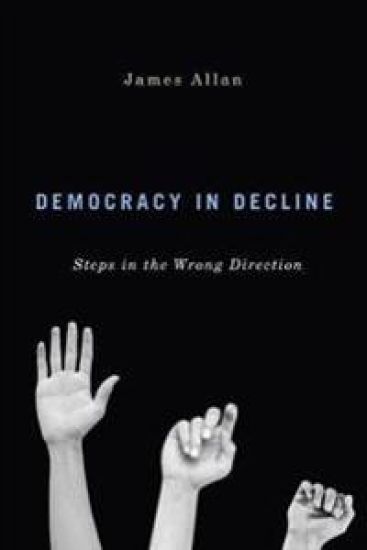
Part lament, part provocative call-to-action, Democracy in Decline charts how democracy is being diluted and restricted in five of the world's oldest democracies - the United States, Canada, the United Kingdom, Australia, and New Zealand. James Allan targets four main, interconnected causes of decline - judicial activism, the transformation and growth of international law, the development of supranational organizations, and the presence of undemocratic elites. He presents a convincing argument that the same trends are occurring whether the country has a constitutional bill of rights (United States and Canada), a statutory bill of rights (the United Kingdom and New Zealand), or no bill of rights at all (Australia). Identifying tactics used by lawyers, judges, and international bureaucrats to deny that any decline has occurred, Allan looks ahead to further deterioration caused by attacks on free speech, intolerant worldviews, internationalization through treaties and conventions, and illegal immigration. Social and political decisions, Allan argues, must be based on counting every adult in a nation state as equal. An essential book for anyone concerned with majority rule and fairness in numbers, Democracy in Decline presents a clear, well-stated account of trends that have been undermining democracy over three decades.
Under the Dragon Flag My Experiences in the Chino-Japanese War
James Allan
Tredition Classics
2013
sidottu
Under the Dragon Flag My Experiences in the Chino-Japanese War
James Allan
Tredition Classics
2013
pokkari
Musicians Eat Cakes: Connections, Coincidences and Similarities in the lives and deaths of pop and rock musicians
James Allan
Createspace Independent Publishing Platform
2012
nidottu
The premise of this book is that a shift of vantage will help elucidate various important issues of law related to judging, to bills of rights and to more abstract questions of legal philosophy. The work begins by focussing on the jurisprudential issue of whether it is desirable to keep separate the demands of law and of morality and uses the device of changing vantages to elucidate the many issues that fall under that aegis. This is followed by a consideration of how judges ought to do their job when interpreting and whether the rule of law ideal differs from rule by judges. The last part of the book focuses explicitly on bills of rights. Building on the earlier parts, the author uses his device of shifting vantages to provide insights into how these instruments affect democratic decision-making and from which perspectives they will look attractive and unattractive. Written in a clear, accessible and engaging style, the book demonstrates that vantage point is a key criterion affecting how one understands and evaluates, firstly, some of the theoretical debates in jurisprudence and then, secondly, what judges are doing and whether a bill of rights is desirable or not.