

Kirjailija
James Bernard Murphy
Kirjat ja teokset yhdessä paikassa: 16 kirjaa, julkaisuja vuosilta 1993-2026, suosituimpien joukossa The Art of Disagreement. Vertaile teosten hintoja ja tarkista saatavuus suomalaisista kirjakaupoista.
16 kirjaa
Kirjojen julkaisuhaarukka 1993-2026.

Deification in Classical Greek Philosophy and the Bible
James Bernard Murphy
Cambridge University Press
2025
pokkari
To be human is to strive to be better, and we cannot be better without knowing what is best. In ancient Greek philosophy and the Bible, what is best is god. Plato and Aristotle argue that the goal of human life is to become as much like god as is humanly possible. Despite its obvious importance, this theme of assimilation to god has been neglected in Anglo-American scholarship. Classical Greek philosophy is best understood as a religious quest for divinity by means of rational discipline. By showing how Greek philosophy grows out of ancient Greek religion and how the philosophical quest for god compares to the biblical quest, we see Plato and Aristotle properly as major religious thinkers. In their shared quest for divine perfection, Greek philosophy and the Bible have enough in common to make their differences deeply illuminating.

Deification in Classical Greek Philosophy and the Bible
James Bernard Murphy
Cambridge University Press
2024
sidottu
To be human is to strive to be better, and we cannot be better without knowing what is best. In ancient Greek philosophy and the Bible, what is best is god. Plato and Aristotle argue that the goal of human life is to become as much like god as is humanly possible. Despite its obvious importance, this theme of assimilation to god has been neglected in Anglo-American scholarship. Classical Greek philosophy is best understood as a religious quest for divinity by means of rational discipline. By showing how Greek philosophy grows out of ancient Greek religion and how the philosophical quest for god compares to the biblical quest, we see Plato and Aristotle properly as major religious thinkers. In their shared quest for divine perfection, Greek philosophy and the Bible have enough in common to make their differences deeply illuminating.
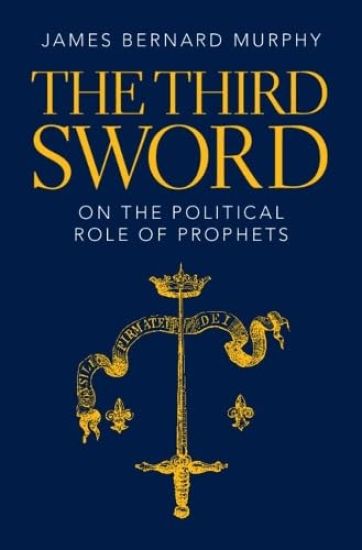
Prophets are wild cards in the game of politics, James Bernard Murphy writes in this startling new book. They risk their lives by calling out the abuses of political and religious leaders, forcing us to confront evils we would prefer to ignore. By setting moral limits on political leaders, prophets chasten our political pretensions and remind us there are values that transcend politics. They wield a third sword—distinct from the familiar swords of state and church power—their sword is the word of God. The Third Sword offers a new take on political history, illustrating a theory of prophetic politics through tales of political crises, interspersed with direct dialogue between the prophets and their persecutors. With chapters on Socrates, Jesus, Joan of Arc, Thomas More, and Martin Luther King, Murphy brings these prophets to life with storytelling that blends biography, history, and political theory.
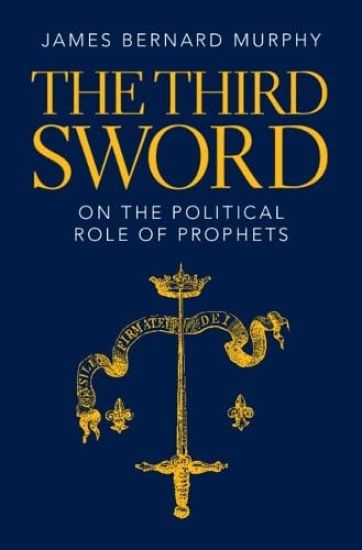
Prophets are wild cards in the game of politics, James Bernard Murphy writes in this startling new book. They risk their lives by calling out the abuses of political and religious leaders, forcing us to confront evils we would prefer to ignore. By setting moral limits on political leaders, prophets chasten our political pretensions and remind us there are values that transcend politics. They wield a third sword—distinct from the familiar swords of state and church power—their sword is the word of God. The Third Sword offers a new take on political history, illustrating a theory of prophetic politics through tales of political crises, interspersed with direct dialogue between the prophets and their persecutors. With chapters on Socrates, Jesus, Joan of Arc, Thomas More, and Martin Luther King, Murphy brings these prophets to life with storytelling that blends biography, history, and political theory.


The Bible today is weaponized by both liberals and conservatives, side cherry-picking their favorite verses. Have you ever wondered why the Bible lends itself to supporting contradictory positions in moral debates--why even the devil quotes Scripture? If so, you will enjoy this book. Haunted by Paradise reveals the unity and coherence of the Bible in the light of paradise. The Bible begins in Eden and ends in the new Jerusalem--in between, the Bible is haunted by the memory of paradise lost and the hope for paradise regained. With paradise as the interpretive key, Murphy unlocks biblical ethics. He shows that there is no Old Testament ethics or New Testament ethics--only a unified biblical ethics. In sixteen short chapters, this book addresses urgent moral questions about issues ranging from capital punishment to war, including divine justice, homosexuality, marriage, nature, racism, patriarchy, and work. In each chapter, Murphy shows how the Bible negotiates the tension between divine ideals and human realities.

A holistic view of human development that rejects the conventional stages of childhood, adulthood, and old age When we talk about human development, we tend to characterize it as proceeding through a series of stages in which we are first children, then adolescents, and finally, adults. But as James Bernard Murphy observes, growth is not limited to the young nor is decline limited to the aged. We are never trapped within the horizon of a particular life stage: children anticipate adulthood and adults recapture childhood. According to Murphy, the very idea of stages of life undermines our ability to see our lives as a whole. In Your Whole Life, Murphy asks: what accounts for the unity of a human life over time? He advocates for an unconventional, developmental story of human nature based on a nested hierarchy of three powers-first, each person's unique human genome insures biological identity over time; second, each person's powers of imagination and memory insure psychological identity over time; and, third, each person's ability to tell his or her own life story insures narrative identity over time. Just as imagination and memory rely upon our biological identity, so our autobiographical stories rest upon our psychological identity. Narrative is not the foundation of personal identity, as many argue, but its capstone. Engaging with the work of Aristotle, Augustine, Jesus, and Rousseau, as well as with the contributions of contemporary evolutionary biologists and psychologists, Murphy challenges the widely shared assumptions in Western thinking about personhood and its development through discrete stages of childhood, adulthood, and old age. He offers, instead, a holistic view in which we are always growing and declining, always learning and forgetting, and always living and dying, and finds that only in relation to one's whole life does the passing of time obtain meaning.

'A wonderful introduction to history’s most influential scribblers' – Steven PinkerWhat is truly at stake in politics? Nothing less than how we should live, as individuals and as communities. This book goes beyond the surface headlines, the fake news and the hysteria to explore the timeless questions posed and answers offered by a diverse group of the 30 greatest political thinkers who have ever lived.Are we political, economic, or religious animals? Should we live in small city-states, nations, or multinational empires? What values should politics promote? Should wealth be owned privately or in common? Do animals also have rights? There is no idea too radical for this global assortment of thinkers, which includes: Confucius; Plato; Augustine; Machiavelli; Burke; Wollstonecraft; Marx; Nietzsche; Gandhi; Qutb; Arendt; Nussbaum, Naess and Rawls. In each brief chapter, the authors paint a vivid portrait of these often prescient, always compelling political thinkers, showing how their ideas grew out of their own dramatic lives and times and evolved beyond them. Now more than ever we need to be reminded that politics can be a noble, inspiring and civilising art. And if we want to understand today’s political world, we need to understand the foundations of politics and its architects. This is the perfect guide to both.
St. Augustine and Roman law are the two bridges from Athens and Jerusalem to the world of modern law. Augustine's almost eerily modern political realism was based upon his deep appreciation of human evil, arising from his insights into the human personality, the product of his reflections on his own life and the history of his times. These insights have traveled well through the ages and are mirrored in the pages of Aquinas, Luther and Calvin, Reinhold Niebuhr, and Hannah Arendt. The articles in this volume describe the life and world of Augustine and the ways in which he conceived both justice and law. They also discuss the little recognized Augustinian contributions to the field of modern hermeneutics - the discipline which informs the art of legal interpretation. Finally, they include Augustine's valuable discussion of church/state relations, the law of just wars, and proper role and limits of coercion, and the procreative dimensions of marriage. The volume also includes an extremely useful, definitive bibliography of Augustine and the law, and will leave readers with an increased appreciation of the contributions which Augustine has made to the history of jurisprudence. No one can read Augustine and these articles on his view of the law without taking away a new view of the law itself.

Why are religious rituals, symbols, and rhetoric so full of images of blood, sacrifice, and death? Why does religious fervor so often lead to Holy War, Crusade, and Jihad? No wonder many people assume that religion tends to give rise to violence. But what if it were the other way around? What if violence actually gave rise to religion? So argued the French literary theorist and anthropologist Rene Girard (1923-2015). Described as the Darwin of the human sciences, he was elected to the French Academy in 2005 for his seminal theories of sacred violence. Girard argued that religious practices function to sublimate, regulate, and discharge human violence in controlled rituals. Where does violence come from? According to Girard, from the social nature of human desire itself. We desire things only because others desire them, so desire is inherently rivalrous, leading to violent conflict. But if a scapegoat can be found, then this war of all against all turns into a war of all against one. Social order, claimed Girard, stems from the unity of a lynch mob. Religious rituals then serve to commemorate the primordial murder of the scapegoat. What are we to make of Girards provocative claims about human desire, violence, scapegoat killings, and religion? Political philosopher James Bernard Murphy presents here a series of sharp and witty dialogues in which Girard attempts to defend his ideas against attacks by rival theorists, among them, Sigmund Freud, William James, Simone Weil, Elias Canetti and Joseph de Maistre. Whatever we might think of his answers, Girard asks challenging, unsettling questions. In these illuminating and lively exchanges, Girard squares off with the titans of social theory.
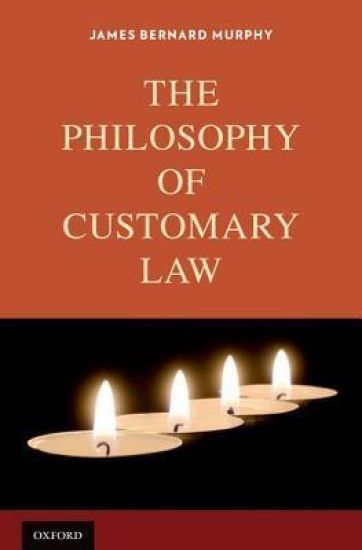
Although many modern philosophers of law describe custom as merely a minor source of law, formal law is actually only one source of the legal customs that govern us. Many laws grow out of custom, and one measure of a law's success is by its creation of an enduring legal custom. Yet custom and customary law have long been neglected topics in unsettled jurisprudential debate. Smaller concerns, such as whether customs can be legitimized by practice or by stipulation, stipulated by an authority or by general consent, or dictated by law or vice versa, lead to broader questions of law and custom as alternative or mutually exclusive modes of social regulation, and whether rational reflection in general ought to replace sub-rational prejudice. Can legal rules function without customary usage, and does custom even matter in society? The Philosophy of Customary Law brings greater theoretical clarity to the often murky topic of custom by showing that custom must be analyzed into two more logically basic concepts: convention and habit. James Bernard Murphy explores the nature and significance of custom and customary law, and how conventions relate to habits in the four classic theories of Aristotle, Francisco Suarez, Jeremy Bentham, and James C. Carter. He establishes that customs are conventional habits and habitual conventions, and allows us to better grasp the many roles that custom plays in a legal system by offering a new foundation of understanding for these concepts.

This volume collects some of the best recent writings on St. Thomas’s philosophy of law and includes a critical examination of Aquinas’s theory of the relation between law and morality, his natural law theory, as well as the modern reformulation of his approach to natural rights. The volume shows how Aquinas understood the importance of positive law and demonstrates the modern relevance of his writings by including Thomistic critiques of modern jurisprudence and examples of applications of Thomistic jurisprudence to specific modern legal problems such as federalism, environmental policy, abortion and euthanasia. The volume also features an introduction which places Aquinas’s writings in the context of modern jurisprudence as well as an extensive bibliography. The volume is suited to the needs of jurisprudence scholars, teachers and students and is an essential resource for all law libraries.
In this first book-length study of positive law, James Bernard Murphy rewrites central chapters in the history of jurisprudence by uncovering a fundamental continuity among four great legal philosophers: Plato, Thomas Aquinas, Thomas Hobbes, and John Austin. In their theories of positive law, Murphy argues, these thinkers represent successive chapters in a single fascinating story. That story revolves around a fundamental ambiguity: is law positive because it is deliberately imposed (as opposed to customary law) or because it lacks moral necessity (as opposed to natural law)? These two senses of positive law are not coextensive yet the discourse of positive law oscillates unstably between them. What, then, is the relation between being deliberately imposed and lacking moral necessity? Murphy demonstrates how the discourse of positive law incorporates both normative and descriptive dimensions of law, and he discusses the relation of positive law not only to jurisprudence but also to the philosophy of language, ethics, theories of social order, and biblical law.

St. Augustine and Roman law are the two bridges from Athens and Jerusalem to the world of modern law. Augustine's almost eerily modern political realism was based upon his deep appreciation of human evil, arising from his insights into the human personality, the product of his reflections on his own life and the history of his times. These insights have traveled well through the ages and are mirrored in the pages of Aquinas, Luther and Calvin, Reinhold Niebuhr, and Hannah Arendt. The articles in this volume describe the life and world of Augustine and the ways in which he conceived both justice and law. They also discuss the little recognized Augustinian contributions to the field of modern hermeneutics - the discipline which informs the art of legal interpretation. Finally, they include Augustine's valuable discussion of church/state relations, the law of just wars, and proper role and limits of coercion, and the procreative dimensions of marriage. The volume also includes an extremely useful, definitive bibliography of Augustine and the law, and will leave readers with an increased appreciation of the contributions which Augustine has made to the history of jurisprudence. No one can read Augustine and these articles on his view of the law without taking away a new view of the law itself.
This book concerns the dignity and the degradation of labor. Because our work has considerable power either to foster or to undermine our happiness and well-being, the degradation of labor is a profound obstacle to human flourishing. Yet the moral dimension of labor has been neglected in our political theory and practice. In this book, James Bernard Murphy aims to restore productive labor to its rightful place in moral and political debate.Ever since Aristotle, there have been many theories of distributive justice but very little in the way of a theory of justice in production. Through a bold reconstruction and critique of Aristotle's views of nature and moral reason, Murphy develops a new Aristotelian theory of productive labor. According to Aristotle, work has dignity when the worker executes what he has first conceived in thought, and work is degraded when one worker merely executes what is conceived by another. With Aristotle's definition of work as a unity of conception and execution, we can see what is wrong with work in the contemporary world: the detailed division of labor has divorced conception from execution. Although the prevalence of monotonous and stultifying work is widely regarded as the inevitable cost of economic progress, Murphy argues that restoring the unity of conception and execution in the design of jobs is compatible with our economic interests in efficient production and is required by our moral interests in human flourishing.