Kirjojen hintavertailu. Mukana 12 142 860 kirjaa ja 12 kauppaa.

Kirjailija

James C. Davis

Kirjat ja teokset yhdessä paikassa: 6 kirjaa, julkaisuja vuosilta 1978-2011, suosituimpien joukossa Leisy V. Hardin U.S. Supreme Court Transcript of Record with Supporting Pleadings. Vertaile teosten hintoja ja tarkista saatavuus suomalaisista kirjakaupoista.

Mukana myös kirjoitusasut: James C Davis

6 kirjaa

Kirjojen julkaisuhaarukka 1978-2011.

Commerce in Color

Commerce in Color

James C. Davis

The University of Michigan Press
2007
nidottu
Commerce in Color explores the juncture of consumer culture and race by examining advertising, literary texts, mass culture, and public events in the United States from 1893 to 1933. James C. Davis takes up a remarkable range of subjects—including the crucial role publishers Boni and Liveright played in the marketing of Harlem Renaissance literature, Henry James’s critique of materialism in The American Scene, and the commodification of racialized popular culture in James Weldon Johnson’s The Autobiography of an Ex-Colored Man—as he argues that racial thinking was central to the emergence of U.S. consumerism and, conversely, that an emerging consumer culture was a key element in the development of racial thinking and the consolidation of racial identity in America. By urging a reassessment of the familiar rubrics of the “culture of consumption” and the “culture of segregation,” Dawson poses new and provocative questions about American culture and social history. Both an influential literary study and an absorbing historical read, Commerce in Color proves that—in America—advertising, publicity, and the development of the modern economy cannot be understood apart from the question of race.“A welcome addition to existing scholarship, Davis’s study of the intersection of racial thinking and the emergence of consumer culture makes connections very few scholars have considered.” —James Smethurst, University of MassachusettsJames C. Davis is Assistant Professor of English at Brooklyn College.
Commerce in Color

Commerce in Color

James C. Davis

The University of Michigan Press
2007
sidottu
Commerce in Color explores the juncture of consumer culture and race by examining advertising, literary texts, mass culture, and public events in the United States from 1893 to 1933. James C. Davis takes up a remarkable range of subjects—including the crucial role publishers Boni and Liveright played in the marketing of Harlem Renaissance literature, Henry James’s critique of materialism in The American Scene, and the commodification of racialized popular culture in James Weldon Johnson’s The Autobiography of an Ex-Colored Man—as he argues that racial thinking was central to the emergence of U.S. consumerism and, conversely, that an emerging consumer culture was a key element in the development of racial thinking and the consolidation of racial identity in America. By urging a reassessment of the familiar rubrics of the “culture of consumption” and the “culture of segregation,” Dawson poses new and provocative questions about American culture and social history. Both an influential literary study and an absorbing historical read, Commerce in Color proves that—in America—advertising, publicity, and the development of the modern economy cannot be understood apart from the question of race.“A welcome addition to existing scholarship, Davis’s study of the intersection of racial thinking and the emergence of consumer culture makes connections very few scholars have considered.” —James Smethurst, University of MassachusettsJames C. Davis is Assistant Professor of English at Brooklyn College.
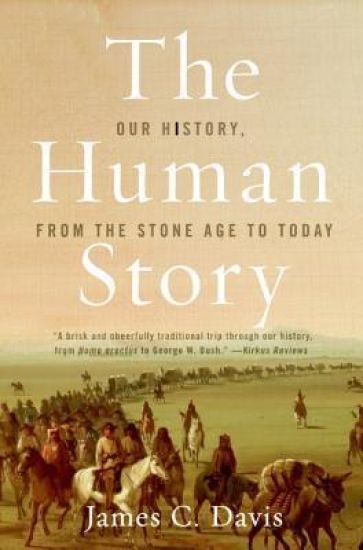
The Human Story

The Human Story

James C Davis

HarperCollins
2005
nidottu
Has there ever been a history of the world as readable as this?In The Human Story, James C. Davis takes us on a journey to ancient times, telling how peoples of the world settled down and founded cities, conquered neighbors, and established religions, and continues over the course of history, when they fought two nearly global wars and journeyed into space.Davis's account is swift and clear, never dull or dry. He lightens it with pungent anecdotes and witty quotes. Although this compact volume may not be hard to pick up, it's definitely hard to put down.For example, on the death of Alexander the Great, who in a decade had never lost a single battle, and who had staked out an empire that spanned the entire Near East and Egypt, Davis writes: "When they heard how ill he was, the king's devoted troops insisted on seeing him. He couldn't speak, but as his soldiers -- every one -- filed by in silence, Alexander's eyes uttered his farewells. He died in June 323 B.C., at the ripe old age of thirty-two."In similar fashion Davis recounts Russia's triumph in the space race as it happened on an autumn night in 1957: "A bugle sounded, flames erupted, and with a roar like rolling thunder, Russia's rocket lifted off. It bore aloft the earth's first artificial satellite, a shiny sphere the size of a basketball. Its name was Sputnik, meaning 'companion' or 'fellow traveler' (through space). The watchers shouted, 'Off. She's off. Our baby's off ' Some danced; others kissed and waved their arms."Though we live in an age of many doubts, James C. Davis thinks we humans are advancing. As The Human Story ends, he concludes, "The world's still cruel; that's understood, / But once was worse. So far so good."