Kirjojen hintavertailu. Mukana 12 137 509 kirjaa ja 12 kauppaa.

Kirjailija

James C. Kearney

Kirjat ja teokset yhdessä paikassa: 5 kirjaa, julkaisuja vuosilta 2011-2023, suosituimpien joukossa No Hope for Heaven, No Fear of Hell. Vertaile teosten hintoja ja tarkista saatavuus suomalaisista kirjakaupoista.

5 kirjaa

Kirjojen julkaisuhaarukka 2011-2023.

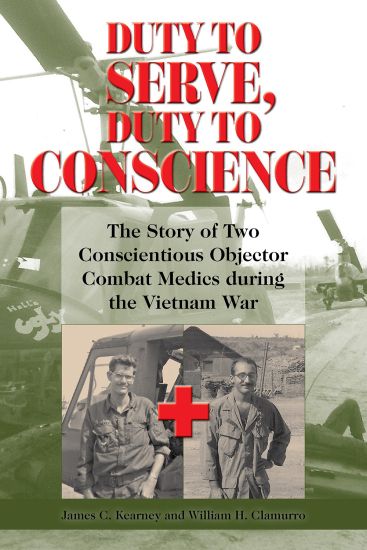
Duty to Serve, Duty to Conscience

Duty to Serve, Duty to Conscience

James C. Kearney; William H Clamurro

UNIVERSITY OF NORTH TEXAS PRESS,U.S.
2023
sidottu
Despite all that has been written about Vietnam, the story of the 1-A-O conscientious objector, who agreed to put on a uni-form and serve in the field without weapons rather than accept alternative service outside the military, has received scarce atten-tion. This joint memoir by two 1-A-O combat medics, James C. Kearney and William H. Clamurro, represents a unique approach to the subject. It is a blend of their personal narratives—with select Vietnam poems by Clamurro—to illustrate noncombatant objection as a unique and relatively unknown form of Vietnam War protest. Both men initially met during training and then served as frontline medics in separate units “outside the wire” in Vietnam. Clamurro was assigned to a tank company in Tay Ninh province next to the Cambodian border, before reassignment to an aid station with the 1st Air Cavalry. Kearney served first as a medic with an artillery battery in the 1st Infantry Division, then as a convoy medic during the Cambodian invasion with the 25th Infantry Division, and finally as a Medevac medic with the 1st Air Cavalry. In this capacity Kearney was seriously wounded during a “hot hoist” in February 1971 and ended up being treated by his friend Clamurro back at base. Because of their status as “a new breed of conscientious objector”—i.e., more political than religious in their convictions—the authors’ experience of the Vietnam War differed fundamentally from that of their fellow draftees and contrasted even with the great majority of their fellow 1-A-O medics, whose conscientious objector status was largely or entirely faith-based.
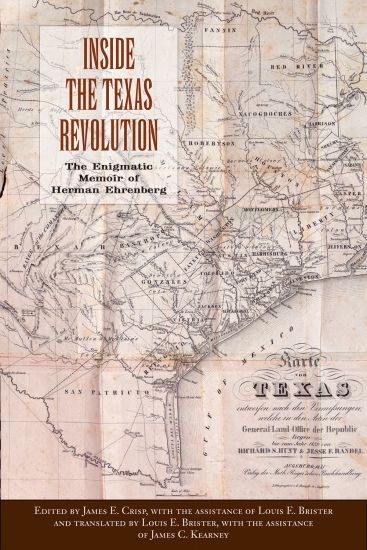
Inside the Texas Revolution

Inside the Texas Revolution

Louis E. Brister; James C. Kearney

Texas State Historical Association,U.S.
2021
sidottu
Herman Ehrenberg wrote the longest, most complete, and most vivid memoir of any soldier in the Texan revolutionary army. His narrative was published in Germany in 1843, but it was little used by Texas historians until the twentieth century, when the first-and very problematic-attempts at translation into English were made. Inside the Texas Revolution: The Enigmatic Memoir of Herman Ehrenberg is a product of the translation skills of the late Louis E. Brister with the assistance of James C. Kearney, both noted specialists on Germans in Texas. The volume's editor, James E. Crisp, has spent much of the last 27 years solving many of the mysteries that still surrounded Ehrenberg's life. It was Crisp who discovered that Ehrenberg lived in the Texas Republic until at least 1840, and spent the spring of that year as ranger on the frontier. Ehrenberg was not a historian, but an ordinary citizen whose narrative of the Texas Revolution contains both spectacular eyewitness accounts of action and almost mythologized versions of major events that he did not witness himself. This volume points out where Ehrenberg is lying or embellishing, explains why he is doing so, and narrates the actual relevant facts as far as they can be determined. Ehrenberg's book is both a testament by a young Texan 'everyman' who presents a laudatory paean to the Texan cause, and a German's explanation of Texas and its 'fight for freedom' against Mexico to his fellow Germans-with a powerful subtext that patriotic Germans should aspire to a similar struggle, and a similar outcome: a free, democratic republic.
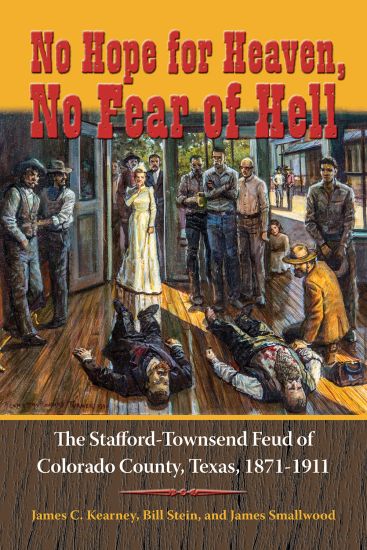
No Hope for Heaven, No Fear of Hell

No Hope for Heaven, No Fear of Hell

James C. Kearney; Bill Stein; James Smallwood

University of North Texas Press,U.S.
2018
nidottu
The Stafford-Townsend feud began with an 1871 shootout in Columbus, Texas, followed by the deaths of the Stafford brothers in 1890. The second phase blossomed after 1898 with the assassination of Larkin Hope, and concluded in 1911 with the violent deaths of Marion Hope, Jim Townsend, and Will Clements, all in the space of one month.
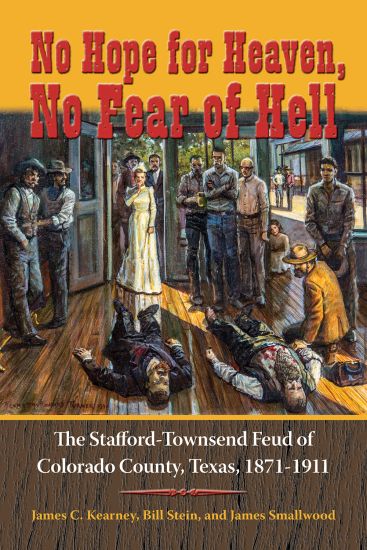
No Hope for Heaven, No Fear of Hell

No Hope for Heaven, No Fear of Hell

James C. Kearney

University of North Texas Press,U.S.
2016
sidottu
Two family names have come to be associated with the violence that plagued Colorado County, Texas, for decades after the end of the Civil War: the Townsends and the Staffords. Both prominent families amassed wealth and achieved status, but it was their resolve to hold on to both, by whatever means necessary, including extra-legal means, that sparked the feud. Elected office was one of the paths to success, but more important was control of the sheriff’s office, which gave one a decided advantage should the threat of gun violence arise.No Hope for Heaven, No Fear of Hell concentrates on those individual acts of private justice associated with the Stafford and Townsend families. It began with an 1871 shootout in Columbus, followed by the deaths of the Stafford brothers in 1890. The second phase blossomed after 1898 with the assassination of Larkin Hope, and concluded in 1911 with the violent deaths of Marion Hope, Jim Townsend, and Will Clements, all in the space of one month.
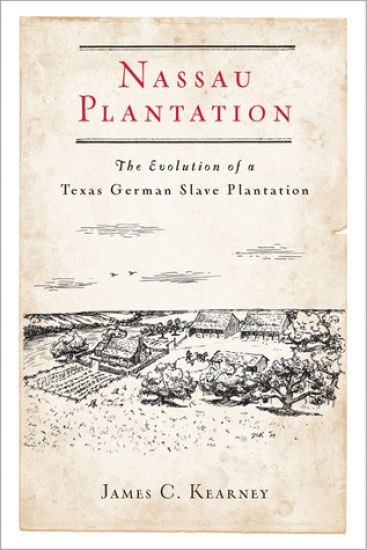
Nassau Plantation

Nassau Plantation

James C. Kearney

University of North Texas Press,U.S.
2011
nidottu
In the 1840s an organisation of German noblemen, the Mainzner Adelsverein, attempted to settle thousands of German emigrants on the Texas frontier. Nassau Plantation, located near modern-day Round Top, Texas, in northern Fayette County, was a significant part of this story. No one, however, has adequately documented the role of the slave plantation or given a convincing explanation of the Adelsverein from the German point of view. James C. Kearney has studied a wealth of original source material (much of it in German) to illuminate the history of the plantation and the larger goals and motivation of the Adelsverein, both in Texas and in Germany. Moreover, this new study highlights the problematic relationship of German emigrants to slavery. Few today realise that the society’s original colonisation plan included ownership and operation of slave plantations. Ironically, the German settlements the society later established became hotbeds of anti-slavery and anti-secessionist sentiment. Responding to criticism in Germany, the society declared its colonies to be “slave free zones” in 1845. This act thrust the society front and centre into the complicated political landscape of Texas prior to annexation. James A. Mayberry, among others, suspected an English-German conspiracy to flood the state with anti-slavery immigrants and delivered a fiery speech in the legislature denouncing the society. In the 1850s the plantation became a magnet for German immigration into Fayette and Austin Counties. In this connection, Kearney explores the role and influence of Otto von Roeder, a largely neglected but important Texas-German. Another chapter deals with the odyssey of the extended von Rosenberg family, who settled on the plantation in 1850 and helped to elevate the nearby town of Round Top into a regional centre of culture and education. Many members of the family subsequently rose to positions of leadership and influence in Texas. Several notable personalities graced the plantation—Carl Prince of Solms-Braunfels, Johann Otto Freiherr von Meusebach, botanist F. Lindheimer, and the renowned naturalist Dr. Ferdinand Roemer, to name a few. Dramatic events also occurred at the plantation, including a deadly shootout, a successful escape by two slaves (documented in an unprecedented way), and litigation over ownership that wound its way to both the Texas Supreme Court and the U.S. Supreme Court.