Kirjojen hintavertailu. Mukana 12 240 543 kirjaa ja 12 kauppaa.

Kirjailija

James C. Scott

Kirjat ja teokset yhdessä paikassa: 18 kirjaa, julkaisuja vuosilta 1977-2026, suosituimpien joukossa Mather Field. Vertaile teosten hintoja ja tarkista saatavuus suomalaisista kirjakaupoista.

18 kirjaa

Kirjojen julkaisuhaarukka 1977-2026.

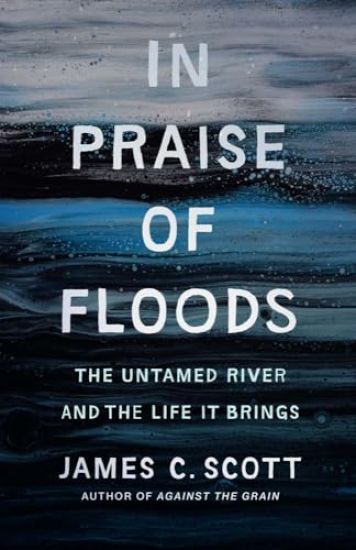
In Praise of Floods: The Untamed River and the Life It Brings
James C. Scott reframes rivers as alive and dynamic, revealing the consequences of treating them as resources for our profit A New Yorker Best Book of the Year "Informative, enjoyable, and provocative. . . . Scott's prose] is dry, clear, and scalding with moral purpose."--Becca Rothfeld, Washington Post Rivers, on a long view, are alive. They are born; they change; they shift their channels; they forge new routes to the sea; they move both gradually and violently; they can teem (usually) with life; they may die a quasi-natural death; they are frequently maimed and even murdered. It is the annual flood pulse--the brief time when the river occupies the floodplain--that gives a river its vitality, but it is human engineering that kills it, suppressing the flood pulse with dams, irrigation, siltation, dikes, and levees. In demonstrating these threats to the riverine world, award-winning author James C. Scott examines the life history of a particular river, the Ayeyarwady (Irrawaddy) of Burma, the heartland and superhighway of Burman culture. Scott opens our understanding of rivers to encompass their entirety--tributaries, wetlands, floodplains, backwaters, eddies, periodic marshlands, and the assemblage of life forms dependent on rivers for their existence and well-being. For anyone interested in the Anthropocene and the Great Acceleration, rivers offer a striking example of the consequences of human intervention in trying to control and domesticate a natural process, the complexity and variability of which we barely understand.
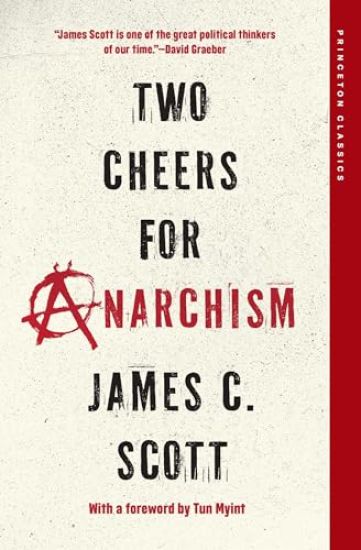
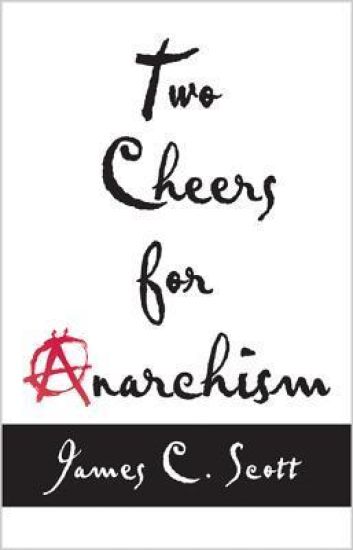
Two Cheers for Anarchism

Two Cheers for Anarchism

James C. Scott; Tun Myint

PRINCETON UNIVERSITY PRESS
2025
pokkari
“One of the world’s most widely read social scientists” (New York Times) offers his most personal and accessible book—a celebration of how ordinary people can resist oppression and injusticeJames Scott taught us what's wrong with seeing like a state. Now, in his most accessible and personal book to date, the acclaimed social scientist makes the case for seeing like an anarchist. Inspired by the core anarchist faith in the possibilities of voluntary cooperation without hierarchy, Two Cheers for Anarchism is an engaging, high-spirited, and often very funny defense of an anarchist way of seeing—one that provides a unique and powerful perspective on everything from everyday social and political interactions to mass protests and revolutions. Through a wide-ranging series of memorable anecdotes and examples, the book describes an anarchist sensibility that celebrates the local knowledge, common sense, and creativity of ordinary people. The result is a kind of handbook on constructive anarchism that challenges us to radically reconsider the value of hierarchy in public and private life, from schools and workplaces to retirement homes and government itself.Beginning with what Scott calls "the law of anarchist calisthenics," an argument for law-breaking inspired by an East German pedestrian crossing, each chapter opens with a story that captures an essential anarchist truth. In the course of telling these stories, Scott touches on a wide variety of subjects: public disorder and riots, desertion, poaching, vernacular knowledge, assembly-line production, globalization, the petty bourgeoisie, school testing, playgrounds, and the practice of historical explanation.Far from a dogmatic manifesto, Two Cheers for Anarchism celebrates the anarchist confidence in the inventiveness and judgment of people who are free to exercise their creative and moral capacities.
In Praise of Floods

In Praise of Floods

James C. Scott

YALE UNIVERSITY PRESS
2025
sidottu
James C. Scott reframes rivers as alive and dynamic, revealing the consequences of treating them as resources for our profit “Informative, enjoyable, and provocative. . . . Scott’s [prose] is dry, clear, and scalding with moral purpose.”—Becca Rothfeld, Washington Post Rivers, on a long view, are alive. They are born; they change; they shift their channels; they forge new routes to the sea; they move both gradually and violently; they can teem (usually) with life; they may die a quasi-natural death; they are frequently maimed and even murdered. It is the annual flood pulse—the brief time when the river occupies the floodplain—that gives a river its vitality, but it is human engineering that kills it, suppressing the flood pulse with dams, irrigation, siltation, dikes, and levees. In demonstrating these threats to the riverine world, award-winning author James C. Scott examines the life history of a particular river, the Ayeyarwady (Irrawaddy) of Burma, the heartland and superhighway of Burman culture. Scott opens our understanding of rivers to encompass their entirety—tributaries, wetlands, floodplains, backwaters, eddies, periodic marshlands, and the assemblage of life forms dependent on rivers for their existence and well-being. For anyone interested in the Anthropocene and the Great Acceleration, rivers offer a striking example of the consequences of human intervention in trying to control and domesticate a natural process, the complexity and variability of which we barely understand.
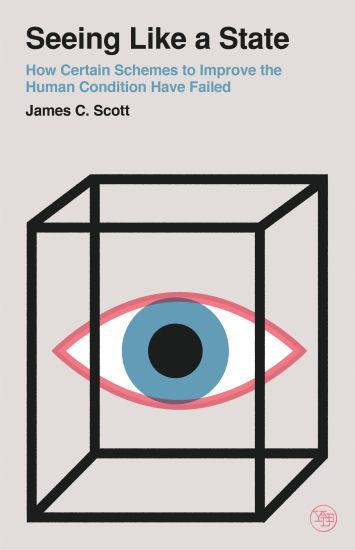
Seeing Like a State

Seeing Like a State

James C. Scott

Yale University Press
2020
pokkari
“One of the most profound and illuminating studies of this century to have been published in recent decades.”—John Gray, New York Times Book Review “A powerful, and in many [ways] insightful, explanation as to why grandiose programs of social reform, not to mention revolution, so often end in tragedy. . . . An important critique of visionary state planning.”—Robert Heilbroner, Lingua Franca Hailed as “a magisterial critique of top-down social planning” by the New York Times, this essential work analyzes disasters from Russia to Tanzania to uncover why states so often fail—sometimes catastrophically—in grand efforts to engineer their society or their environment, and uncovers the conditions common to all such planning disasters. “Beautifully written, this book calls into sharp relief the nature of the world we now inhabit.”—New Yorker “A tour de force.”—Charles Tilly, Columbia University The Institution for Social and Policy Studies
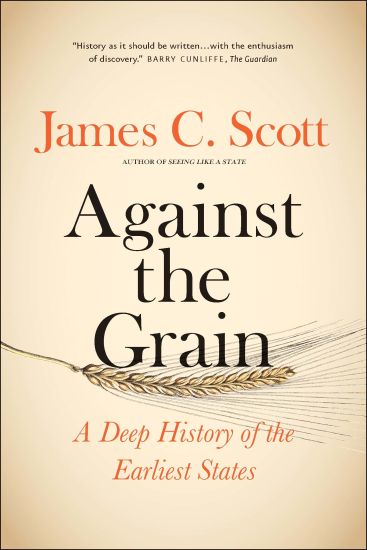
Against the Grain

Against the Grain

James C. Scott

Yale University Press
2018
pokkari
An account of all the new and surprising evidence now available that contradicts the standard narrative for the beginnings of the earliest civilizations An Economist Best History Book 2017 “Scott is one of those rare academics whose writing is a thing of beauty.”—Rana Dasgupta, The Week “Scott hits the nail squarely on the head by exposing the staggering price our ancestors paid for civilization and political order.”—Walter Scheidel, Financial Times Why did humans abandon hunting and gathering for sedentary communities dependent on livestock and cereal grains, and governed by precursors of today’s states? Most people believe that plant and animal domestication allowed humans, finally, to settle down and form agricultural villages, towns, and states, which made possible civilization, law, public order, and a presumably secure way of living. But archaeological and historical evidence challenges this narrative. The first agrarian states, says James C. Scott, were born of accumulations of domestications: first fire, then plants, livestock, subjects of the state, captives, and finally women in the patriarchal family—all of which can be viewed as a way of gaining control over reproduction. Scott explores why we avoided sedentism and plow agriculture, the advantages of mobile subsistence, the unforeseeable disease epidemics arising from crowding plants, animals, and grain, and why all early states are based on millets and cereal grains and unfree labor. He also discusses the “barbarians” who long evaded state control, as a way of understanding continuing tension between states and nonsubject peoples.
Two Cheers for Anarchism

Two Cheers for Anarchism

James C. Scott

Princeton University Press
2014
pokkari
James Scott taught us what's wrong with seeing like a state. Now, in his most accessible and personal book to date, the acclaimed social scientist makes the case for seeing like an anarchist. Inspired by the core anarchist faith in the possibilities of voluntary cooperation without hierarchy, Two Cheers for Anarchism is an engaging, high-spirited, and often very funny defense of an anarchist way of seeing--one that provides a unique and powerful perspective on everything from everyday social and political interactions to mass protests and revolutions. Through a wide-ranging series of memorable anecdotes and examples, the book describes an anarchist sensibility that celebrates the local knowledge, common sense, and creativity of ordinary people. The result is a kind of handbook on constructive anarchism that challenges us to radically reconsider the value of hierarchy in public and private life, from schools and workplaces to retirement homes and government itself. Beginning with what Scott calls "the law of anarchist calisthenics," an argument for law-breaking inspired by an East German pedestrian crossing, each chapter opens with a story that captures an essential anarchist truth. In the course of telling these stories, Scott touches on a wide variety of subjects: public disorder and riots, desertion, poaching, vernacular knowledge, assembly-line production, globalization, the petty bourgeoisie, school testing, playgrounds, and the practice of historical explanation. Far from a dogmatic manifesto, Two Cheers for Anarchism celebrates the anarchist confidence in the inventiveness and judgment of people who are free to exercise their creative and moral capacities.
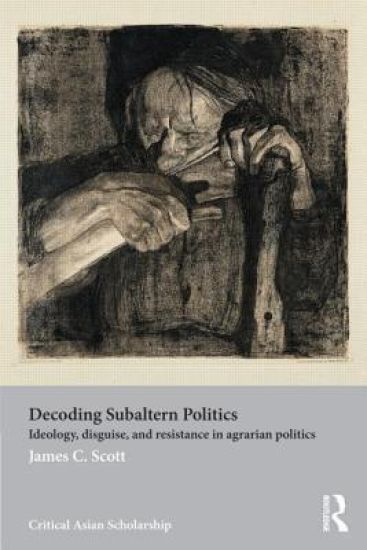
Decoding Subaltern Politics

Decoding Subaltern Politics

James C. Scott

Routledge
2012
nidottu
James C. Scott has researched and written on subaltern groups, and, in particular, peasants, rebellion, resistance, and agriculture, for over 35 years. Yet much of Scott’s most interesting work on the peasantry and the state, both conceptually and empirically, has never been published in book form. For the first time Decoding Subaltern Politics: Ideology, Disguise, and Resistance in Agrarian Politics, brings together some of his most important work in one volume. The book covers three distinct yet interlinked bodies of work. The first lays out a framework for understanding peasant politics and rebellion, much of which is applicable to rural areas of the contemporary global south. Scott then goes on to develop his arguments regarding everyday forms of peasant resistance using the comparative example of the religious tithe in France and Malaysia, and tracing the forms of resistance that cover their own tracks and avoid direct clashes with authorities. For much of the world’s population, and for most of its history, this sort of politics was far more common than the violent clashes that dominate the history books, and in this book one can examine the anatomy of such resistance in rich comparative detail. Finally, Scott explores how the state’s increasing grip on its population: its identity, land-holding, income, and movements, is a precondition for political hegemony. Crucially, in examining the invention of state-mandated legal identities, especially, the permanent patronym and the vagaries of its imposition on vernacular life, Scott lays bare the micro-processes of state-formation and resistance.Written by one of the leading social theorists of our age, Decoding Subaltern Politics: Ideology, Disguise, and Resistance in Agrarian Politics is an indispensible guide to the study of subaltern culture and politics and is essential reading for political scientists, anthropologists, sociologists and historians alike.
Decoding Subaltern Politics

Decoding Subaltern Politics

James C. Scott

Routledge
2012
sidottu
James C. Scott has researched and written on subaltern groups, and, in particular, peasants, rebellion, resistance, and agriculture, for over 35 years. Yet much of Scott’s most interesting work on the peasantry and the state, both conceptually and empirically, has never been published in book form. For the first time Decoding Subaltern Politics: Ideology, Disguise, and Resistance in Agrarian Politics, brings together some of his most important work in one volume. The book covers three distinct yet interlinked bodies of work. The first lays out a framework for understanding peasant politics and rebellion, much of which is applicable to rural areas of the contemporary global south. Scott then goes on to develop his arguments regarding everyday forms of peasant resistance using the comparative example of the religious tithe in France and Malaysia, and tracing the forms of resistance that cover their own tracks and avoid direct clashes with authorities. For much of the world’s population, and for most of its history, this sort of politics was far more common than the violent clashes that dominate the history books, and in this book one can examine the anatomy of such resistance in rich comparative detail. Finally, Scott explores how the state’s increasing grip on its population: its identity, land-holding, income, and movements, is a precondition for political hegemony. Crucially, in examining the invention of state-mandated legal identities, especially, the permanent patronym and the vagaries of its imposition on vernacular life, Scott lays bare the micro-processes of state-formation and resistance.Written by one of the leading social theorists of our age, Decoding Subaltern Politics: Ideology, Disguise, and Resistance in Agrarian Politics is an indispensible guide to the study of subaltern culture and politics and is essential reading for political scientists, anthropologists, sociologists and historians alike.
The Politics of Food Supply

The Politics of Food Supply

Bill Winders; James C. Scott

Yale University Press
2012
pokkari
This book deals with an important and timely issue: the political and economic forces that have shaped agricultural policies in the United States during the past eighty years. It explores the complex interactions of class, market, and state as they have affected the formulation and application of agricultural policy decisions since the New Deal, showing how divisions and coalitions within Southern, Corn Belt, and Wheat Belt agriculture were central to the ebb and flow of price supports and production controls. In addition, the book highlights the roles played by the world economy, the civil rights movement, and existing national policy to provide an invaluable analysis of past and recent trends in supply management policy.
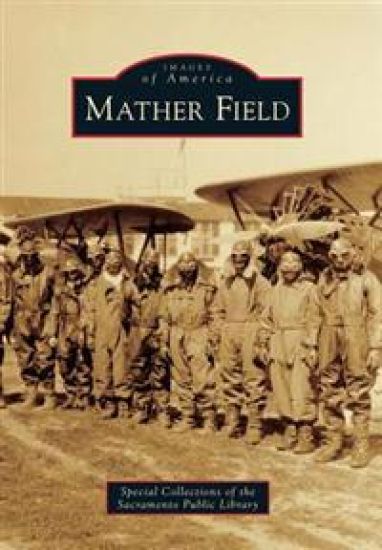
Mather Field

Mather Field

James C. Scott; Tom Tolley

Arcadia Publishing (SC)
2012
nidottu
Born from America's need to train aviators for the Great War, Mather Field has sat sentinel to the east of Sacramento for nearly a century. Overnight, the base transformed a lonely domain of cattle and vineyards into an aerie where fledgling man-birds were taught to fly and kill. Although readapted during the interwar period to concerns of fire control and mail delivery, Mather still inspired, as evidenced by the 1930 Air Corps maneuvers. World War II renewed Mather, as training bomber crews and repatriating veterans of the Pacific war were primary responsibilities for what was becoming a self-sustaining city of churches, schools, and burgeoning neighborhoods.
The Art of Not Being Governed

The Art of Not Being Governed

James C. Scott

Yale University Press
2010
pokkari
From the acclaimed author and scholar James C. Scott, the compelling tale of Asian peoples who until recently have stemmed the vast tide of state-making to live at arm’s length from any organized state society For two thousand years, the disparate groups that now reside in Zomia (a mountainous region the size of Europe that consists of portions of seven Asian countries) have fled the projects of the organized state societies that surround them—slavery, conscription, taxes, corvée labor, epidemics, and warfare. This book, essentially an “anarchist history,” is the first-ever examination of the huge literature on state-making whose author evaluates why people would deliberately and reactively remain stateless. Among the strategies employed by the people of Zomia to remain stateless are physical dispersion in rugged terrain; agricultural practices that enhance mobility; pliable ethnic identities; devotion to prophetic, millenarian leaders; and maintenance of a largely oral culture that allows them to reinvent their histories and genealogies as they move between and around states. In accessible language, James Scott, recognized worldwide as an eminent authority in Southeast Asian, peasant, and agrarian studies, tells the story of the peoples of Zomia and their unlikely odyssey in search of self-determination. He redefines our views on Asian politics, history, demographics, and even our fundamental ideas about what constitutes civilization, and challenges us with a radically different approach to history that presents events from the perspective of stateless peoples and redefines state-making as a form of “internal colonialism.” This new perspective requires a radical reevaluation of the civilizational narratives of the lowland states. Scott’s work on Zomia represents a new way to think of area studies that will be applicable to other runaway, fugitive, and marooned communities, be they Gypsies, Cossacks, tribes fleeing slave raiders, Marsh Arabs, or San-Bushmen.
Agrarian Studies

Agrarian Studies

James C. Scott

Yale University Press
2001
pokkari
A fresh interdisciplinary analysis of rural society and agrarian issues This book presents an account of an intellectual breakthrough in the study of rural society and agriculture. Its ten chapters, selected for their originality and synthesis from the colloquia of the Program in Agrarian Studies at Yale University, encompass various disciplines, diverse historical periods, and several regions of the world. The contributors’ fresh analyses will broaden the perspectives of readers with interests as wide-ranging as rural sociology, environmentalism, political science, history, anthropology, economics, and art history. The ten studies recast and expand what is known about rural society and agrarian issues, examining such topics as poverty, subsistence, cultivation, ecology, justice, art, custom, law, ritual life, cooperation, and state action. Each contribution provides a point of departure for new study, encouraging deeper thinking across disciplinary boundaries and frontiers.
Seeing Like a State

Seeing Like a State

James C. Scott

Yale University Press
1999
nidottu
“Illuminating and beautifully written, this book calls into sharp relief the nature of the world we now inhabit.”—New Yorker “A magisterial critique of top-down social planning.”—Jennifer Schuessler, New York Times “One of the most profound and illuminating studies of this century to have been published in recent decades.”—John Gray, New York Times Book Review Compulsory ujamaa villages in Tanzania, collectivization in Russia, Le Corbusier’s urban planning theory realized in Brasilia, the Great Leap Forward in China, agricultural "modernization" in the Tropics—the twentieth century has been racked by grand utopian schemes that have inadvertently brought death and disruption to millions. Why do well-intentioned plans for improving the human condition go tragically awry? In this wide-ranging and original book, James C. Scott analyzes failed cases of large-scale authoritarian plans in a variety of fields. Centrally managed social plans misfire, Scott argues, when they impose schematic visions that do violence to complex interdependencies that are not—and cannot—be fully understood. Further, the success of designs for social organization depends upon the recognition that local, practical knowledge is as important as formal, epistemic knowledge. The author builds a persuasive case against “development theory” and imperialistic state planning that disregards the values, desires, and objections of its subjects. He identifies and discusses four conditions common to all planning disasters: administrative ordering of nature and society by the state; a “high-modernist ideology” that places confidence in the ability of science to improve every aspect of human life; a willingness to use authoritarian state power to effect large- scale interventions; and a prostrate civil society that cannot effectively resist such plans.
Domination and the Arts of Resistance

Domination and the Arts of Resistance

James C. Scott

Yale University Press
1992
pokkari
“A splendid study, surely one of the most important that has appeared on the whole matter of power and resistance.”—Natalie Zemon Davis Confrontations between the powerless and powerful are laden with deception—the powerless feign deference and the powerful subtly assert their mastery. Peasants, serfs, untouchables, slaves, laborers, and prisoners are not free to speak their minds in the presence of power. These subordinate groups instead create a secret discourse that represents a critique of power spoken behind the backs of the dominant. At the same time, the powerful also develop a private dialogue about practices and goals of their rule that cannot be openly avowed. In this book, renowned social scientist James C. Scott offers a penetrating discussion both of the public roles played by the powerful and powerless and the mocking, vengeful tone they display off stage—what he terms their public and hidden transcripts. Using examples from the literature, history, and politics of cultures around the world, Scott examines the many guises this interaction has taken throughout history and the tensions and contradictions it reflects.
Weapons of the Weak

Weapons of the Weak

James C. Scott

Yale University Press
1987
pokkari
“Splendid. . . . Combines the readability of Akenfield or Pig Earth with an accessible and illuminating theoretical commentary.”—A. F. Robertson, Times Higher Education Supplement “Weapons of the Weak is a brilliant book, combining a sure feel for the subjective side of struggle with a deft handling of economic and political trends.”—John R. Bowen, Journal of Peasant Studies “No one who wants to understand peasant society, in or out of Southeast Asia, or theories of change, should fail to read [this book].”—Daniel S. Lev, Journal of Asian Studies This sensitive picture of the constant and circumspect struggle waged by peasants materially and ideologically against their oppressors shows that techniques of evasion and resistance may represent the most significant and effective means of class struggle in the long run.
The Moral Economy of the Peasant

The Moral Economy of the Peasant

James C. Scott

Yale University Press
1977
pokkari
“This work is a profound and fundamental contribution to the issues addressed.”—Sociology “Vital to an understanding of peasant politics.”—Library Journal James C. Scott places the critical problem of the peasant household—subsistence—at the center of this study. The fear of food shortages, he argues persuasively, explains many otherwise puzzling technical, social, and moral arrangements in peasant society, such as resistance to innovation, the desire to own land even at some cost in terms of income, relationships with other people, and relationships with institutions, including the state. Once the centrality of the subsistence problem is recognized, its effects on notions of economic and political justice can also be seen. Scott draws from the history of agrarian society in lower Burma and Vietnam to show how the transformations of the colonial era systematically violated the peasants’ “moral economy” and created a situation of potential rebellion and revolution. Demonstrating keen insights into the behavior of people in other cultures and a rare ability to generalize soundly from case studies, Scott offers a different perspective on peasant behavior that will be of interest particularly to political scientists, anthropologists, sociologists, and Southeast Asianists.