Kirjojen hintavertailu. Mukana 12 191 972 kirjaa ja 12 kauppaa.

Kirjailija

James D. Nichols

Kirjat ja teokset yhdessä paikassa: 6 kirjaa, julkaisuja vuosilta 2001-2021, suosituimpien joukossa Spatial Dynamics and Ecology of Large Ungulate Populations in Tropical Forests of India. Vertaile teosten hintoja ja tarkista saatavuus suomalaisista kirjakaupoista.

Mukana myös kirjoitusasut: James D Nichols

6 kirjaa

Kirjojen julkaisuhaarukka 2001-2021.

Spatial Dynamics and Ecology of Large Ungulate Populations in Tropical Forests of India

Spatial Dynamics and Ecology of Large Ungulate Populations in Tropical Forests of India

N. Samba Kumar; K. Ullas Karanth; James D. Nichols; Srinivas Vaidyanathan; Beth Gardner; Jagdish Krishnaswamy

SPRINGER VERLAG, SINGAPORE
2021
nidottu
Large ungulates in tropical forests are among the most threatened taxa of mammals. Excessive hunting, degradation of and encroachments on their natural habitats by humans have contributed to drastic reductions in wild ungulate populations in recent decades. As such, reliable assessments of ungulate-habitat relationships and the spatial dynamics of their populations are urgently needed to provide a scientific basis for conservation efforts. However, such rigorous assessments are methodologically complex and logistically difficult, and consequently many commonly used ungulate population survey methods do not address key problems. As a result of such deficiencies, key parameters related to population distribution, abundance, habitat ecology and management of tropical forest ungulates remain poorly understood. This book addresses this critical knowledge gap by examining how population abundance patterns in five threatened species of large ungulates vary across spacein the tropical forests of the Nagarahole-Bandipur reserves in southwestern India. It also explains the development and application of an innovative methodology – spatially explicit line transect sampling – based on an advanced hierarchical modelling under the Bayesian inferential framework, which overcomes common methodological deficiencies in current ungulate surveys. The methods and results presented provide valuable reference material for researchers and professionals involved in studying and managing wild ungulate populations around the globe.
Spatial Dynamics and Ecology of Large Ungulate Populations in Tropical Forests of India

Spatial Dynamics and Ecology of Large Ungulate Populations in Tropical Forests of India

N. Samba Kumar; K. Ullas Karanth; James D. Nichols; Srinivas Vaidyanathan; Beth Gardner; Jagdish Krishnaswamy

Springer Verlag, Singapore
2020
sidottu
Large ungulates in tropical forests are among the most threatened taxa of mammals. Excessive hunting, degradation of and encroachments on their natural habitats by humans have contributed to drastic reductions in wild ungulate populations in recent decades. As such, reliable assessments of ungulate-habitat relationships and the spatial dynamics of their populations are urgently needed to provide a scientific basis for conservation efforts. However, such rigorous assessments are methodologically complex and logistically difficult, and consequently many commonly used ungulate population survey methods do not address key problems. As a result of such deficiencies, key parameters related to population distribution, abundance, habitat ecology and management of tropical forest ungulates remain poorly understood. This book addresses this critical knowledge gap by examining how population abundance patterns in five threatened species of large ungulates vary across spacein the tropical forests of the Nagarahole-Bandipur reserves in southwestern India. It also explains the development and application of an innovative methodology – spatially explicit line transect sampling – based on an advanced hierarchical modelling under the Bayesian inferential framework, which overcomes common methodological deficiencies in current ungulate surveys. The methods and results presented provide valuable reference material for researchers and professionals involved in studying and managing wild ungulate populations around the globe.
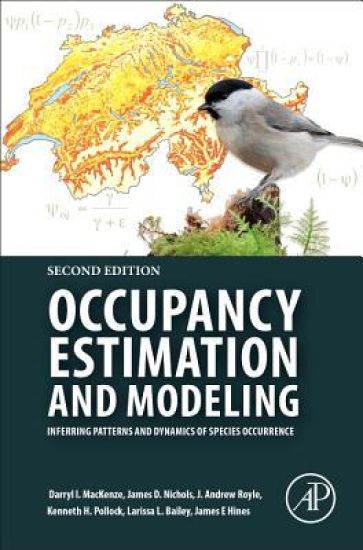
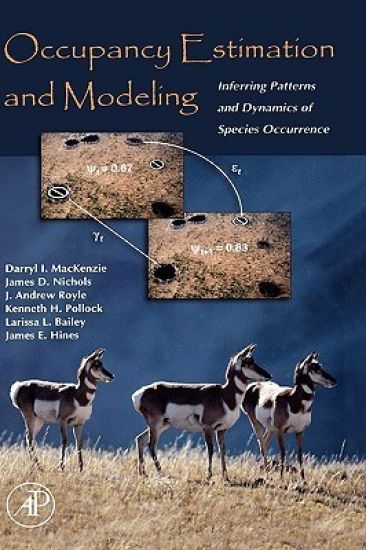
Occupancy Estimation and Modeling

Occupancy Estimation and Modeling

Darryl I. MacKenzie; James D. Nichols; J. Andrew Royle; Kenneth H. Pollock; Larissa Bailey; James E. Hines

Academic Press Inc
2017
nidottu
Occupancy Estimation and Modeling: Inferring Patterns and Dynamics of Species Occurrence, Second Edition, provides a synthesis of model-based approaches for analyzing presence-absence data, allowing for imperfect detection. Beginning from the relatively simple case of estimating the proportion of area or sampling units occupied at the time of surveying, the authors describe a wide variety of extensions that have been developed since the early 2000s. This provides an improved insight about species and community ecology, including, detection heterogeneity; correlated detections; spatial autocorrelation; multiple states or classes of occupancy; changes in occupancy over time; species co-occurrence; community-level modeling, and more. Occupancy Estimation and Modeling: Inferring Patterns and Dynamics of Species Occurrence, Second Edition has been greatly expanded and detail is provided regarding the estimation methods and examples of their application are given. Important study design recommendations are also covered to give a well rounded view of modeling.
Occupancy Estimation and Modeling

Occupancy Estimation and Modeling

Darryl I. MacKenzie; James D. Nichols; J. Andrew Royle; Kenneth H. Pollock; Larissa Bailey; James E. Hines

Academic Press Inc
2005
sidottu
Occupancy Estimation and Modeling is the first book to examine the latest methods in analyzing presence/absence data surveys. Using four classes of models (single-species, single-season; single-species, multiple season; multiple-species, single-season; and multiple-species, multiple-season), the authors discuss the practical sampling situation, present a likelihood-based model enabling direct estimation of the occupancy-related parameters while allowing for imperfect detectability, and make recommendations for designing studies using these models.
Analysis and Management of Animal Populations

Analysis and Management of Animal Populations

Byron K. Williams; James D. Nichols; Michael J. Conroy

Academic Press Inc
2002
sidottu
Analysis and Management of Animal Populations deals with the processes involved in making informed decisions about the management of animal populations. It covers the modeling of population responses to management actions, the estimation of quantities needed in the modeling effort, and the application of these estimates and models to the development of sound management decisions. The book synthesizes and integrates in a single volume the methods associated with these themes, as they apply to ecological assessment and conservation of animal populations.
Dispersal

Dispersal

Jean Clobert; Etienne Danchin; Andre A Dhondt; James D Nichols

Oxford University Press
2001
sidottu
The ability of species to migrate and disperse is a trait that has interested ecologists for many years. Now that many species and ecosystems face major environmental threats in the shape of habitat fragmentation and global climate change, the ability of species to adapt to these changes by dispersing, migrating, or moving between different patches of habitat can be crucial to ensuring their survival. This text provides an overview of the study of dispersal. The causes, mechanisms, and consequences of dispersal at the individual, population, and species levels are considered. The promise of new techniques and models for studying dispersal, drawn from molecular biology and from demography, is explored. Perspectives on the study of dispersal are offered from evolution, conservation biology, and genetics. Throughout the book, theoretical approaches are combined with empirical data, and care has been taken to include examples from as wide a range of species as possible.