Kirjojen hintavertailu. Mukana 12 595 353 kirjaa ja 12 kauppaa.

Kirjailija

James E. Fleming

Kirjat ja teokset yhdessä paikassa: 6 kirjaa, julkaisuja vuosilta 2006-2022, suosituimpien joukossa Securing Constitutional Democracy. Vertaile teosten hintoja ja tarkista saatavuus suomalaisista kirjakaupoista.

6 kirjaa

Kirjojen julkaisuhaarukka 2006-2022.

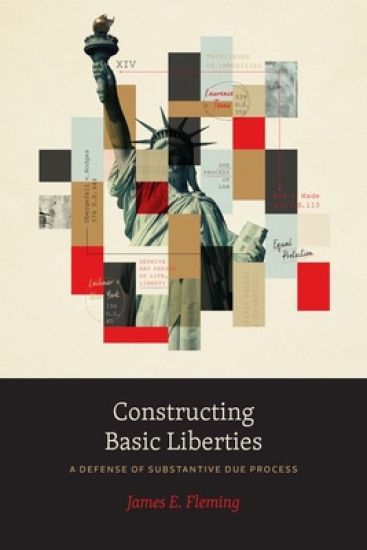
Constructing Basic Liberties

Constructing Basic Liberties

James E. Fleming

THE UNIVERSITY OF CHICAGO PRESS
2022
sidottu
A strong and lively defense of substantive due process. From reproductive rights to marriage for same-sex couples, many of our basic liberties owe their protection to landmark Supreme Court decisions that have hinged on the doctrine of substantive due process. This doctrine is controversial—a battleground for opposing views around the relationship between law and morality in circumstances of moral pluralism—and is deeply vulnerable today. Against recurring charges that the practice of substantive due process is dangerously indeterminate and irredeemably undemocratic, Constructing Basic Liberties reveals the underlying coherence and structure of substantive due process and defends it as integral to our constitutional democracy. Reviewing the development of the doctrine over the last half-century, James E. Fleming rebuts popular arguments against substantive due process and shows that the Supreme Court has constructed basic liberties through common law constitutional interpretation: reasoning by analogy from one case to the next and making complex normative judgments about what basic liberties are significant for personal self-government. Elaborating key distinctions and tools for interpretation, Fleming makes a powerful case that substantive due process is a worthy practice that is based on the best understanding of our constitutional commitments to protecting ordered liberty and securing the status and benefits of equal citizenship for all.
Constructing Basic Liberties

Constructing Basic Liberties

James E. Fleming

THE UNIVERSITY OF CHICAGO PRESS
2022
nidottu
A strong and lively defense of substantive due process. From reproductive rights to marriage for same-sex couples, many of our basic liberties owe their protection to landmark Supreme Court decisions that have hinged on the doctrine of substantive due process. This doctrine is controversial—a battleground for opposing views around the relationship between law and morality in circumstances of moral pluralism—and is deeply vulnerable today. Against recurring charges that the practice of substantive due process is dangerously indeterminate and irredeemably undemocratic, Constructing Basic Liberties reveals the underlying coherence and structure of substantive due process and defends it as integral to our constitutional democracy. Reviewing the development of the doctrine over the last half-century, James E. Fleming rebuts popular arguments against substantive due process and shows that the Supreme Court has constructed basic liberties through common law constitutional interpretation: reasoning by analogy from one case to the next and making complex normative judgments about what basic liberties are significant for personal self-government. Elaborating key distinctions and tools for interpretation, Fleming makes a powerful case that substantive due process is a worthy practice that is based on the best understanding of our constitutional commitments to protecting ordered liberty and securing the status and benefits of equal citizenship for all.
Fidelity to Our Imperfect Constitution

Fidelity to Our Imperfect Constitution

James E. Fleming

Oxford University Press Inc
2015
sidottu
In recent years, some have asked "Are we all originalists now?" and many have assumed that originalists have a monopoly on concern for fidelity in constitutional interpretation. In Fidelity to Our Imperfect Constitution, James Fleming rejects originalisms-whether old or new, concrete or abstract, living or dead. Instead, he defends what Ronald Dworkin called a "moral reading" of the United States Constitution, or a "philosophic approach" to constitutional interpretation. He refers to conceptions of the Constitution as embodying abstract moral and political principles-not codifying concrete historical rules or practices-and of interpretation of those principles as requiring normative judgments about how they are best understood-not merely historical research to discover relatively specific original meanings. Through examining the spectacular concessions that originalists have made to their critics, he shows the extent to which even they acknowledge the need to make normative judgments in constitutional interpretation. Fleming argues that fidelity in interpreting the Constitution as written requires a moral reading or philosophic approach. Fidelity commits us to honoring our aspirational principles, not following the relatively specific original meanings (or original expected applications) of the founders. Originalists would enshrine an imperfect Constitution that does not deserve our fidelity. Only a moral reading or philosophic approach, which aspires to interpret our imperfect Constitution so as to make it the best it can be, gives us hope of interpreting it in a manner that may deserve our fidelity.
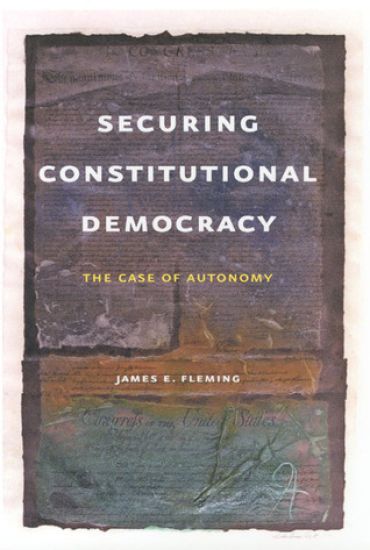
Securing Constitutional Democracy

Securing Constitutional Democracy

James E. Fleming

University of Chicago Press
2006
sidottu
Famously described by Louis Brandeis as "the most comprehensive of rights" and "the right most valued by civilized men," the right of privacy or autonomy is more embattled during modern times than any other. Debate over its meaning, scope, and constitutional status is so widespread that it all but defines the post-1960s era of constitutional interpretation. Conservative Robert Bork called it "a loose canon in the law," while feminist Catharine MacKinnon attacked it as the "right of men to be left alone to oppress women." Can a right with such prominent critics from across the political spectrum be grounded in constitutional law? In this book, James E. Fleming responds to these controversies by arguing that the right to privacy or autonomy should be grounded in a theory of securing constitutional democracy. His framework seeks to secure the basic liberties that are preconditions for deliberative democracy - to allow citizens to deliberate about the institutions and policies of their government - as well as deliberative autonomy - to enable citizens to deliberate about the conduct of their own lives. Together, Fleming shows, these two preconditions can afford everyone the status of free and equal citizenship in our morally pluralistic constitutional democracy.
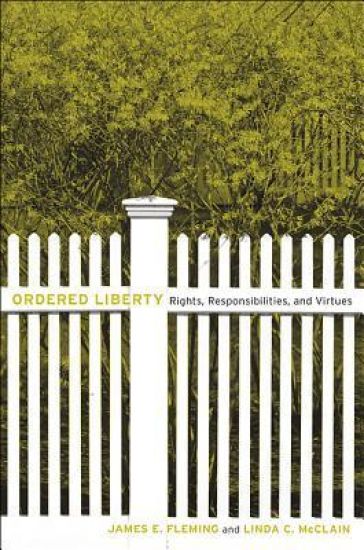
Ordered Liberty

Ordered Liberty

James E. Fleming; Linda C. McClain

Harvard University Press
2013
sidottu
Many have argued in recent years that the U.S. constitutional system exalts individual rights over responsibilities, virtues, and the common good. Answering the charges against liberal theories of rights, James Fleming and Linda McClain develop and defend a civic liberalism that takes responsibilities and virtues—as well as rights—seriously. They provide an account of ordered liberty that protects basic liberties stringently, but not absolutely, and permits government to encourage responsibility and inculcate civic virtues without sacrificing personal autonomy to collective determination.The battle over same-sex marriage is one of many current controversies the authors use to defend their understanding of the relationship among rights, responsibilities, and virtues. Against accusations that same-sex marriage severs the rights of marriage from responsible sexuality, procreation, and parenthood, they argue that same-sex couples seek the same rights, responsibilities, and goods of civil marriage that opposite-sex couples pursue. Securing their right to marry respects individual autonomy while also promoting moral goods and virtues. Other issues to which they apply their idea of civic liberalism include reproductive freedom, the proper roles and regulation of civil society and the family, the education of children, and clashes between First Amendment freedoms (of association and religion) and antidiscrimination law. Articulating common ground between liberalism and its critics, Fleming and McClain develop an account of responsibilities and virtues that appreciates the value of diversity in our morally pluralistic constitutional democracy.
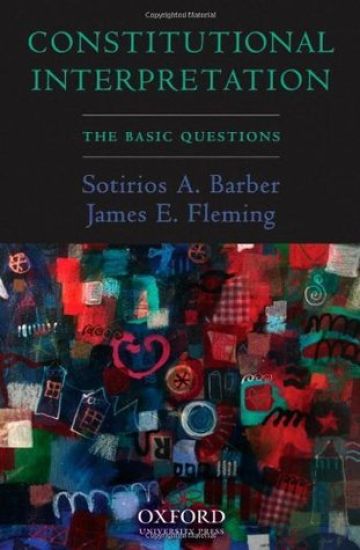
Constitutional Interpretation

Constitutional Interpretation

Sotirios A. Barber; James E. Fleming

Oxford University Press Inc
2007
nidottu
Ronald Dworkin famously argued that fidelity in interpreting the Constitution as written calls for a fusion of constitutional law and moral philosophy. Barber and Fleming take up that call, arguing for a philosophic approach to constitutional interpretation. In doing so, they systematically critique the competing approaches - textualism, consensualism, originalism, structuralism, doctrinalism, minimalism, and pragmatism - that aim and claim to avoid a philosophic approach. Constitutional Interpretation: The Basic Questions illustrates that these approaches cannot avoid philosophic reflection and choice in interpreting the Constitution. Barber and Fleming contend that fidelity in constitutional interpretation requires a fusion of philosophic and other approaches, properly understood. Within such a fusion, interpreters would begin to think of text, consensus, intentions, structures, and doctrines not as alternatives to, but as sites of philosophic reflection about the best understanding of our constitutional commitments. Constitutional Interpretation: The Basic Questions examines the fundamental inquiries that arise in interpreting constitutional law. In doing so, the authors survey the controversial and intriguing questions that have stirred constitutional debate in the United States for over two centuries, such as: how and for what ends should governmental institutions and powers be arranged; what does the Constitution mean under general circumstances and how should it be interpreted during concrete controversies; and finally how do we decide what our constitution means and who ultimately decides its meaning.