Kirjojen hintavertailu. Mukana 12 327 563 kirjaa ja 12 kauppaa.

Kirjailija

James E. Gentle

Kirjat ja teokset yhdessä paikassa: 10 kirjaa, julkaisuja vuosilta 1998-2025, suosituimpien joukossa Numerical Linear Algebra for Applications in Statistics. Vertaile teosten hintoja ja tarkista saatavuus suomalaisista kirjakaupoista.

10 kirjaa

Kirjojen julkaisuhaarukka 1998-2025.

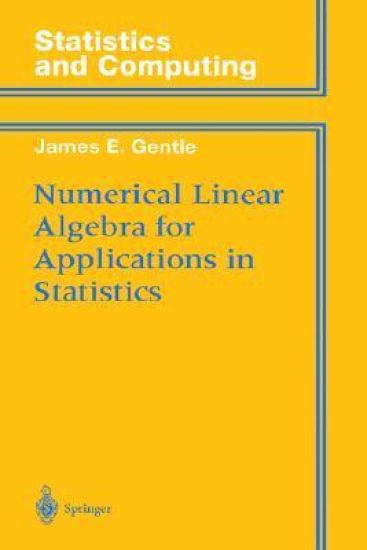
Numerical Linear Algebra for Applications in Statistics

Numerical Linear Algebra for Applications in Statistics

James E. Gentle

Springer-Verlag New York Inc.
2012
nidottu
Numerical linear algebra is one of the most important subjects in the field of statistical computing. Statistical methods in many areas of application require computations with vectors and matrices. This book describes accurate and efficient computer algorithms for factoring matrices, solving linear systems of equations, and extracting eigenvalues and eigenvectors. Although the book is not tied to any particular software system, it describes and gives examples of the use of modern computer software for numerical linear algebra. An understanding of numerical linear algebra requires basic knowledge both of linear algebra and of how numerical data are stored and manipulated in the computer. The book begins with a discussion of the basics of numerical computations, and then describes the relevant properties of matrix inverses, matrix factorizations, matrix and vector norms, and other topics in linear algebra; hence, the book is essentially self- contained. The topics addressed in this bookconstitute the most important material for an introductory course in statistical computing, and should be covered in every such course. The book includes exercises and can be used as a text for a first course in statistical computing or as supplementary text for various courses that emphasize computations. James Gentle is University Professor of Computational Statistics at George Mason University. During a thirteen-year hiatus from academic work before joining George Mason, he was director of research and design at the world's largest independent producer of Fortran and C general-purpose scientific software libraries. These libraries implement many algorithms for numerical linear algebra. He is a Fellow of the American Statistical Association and member of the International Statistical Institute. He has held several national
Matrix Algebra

Matrix Algebra

James E. Gentle

Springer International Publishing AG
2024
sidottu
This book presents the theory of matrix algebra for statistical applications, explores various types of matrices encountered in statistics, and covers numerical linear algebra. Matrix algebra is one of the most important areas of mathematics in data science and in statistical theory, and previous editions had essential updates and comprehensive coverage on critical topics in mathematics.This 3rd edition offers a self-contained description of relevant aspects of matrix algebra for applications in statistics. It begins with fundamental concepts of vectors and vector spaces; covers basic algebraic properties of matrices and analytic properties of vectors and matrices in multivariate calculus; and concludes with a discussion on operations on matrices, in solutions of linear systems and in eigenanalysis. It also includes discussions of the R software package, with numerous examples and exercises.Matrix Algebra considers various types of matrices encountered in statistics, such as projection matrices and positive definite matrices, and describes special properties of those matrices; as well as describing various applications of matrix theory in statistics, including linear models, multivariate analysis, and stochastic processes. It begins with a discussion of the basics of numerical computations and goes on to describe accurate and efficient algorithms for factoring matrices, how to solve linear systems of equations, and the extraction of eigenvalues and eigenvectors. It covers numerical linear algebra—one of the most important subjects in the field of statistical computing. The content includes greater emphases on R, and extensive coverage of statistical linear models. Matrix Algebra is ideal for graduate and advanced undergraduate students, or as a supplementary text for courses in linear models or multivariate statistics. It’s also ideal for use in a course in statistical computing, or as a supplementary text forvarious courses that emphasize computations.
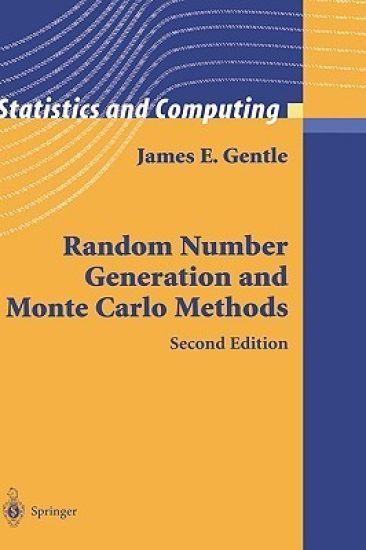
Random Number Generation and Monte Carlo Methods

Random Number Generation and Monte Carlo Methods

James E. Gentle

Springer-Verlag New York Inc.
2003
sidottu
Monte Carlo simulation has become one of the most important tools in all fields of science. Simulation methodology relies on a good source of numbers that appear to be random. These "pseudorandom" numbers must pass statistical tests just as random samples would. Methods for producing pseudorandom numbers and transforming those numbers to simulate samples from various distributions are among the most important topics in statistical computing. This book surveys techniques of random number generation and the use of random numbers in Monte Carlo simulation. The book covers basic principles, as well as newer methods such as parallel random number generation, nonlinear congruential generators, quasi Monte Carlo methods, and Markov chain Monte Carlo. The best methods for generating random variates from the standard distributions are presented, but also general techniques useful in more complicated models and in novel settings are described. The emphasis throughout the book is on practical methods that work well in current computing environments. The book includes exercises and can be used as a test or supplementary text for various courses in modern statistics. It could serve as the primary test for a specialized course in statistical computing, or as a supplementary text for a course in computational statistics and other areas of modern statistics that rely on simulation. The book, which covers recent developments in the field, could also serve as a useful reference for practitioners. Although some familiarity with probability and statistics is assumed, the book is accessible to a broad audience. The second edition is approximately 50% longer than the first edition. It includes advances in methods for parallel random number generation, universal methods for generation of nonuniform variates, perfect sampling, and software for random number generation.
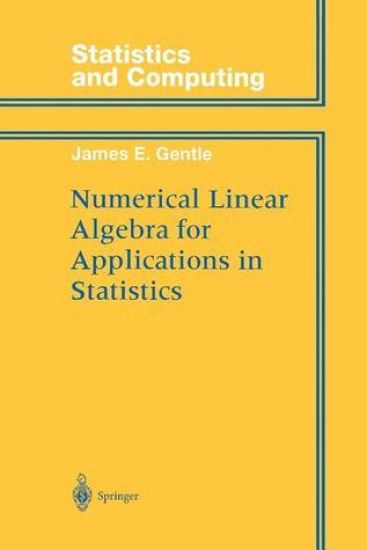
Numerical Linear Algebra for Applications in Statistics

Numerical Linear Algebra for Applications in Statistics

James E. Gentle

Springer-Verlag New York Inc.
1998
sidottu
Numerical linear algebra is one of the most important subjects in the field of statistical computing. Statistical methods in many areas of application require computations with vectors and matrices. This book describes accurate and efficient computer algorithms for factoring matrices, solving linear systems of equations, and extracting eigenvalues and eigenvectors. Although the book is not tied to any particular software system, it describes and gives examples of the use of modern computer software for numerical linear algebra. An understanding of numerical linear algebra requires basic knowledge both of linear algebra and of how numerical data are stored and manipulated in the computer. The book begins with a discussion of the basics of numerical computations, and then describes the relevant properties of matrix inverses, matrix factorizations, matrix and vector norms, and other topics in linear algebra; hence, the book is essentially self- contained. The topics addressed in this bookconstitute the most important material for an introductory course in statistical computing, and should be covered in every such course. The book includes exercises and can be used as a text for a first course in statistical computing or as supplementary text for various courses that emphasize computations. James Gentle is University Professor of Computational Statistics at George Mason University. During a thirteen-year hiatus from academic work before joining George Mason, he was director of research and design at the world's largest independent producer of Fortran and C general-purpose scientific software libraries. These libraries implement many algorithms for numerical linear algebra. He is a Fellow of the American Statistical Association and member of the International Statistical Institute. He has held several national
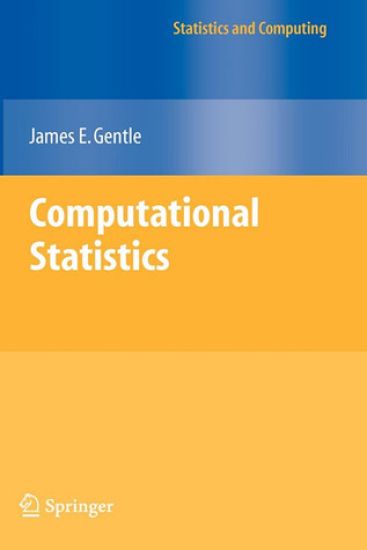
Computational Statistics

Computational Statistics

James E. Gentle

Springer-Verlag New York Inc.
2012
nidottu
Computational inference has taken its place alongside asymptotic inference and exact techniques in the standard collection of statistical methods. Computational inference is based on an approach to statistical methods that uses modern computational power to simulate distributional properties of estimators and test statistics. This book describes computationally-intensive statistical methods in a unified presentation, emphasizing techniques, such as the PDF decomposition, that arise in a wide range of methods. The book assumes an intermediate background in mathematics, computing, and applied and theoretical statistics. The first part of the book, consisting of a single long chapter, reviews this background material while introducing computationally-intensive exploratory data analysis and computational inference. The six chapters in the second part of the book are on statistical computing. This part describes arithmetic in digital computers and how the nature of digital computations affects algorithms used in statistical methods. Building on the first chapters on numerical computations and algorithm design, the following chapters cover the main areas of statistical numerical analysis, that is, approximation of functions, numerical quadrature, numerical linear algebra, solution of nonlinear equations, optimization, and random number generation. The third and fourth parts of the book cover methods of computational statistics, including Monte Carlo methods, randomization and cross validation, the bootstrap, probability density estimation, and statistical learning. The book includes a large number of exercises with some solutions provided in an appendix.
Elements of Computational Statistics

Elements of Computational Statistics

James E. Gentle

Springer-Verlag New York Inc.
2010
nidottu
In recent years developments in statistics have to a great extent gone hand in hand with developments in computing. Indeed, many of the recent advances in statistics have been dependent on advances in computer science and techn- ogy. Many of the currently interesting statistical methods are computationally intensive, eitherbecausetheyrequireverylargenumbersofnumericalcompu- tions or because they depend on visualization of many projections of the data. The class of statistical methods characterized by computational intensity and the supporting theory for such methods constitute a discipline called “com- tational statistics”. (Here, I am following Wegman, 1988, and distinguishing “computationalstatistics”from“statisticalcomputing”, whichwetaketomean “computational methods, including numerical analysis, for statisticians”.) The computationally-intensive methods of modern statistics rely heavily on the developments in statistical computing and numerical analysis generally. Computational statistics shares two hallmarks with other “computational” sciences, such as computational physics, computational biology, and so on. One is a characteristic of the methodology: it is computationally intensive. The other is the nature of the tools of discovery. Tools of the scienti?c method have generally been logical deduction (theory) and observation (experimentation). The computer, used to explore large numbers of scenarios, constitutes a new type of tool. Use of the computer to simulate alternatives and to present the research worker with information about these alternatives is a characteristic of thecomputationalsciences. Insomewaysthisusageisakintoexperimentation. The observations, however, are generated from an assumed model, and those simulated data are used toevaluate and study the model.
Random Number Generation and Monte Carlo Methods

Random Number Generation and Monte Carlo Methods

James E. Gentle

Springer-Verlag New York Inc.
2010
nidottu
Monte Carlo simulation has become one of the most important tools in all fields of science. Simulation methodology relies on a good source of numbers that appear to be random. These "pseudorandom" numbers must pass statistical tests just as random samples would. Methods for producing pseudorandom numbers and transforming those numbers to simulate samples from various distributions are among the most important topics in statistical computing. This book surveys techniques of random number generation and the use of random numbers in Monte Carlo simulation. The book covers basic principles, as well as newer methods such as parallel random number generation, nonlinear congruential generators, quasi Monte Carlo methods, and Markov chain Monte Carlo. The best methods for generating random variates from the standard distributions are presented, but also general techniques useful in more complicated models and in novel settings are described. The emphasis throughout the book is on practical methods that work well in current computing environments. The book includes exercises and can be used as a test or supplementary text for various courses in modern statistics. It could serve as the primary test for a specialized course in statistical computing, or as a supplementary text for a course in computational statistics and other areas of modern statistics that rely on simulation. The book, which covers recent developments in the field, could also serve as a useful reference for practitioners. Although some familiarity with probability and statistics is assumed, the book is accessible to a broad audience. The second edition is approximately 50% longer than the first edition. It includes advances in methods for parallel random number generation, universal methods for generation of nonuniform variates, perfect sampling, and software for random number generation.
Computational Statistics

Computational Statistics

James E. Gentle

Springer-Verlag New York Inc.
2009
sidottu
Computational inference has taken its place alongside asymptotic inference and exact techniques in the standard collection of statistical methods. Computational inference is based on an approach to statistical methods that uses modern computational power to simulate distributional properties of estimators and test statistics. This book describes computationally-intensive statistical methods in a unified presentation, emphasizing techniques, such as the PDF decomposition, that arise in a wide range of methods. The book assumes an intermediate background in mathematics, computing, and applied and theoretical statistics. The first part of the book, consisting of a single long chapter, reviews this background material while introducing computationally-intensive exploratory data analysis and computational inference. The six chapters in the second part of the book are on statistical computing. This part describes arithmetic in digital computers and how the nature of digital computations affects algorithms used in statistical methods. Building on the first chapters on numerical computations and algorithm design, the following chapters cover the main areas of statistical numerical analysis, that is, approximation of functions, numerical quadrature, numerical linear algebra, solution of nonlinear equations, optimization, and random number generation. The third and fourth parts of the book cover methods of computational statistics, including Monte Carlo methods, randomization and cross validation, the bootstrap, probability density estimation, and statistical learning. The book includes a large number of exercises with some solutions provided in an appendix.
Elements of Computational Statistics

Elements of Computational Statistics

James E. Gentle

Springer-Verlag New York Inc.
2002
sidottu
In recent years developments in statistics have to a great extent gone hand in hand with developments in computing. Indeed, many of the recent advances in statistics have been dependent on advances in computer science and techn- ogy. Many of the currently interesting statistical methods are computationally intensive, eitherbecausetheyrequireverylargenumbersofnumericalcompu- tions or because they depend on visualization of many projections of the data. The class of statistical methods characterized by computational intensity and the supporting theory for such methods constitute a discipline called “com- tational statistics”. (Here, I am following Wegman, 1988, and distinguishing “computationalstatistics”from“statisticalcomputing”, whichwetaketomean “computational methods, including numerical analysis, for statisticians”.) The computationally-intensive methods of modern statistics rely heavily on the developments in statistical computing and numerical analysis generally. Computational statistics shares two hallmarks with other “computational” sciences, such as computational physics, computational biology, and so on. One is a characteristic of the methodology: it is computationally intensive. The other is the nature of the tools of discovery. Tools of the scienti?c method have generally been logical deduction (theory) and observation (experimentation). The computer, used to explore large numbers of scenarios, constitutes a new type of tool. Use of the computer to simulate alternatives and to present the research worker with information about these alternatives is a characteristic of thecomputationalsciences. Insomewaysthisusageisakintoexperimentation. The observations, however, are generated from an assumed model, and those simulated data are used toevaluate and study the model.