Kirjailija
James Ferguson
Kirjat ja teokset yhdessä paikassa: 103 kirjaa, julkaisuja vuosilta 1988-2026, suosituimpien joukossa Robert Ferguson, the Plotter. Vertaile teosten hintoja ja tarkista saatavuus suomalaisista kirjakaupoista.
103 kirjaa
Kirjojen julkaisuhaarukka 1988-2026.
Astronomy Explained Upon Sir Isaac Newton's Principles, and Made Easy to Those who Have not Studied Mathematics. To Which are Added, a Plain Method of Finding the Distances of all the Planets From the sun The Third Edition
James Ferguson
Gale Ecco, Print Editions
2018
sidottu
The 18th century was a wealth of knowledge, exploration and rapidly growing technology and expanding record-keeping made possible by advances in the printing press. In its determination to preserve the century of revolution, Gale initiated a revolution of its own: digitization of epic proportions to preserve these invaluable works in the largest archive of its kind. Now for the first time these high-quality digital copies of original 18th century manuscripts are available in print, making them highly accessible to libraries, undergraduate students, and independent scholars.Medical theory and practice of the 1700s developed rapidly, as is evidenced by the extensive collection, which includes descriptions of diseases, their conditions, and treatments. Books on science and technology, agriculture, military technology, natural philosophy, even cookbooks, are all contained here.++++The below data was compiled from various identification fields in the bibliographic record of this title. This data is provided as an additional tool in helping to insure edition identification: ++++British LibraryT134283London: printed for A. Millar, 1764. 8],354, 10]p., XVII plates; 4
Astronomy Explained Upon Sir Isaac Newton's Principles, and Made Easy to Those Who Have Not Studied Mathematics. to Which Are Added, a Plain Method of Finding the Distances of All the Planets from the Sun the Sixth Edition, Corrected
James Ferguson
Gale Ecco, Print Editions
2018
sidottu
The 18th century was a wealth of knowledge, exploration and rapidly growing technology and expanding record-keeping made possible by advances in the printing press. In its determination to preserve the century of revolution, Gale initiated a revolution of its own: digitization of epic proportions to preserve these invaluable works in the largest archive of its kind. Now for the first time these high-quality digital copies of original 18th century manuscripts are available in print, making them highly accessible to libraries, undergraduate students, and independent scholars.Medical theory and practice of the 1700s developed rapidly, as is evidenced by the extensive collection, which includes descriptions of diseases, their conditions, and treatments. Books on science and technology, agriculture, military technology, natural philosophy, even cookbooks, are all contained here.++++The below data was compiled from various identification fields in the bibliographic record of this title. This data is provided as an additional tool in helping to insure edition identification: ++++British LibraryT018602With an index.London: printed for W. Strahan, J. Rivington and Sons, J. Hinton, T. Longman, T. Lowndes and 6 others in London], 1778. 8],501, 15]p., plates; 8
Astronomy Explained Upon Sir Isaac Newton's Principles, and Made Easy to Those who Have not Studied Mathematics. By James Ferguson
James Ferguson
Gale Ecco, Print Editions
2018
sidottu
The 18th century was a wealth of knowledge, exploration and rapidly growing technology and expanding record-keeping made possible by advances in the printing press. In its determination to preserve the century of revolution, Gale initiated a revolution of its own: digitization of epic proportions to preserve these invaluable works in the largest archive of its kind. Now for the first time these high-quality digital copies of original 18th century manuscripts are available in print, making them highly accessible to libraries, undergraduate students, and independent scholars.Medical theory and practice of the 1700s developed rapidly, as is evidenced by the extensive collection, which includes descriptions of diseases, their conditions, and treatments. Books on science and technology, agriculture, military technology, natural philosophy, even cookbooks, are all contained here.++++The below data was compiled from various identification fields in the bibliographic record of this title. This data is provided as an additional tool in helping to insure edition identification: ++++British LibraryT018586With an index.London: printed for, and sold by the author, 1756. 8],267, 9]p., plates; 4

Astronomy Explained Upon Sir Isaac Newton's Principles, and Made Easy to Those who Have not Studied Mathematics. By James Ferguson. The Second Edition
James Ferguson
Gale Ecco, Print Editions
2018
sidottu
The 18th century was a wealth of knowledge, exploration and rapidly growing technology and expanding record-keeping made possible by advances in the printing press. In its determination to preserve the century of revolution, Gale initiated a revolution of its own: digitization of epic proportions to preserve these invaluable works in the largest archive of its kind. Now for the first time these high-quality digital copies of original 18th century manuscripts are available in print, making them highly accessible to libraries, undergraduate students, and independent scholars.Medical theory and practice of the 1700s developed rapidly, as is evidenced by the extensive collection, which includes descriptions of diseases, their conditions, and treatments. Books on science and technology, agriculture, military technology, natural philosophy, even cookbooks, are all contained here.++++The below data was compiled from various identification fields in the bibliographic record of this title. This data is provided as an additional tool in helping to insure edition identification: ++++British LibraryT018585With an index.London: printed for, and sold by the author, 1757. 8],283, 9]p., plates; 4

Two Letters to the Rev. Mr. John Kennedy, Containing an Account of Many Mistakes in the Astronomical Part of his Scripture Chronology. And his Abusive Treatment of Astronomical Authors. By James Ferguson, F.R.S
James Ferguson
Gale Ecco, Print Editions
2018
sidottu
The 18th century was a wealth of knowledge, exploration and rapidly growing technology and expanding record-keeping made possible by advances in the printing press. In its determination to preserve the century of revolution, Gale initiated a revolution of its own: digitization of epic proportions to preserve these invaluable works in the largest archive of its kind. Now for the first time these high-quality digital copies of original 18th century manuscripts are available in print, making them highly accessible to libraries, undergraduate students, and independent scholars.Medical theory and practice of the 1700s developed rapidly, as is evidenced by the extensive collection, which includes descriptions of diseases, their conditions, and treatments. Books on science and technology, agriculture, military technology, natural philosophy, even cookbooks, are all contained here.++++The below data was compiled from various identification fields in the bibliographic record of this title. This data is provided as an additional tool in helping to insure edition identification: ++++British LibraryT134293With a half-title.London: printed for T. Cadell, 1775. 4],32p.; 8

The Young Gentleman and Lady's Astronomy, Familiarly Explained in ten Dialogues Between Neander and Eudosia. To Which is Added, The Description and use of the Globes and Armillary Sphere. By James Ferguson,
James Ferguson
Gale Ecco, Print Editions
2018
sidottu
The 18th century was a wealth of knowledge, exploration and rapidly growing technology and expanding record-keeping made possible by advances in the printing press. In its determination to preserve the century of revolution, Gale initiated a revolution of its own: digitization of epic proportions to preserve these invaluable works in the largest archive of its kind. Now for the first time these high-quality digital copies of original 18th century manuscripts are available in print, making them highly accessible to libraries, undergraduate students, and independent scholars.Medical theory and practice of the 1700s developed rapidly, as is evidenced by the extensive collection, which includes descriptions of diseases, their conditions, and treatments. Books on science and technology, agriculture, military technology, natural philosophy, even cookbooks, are all contained here.++++The below data was compiled from various identification fields in the bibliographic record of this title. This data is provided as an additional tool in helping to insure edition identification: ++++British LibraryT131240In two parts, the second having a divisional titlepage and separate pagination; the register is continuous.Dublin: printed by Boulter Grierson, 1768. 4],146,91, 1]p., VIIIplates; 8



Both on the continent and off, “Africa” is spoken of in terms of crisis: as a place of failure and seemingly insurmountable problems, as a moral challenge to the international community. What, though, is really at stake in discussions about Africa, its problems, and its place in the world? And what should be the response of those scholars who have sought to understand not the “Africa” portrayed in broad strokes in journalistic accounts and policy papers but rather specific places and social realities within Africa?In Global Shadows the renowned anthropologist James Ferguson moves beyond the traditional anthropological focus on local communities to explore more general questions about Africa and its place in the contemporary world. Ferguson develops his argument through a series of provocative essays which open-as he shows they must-into interrogations of globalization, modernity, worldwide inequality, and social justice. He maintains that Africans in a variety of social and geographical locations increasingly seek to make claims of membership within a global community, claims that contest the marginalization that has so far been the principal fruit of “globalization” for Africa. Ferguson contends that such claims demand new understandings of the global, centered less on transnational flows and images of unfettered connection than on the social relations that selectively constitute global society and on the rights and obligations that characterize it.Ferguson points out that anthropologists and others who have refused the category of Africa as empirically problematic have, in their devotion to particularity, allowed themselves to remain bystanders in the broader conversations about Africa. In Global Shadows, he urges fellow scholars into the arena, encouraging them to find a way to speak beyond the academy about Africa’s position within an egregiously imbalanced world order.
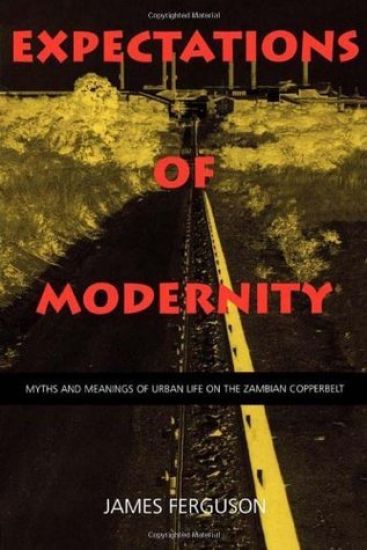
Once lauded as the wave of the African future, Zambia's economic boom in the 1960s and early 1970s was fueled by the export of copper and other primary materials. Since the mid-1970s, however, the urban economy has rapidly deteriorated, leaving workers scrambling to get by. "Expectations of Modernity" explores the social and cultural responses to this prolonged period of sharp economic decline. Focusing on the experiences of mineworkers in the Copperbelt region, James Ferguson traces the failure of standard narratives of urbanization and social change to make sense of the Copperbelt's recent history. He instead develops alternative analytic tools appropriate for an 'ethnography of decline'. Ferguson shows how the Zambian copper workers understand their own experience of social, cultural, and economic 'advance' and 'decline'. Ferguson's ethnographic study transports us into their lives - the dynamics of their relations with family and friends, as well as copper companies and government agencies. Theoretically sophisticated and vividly written, "Expectations of Modernity" will appeal not only to those interested in Africa today, but to anyone contemplating the illusory successes of today's globalizing economy.

The US invasion of Grenada in 1983 was seen as a victory for freedom. By the early 1990s, however, the story of post-invasion Grenada had become one of disillusionment and cynicism. This work reveals the extent of the US failure, economic and political, and its impact on the island's people.

Looks at the Caribbean behind the tourist brochures: small, vulnerable countries beset by poverty and injustice, searching for a road out of underdevelopment. It traces the history of the area and looks at recent experiences of Jamaica, Grenada, Trinidad & Tobago, and Haiti.