Kirjojen hintavertailu. Mukana 12 431 240 kirjaa ja 12 kauppaa.

Kirjailija

James Fergusson

Kirjat ja teokset yhdessä paikassa: 111 kirjaa, julkaisuja vuosilta 2003-2025, suosituimpien joukossa Architecture at Ahmedabad, the Capital of Goozerat, photographed by Colonel Biggs, ... With an historical and descriptive sketch, by T. C. H., ... and architectural notes by J. Fergusson, etc.. Vertaile teosten hintoja ja tarkista saatavuus suomalaisista kirjakaupoista.

Mukana myös kirjoitusasut: James. Fergusson

111 kirjaa

Kirjojen julkaisuhaarukka 2003-2025.

The Holy Sepulchre And The Temple At Jerusalem
This work has been selected by scholars as being culturally important, and is part of the knowledge base of civilization as we know it. This work was reproduced from the original artifact, and remains as true to the original work as possible. Therefore, you will see the original copyright references, library stamps (as most of these works have been housed in our most important libraries around the world), and other notations in the work.This work is in the public domain in the United States of America, and possibly other nations. Within the United States, you may freely copy and distribute this work, as no entity (individual or corporate) has a copyright on the body of the work.As a reproduction of a historical artifact, this work may contain missing or blurred pages, poor pictures, errant marks, etc. Scholars believe, and we concur, that this work is important enough to be preserved, reproduced, and made generally available to the public. We appreciate your support of the preservation process, and thank you for being an important part of keeping this knowledge alive and relevant.
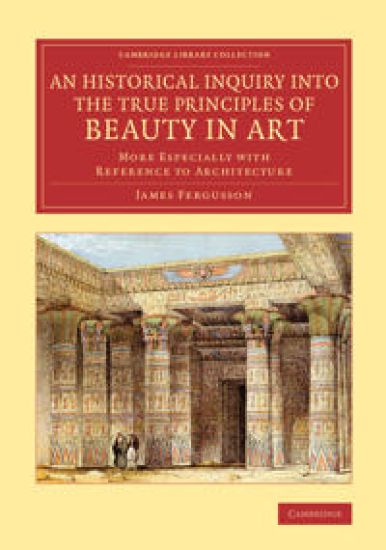
An Historical Inquiry into the True Principles of Beauty in Art
Born in Scotland, James Fergusson (1808–86) spent ten years as an indigo planter in India before embarking upon a second career as an architectural historian. Despite his lack of formal training, he became an expert in the field of Indian architecture, publishing Cave Temples of India and a History of Indian and Eastern Architecture, as well as The Holy Sepulchre and the Temple at Jerusalem, all reissued in the Cambridge Library Collection. In this illustrated work of 1849, he considers beauty in art, expressed chiefly by the architectural styles of different civilisations, beginning with ancient Egypt, and finishing with ancient Rome. (This book is named 'Part the First', but no subsequent volumes were written.) The first section is theoretical, tracing the intellectual development of man and his aesthetic sense, while the second considers the surviving evidence of the ideas of beauty held in the ancient world.
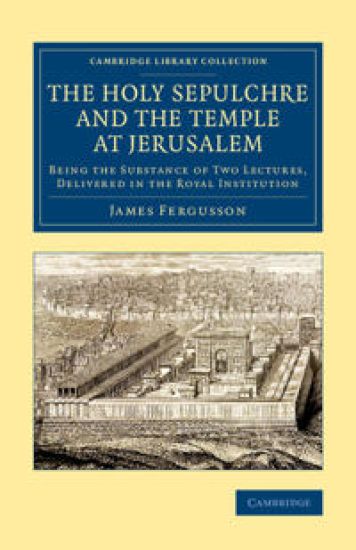
The Holy Sepulchre and the Temple at Jerusalem

The Holy Sepulchre and the Temple at Jerusalem

James Fergusson

Cambridge University Press
2015
pokkari
Born in Scotland, James Fergusson (1808–86) spent ten years as an indigo planter in India before embarking upon a second career as an architectural historian. Despite his lack of formal training, he became an expert in the field of Indian architecture. The topography and temples of ancient Jerusalem also fascinated him. This 1865 collection of two lectures summarises his controversial topographical and architectural argument that the location where Constantine erected the original Holy Sepulchre was the Dome of the Rock on the Temple Mount. Fergusson then describes the Temple in its successive forms, arguing against the view that the rock known as the foundation stone was the site of the Jewish altar. The work is illustrated throughout with plans and drawings. Fergusson's Cave Temples of India (1880) and the two-volume revised edition of his History of Indian and Eastern Architecture (1910) are also reissued in the Cambridge Library Collection.
World's Most Dangerous Place

World's Most Dangerous Place

James Fergusson

Transworld Publishers Ltd
2014
pokkari
The author is among the few to have witnessed at first hand the devastating reality of life in the failed and desperate state of Somalia. In this book, he takes us to the heart of the struggle, meeting everyone from politicians, pirates, extremists and mercenaries to aid workers, civilians and refugees.
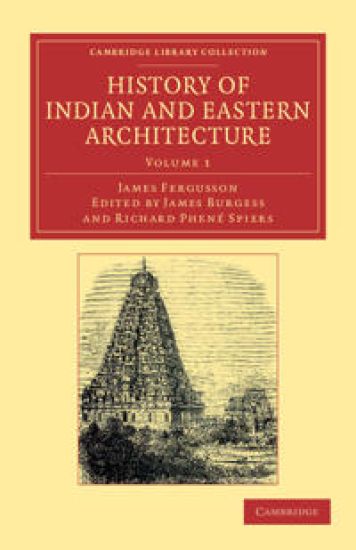
History of Indian and Eastern Architecture

History of Indian and Eastern Architecture

James Fergusson

Cambridge University Press
2013
pokkari
Born in Scotland, James Fergusson (1808–86) spent ten years as an indigo planter in India before embarking upon a second career as an architectural historian. Although he had no formal training, he became one of the most respected researchers in the field and an expert on India's cave temples. His History of Indian and Eastern Architecture was first published in 1876 and became a standard work. It was revised in this two-volume edition of 1910 by James Burgess (1832–1916), former Director of the Archaeological Survey of India, and Richard Spiers (1838–1916), a noted architect and historian of architecture. Volume 1 covers Buddhist and Himalayan architecture, the Dravidian style of southern India, and the later Chalukyan style from southern and central India in the early medieval period. Illustrated with 280 maps, plans and drawings, this work of impressive scope remains relevant to students of Indian architecture and history.
History of Indian and Eastern Architecture: Volume 2

History of Indian and Eastern Architecture: Volume 2

James Fergusson

Cambridge University Press
2013
pokkari
Born in Scotland, James Fergusson (1808–86) spent ten years as an indigo planter in India before embarking upon a second career as an architectural historian. Although he had no formal training, he became one of the most respected researchers in the field and an expert on India's cave temples. His History of Indian and Eastern Architecture was first published in 1876 and became a standard work. It was revised in this two-volume edition of 1910 by James Burgess (1832–1916), former Director of the Archaeological Survey of India, and Richard Spiers (1838–1916), a noted architect and historian of architecture. Volume 2 covers Jain and Indo-Aryan architecture, Islamic architecture in India, and the buildings of Burma, Cambodia, Thailand and Java. The final chapter looks at Chinese and Japanese temples. Illustrated with nearly 300 maps, plans and drawings, this work of impressive scope remains relevant to students of Indian and Asian architecture and history.
The Cave Temples of India

The Cave Temples of India

James Fergusson; James Burgess

Cambridge University Press
2013
pokkari
Born in Scotland, James Fergusson (1808–86) spent ten years as an indigo planter in India, the profits from which allowed him to embark upon a second career as an architectural historian. Although he had no formal training, he became one of the most respected researchers in the field, particularly in Indian architecture. He made numerous trips around India in order to study and document its cave temples, publishing his first book on the subject in 1845. In 1880, he returned to the subject, collaborating with the archaeologist James Burgess (1832–1916) as part of the Archaeological Survey of India. It was Fergusson who first categorized the temples, suggesting that they could be classified through reference to the religious order and function. Illustrated with more than 150 maps, plans and drawings, this work of impressive scope remains of relevance to students of Indian architecture and history.
The World's Most Dangerous Place: Inside the Outlaw State of Somalia
Although the war in Afghanistan is now in its endgame, the West's struggle to eliminate the threat from Al Qaeda is far from over. A decade after 9/11, the war on terror has entered a new phase and, it would seem, a new territory. In early 2010, Al Qaeda operatives were reportedly "streaming" out of central Asia toward Somalia and the surrounding region. Somalia, now home to some of the world's most dangerous terrorists, was already the world's most failed state. Two decades of anarchy have spawned not just Islamic extremism but piracy, famine, and a seemingly endless clan-based civil war that has killed an estimated 500,000, turned millions into refugees, and caused hundreds of thousands more to flee and settle in Europe and North America. What is now happening in Somalia directly threatens the security of the world, possibly more than any other region on earth. James Fergusson's book is the first accessible account of how Somalia became the world's most dangerous place and what we can--and should--do about it.
Taliban

Taliban

James Fergusson

Da Capo Press Inc
2012
pokkari
From a small group of religious students formed in 1994, the Taliban quickly grew into a national movement that occupied all of Afghanistan. When the Americans overthrew the Taliban in 2001, the United States thought the regime had been defeated. Yet today, more than a decade later, the Taliban continue to wage a bloody insurgency. In this extraordinary and compelling account of the rise, fall, and return of the Taliban, award-winning author James Fergusson presents the reality of the movement so often mischaracterized in the press while asking provocative yet necessary questions about the current strategy in Afghanistan.
Taliban

Taliban

James Fergusson

Transworld Publishers Ltd
2011
pokkari
The Taliban, as they now called themselves - taliban is the plural of talib, literally ''one who seeks knowledge'' - had a simple mission statement: the disarmament of the population, and the establishment of a theocracy based on Sharia law.
The Holy Places at Jerusalem, Or, Fergusson's Theories and Pierotti's Discoveries. [With Plates.]

The Holy Places at Jerusalem, Or, Fergusson's Theories and Pierotti's Discoveries. [With Plates.]

Thomas George Bonney; James Fergusson; Ermete Pierotti

British Library, Historical Print Editions
2011
pokkari
Title: The Holy Places at Jerusalem, or, Fergusson's theories and Pierotti's discoveries. With plates.]Publisher: British Library, Historical Print EditionsThe British Library is the national library of the United Kingdom. It is one of the world's largest research libraries holding over 150 million items in all known languages and formats: books, journals, newspapers, sound recordings, patents, maps, stamps, prints and much more. Its collections include around 14 million books, along with substantial additional collections of manuscripts and historical items dating back as far as 300 BC.The HISTORY OF ASIA collection includes books from the British Library digitised by Microsoft. This series includes ethnographic and general histories of distinct peripheral coastal regions that comprise South and East Asia. Other works focus on cultural history, archaeology, and linguistics. These books help readers understand the forces that shaped the ancient civilisations and influenced the modern countries of Asia. ++++The below data was compiled from various identification fields in the bibliographic record of this title. This data is provided as an additional tool in helping to insure edition identification: ++++ British Library Bonney, Thomas George; Fergusson, James; Pierotti, Ermete; 1864. 32 p.; 8 . 10076.bb.21.