Kirjojen hintavertailu. Mukana 12 595 353 kirjaa ja 12 kauppaa.

Kirjailija

James Lee

Kirjat ja teokset yhdessä paikassa: 461 kirjaa, julkaisuja vuosilta 2004-2026, suosituimpien joukossa Silesian Folk Tales. Vertaile teosten hintoja ja tarkista saatavuus suomalaisista kirjakaupoista.

461 kirjaa

Kirjojen julkaisuhaarukka 2004-2026.

It is Written!: Spiritual Warfare Focusing on God and His Mighty Power
Believers in Christ must focus on God's divine authority and power to destroy the works of the devil by evangelizing the world. When we are engaging in all sorts of spiritual battles in life, we must focus on becoming strong in the Lord and in the power of His might (Ephesians 6:10), and not focus on Satan and his evil hosts of darkness. In this book, we will examine the Scriptures to see how the heroes of the faith conducted spiritual warfare so we can learn from their examples how to apply their principles to our own spiritual battles.
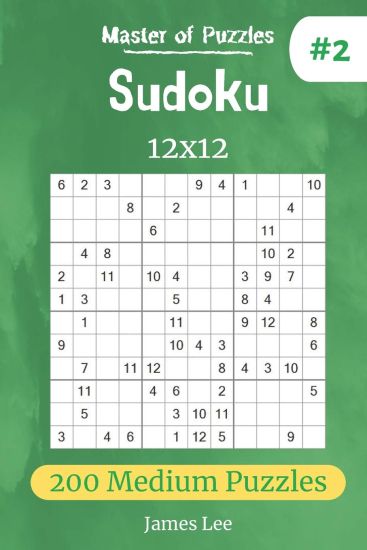
Master of Puzzles - Sudoku 12x12 200 Medium Puzzles vol.2
The puzzle a 12 x 12 grid made up of 3 x 4 subgrids (called "regions"). Some cells already contain numbers, known as "givens". The goal is to fill in the empty cells, one number in each, so that each column, row, and region contains the numbers 1 through 12 exactly once. Each number in the solution therefore occurs only once in each of three "directions", hence the "single numbers" implied by the puzzle's name.
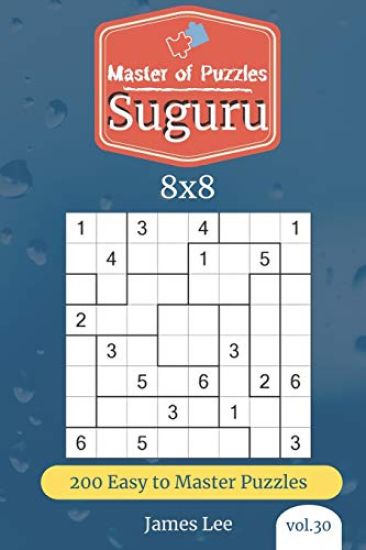
Master of Puzzles - Suguru 200 Easy to Master Puzzles 8x8 (vol. 30)
Suguru, also known as Tectonics or Number Blocks, is a Japanese puzzle invented by Naoki Inaba. The goal is to fill a given rectangular grid with numbers, so that every designated area contains a sequence of non-repeating, consecutive numbers, starting from 1 and going up. Also, adjacent (touching) cells should not contain the same number, even diagonally.
Hard Puzzles Book - Suguru, Binary, Tapa, Straights - 200 Hard Puzzles vol.10
-Suguru, also known as Tectonics or Number Blocks, is a Japanese puzzle invented by Naoki Inaba. The goal is to fill a given rectangular grid with numbers, so that every designated area contains a sequence of non-repeating, consecutive numbers, starting from 1 and going up. Also, adjacent (touching) cells should not contain the same number, even diagonally.-Binary (also known as "Binairo Puzzle", "Takuzu", "Tohu wa Vohu") is played on a rectangular or square grid. The goal is to fill in the grid with digits "0" and "1" according to the following rules: Each box should contain a zero or a one.No more than two similar numbers next to or below each other are allowed.Each row and each column should contain an equal number of zeros and ones (or one more for odd sized grids).Each row is unique, and each column is unique.-Tapa is a logic puzzle. The goal is to blacken some cells of the grid.Shade some empty cells black to create a single connected wall. Numbers in a cell indicate the length of consecutive shaded blocks in the neighboring cells. If there is more than one number in a cell, then there must be at least one white (unshaded) cell between the black cell groups. Cells with numbers cannot be shaded, and the shaded cells cannot form a 2 2 square anywhere in the grid. Question marks can be used instead of clue numbers. Each question mark can represent any nonzero integer.-(Straights) The solver is given a 9x9 grid, partially divided by black cells into compartments. Each compartment, vertically or horizontally, must contain a straight - a set of consecutive numbers, but in any order. For example: 7, 6, 4, 5 is valid, but 1, 3, 8, 7 is not. Like sudoku, the solver must fill the remaining white cells with numbers 1 to 9 (or 1 to n in puzzles with N cells per side) such that each row and column contains unique digits. Whereas Sudoku has the additional constraint of 3x3 boxes, in Str8ts rows and columns are divided by blacks cells. Additional clues are set in some of the black cells - these numbers remove that digit as an option in the row and column. Such digits do not form part of any straight.
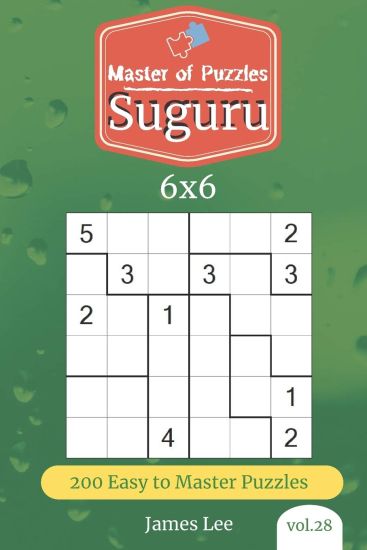
Master of Puzzles - Suguru 200 Easy to Master Puzzles 6x6 (vol. 28)
Suguru, also known as Tectonics or Number Blocks, is a Japanese puzzle invented by Naoki Inaba. The goal is to fill a given rectangular grid with numbers, so that every designated area contains a sequence of non-repeating, consecutive numbers, starting from 1 and going up. Also, adjacent (touching) cells should not contain the same number, even diagonally.
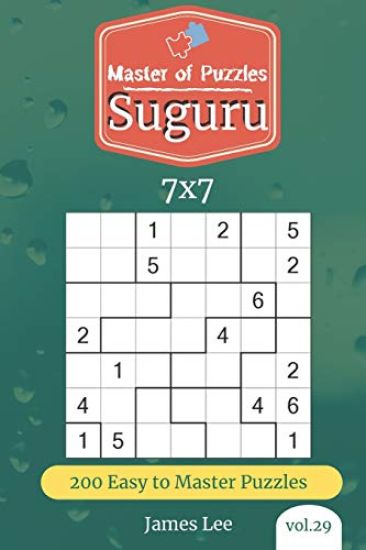
Master of Puzzles - Suguru 200 Easy to Master Puzzles 7x7 (vol. 29)
Suguru, also known as Tectonics or Number Blocks, is a Japanese puzzle invented by Naoki Inaba. The goal is to fill a given rectangular grid with numbers, so that every designated area contains a sequence of non-repeating, consecutive numbers, starting from 1 and going up. Also, adjacent (touching) cells should not contain the same number, even diagonally.
Hard Puzzles Book - Sudoku X, Anti Diagonal Sudoku, Killer Sudoku, Consecutive Sudoku - 200 Hard Puzzles vol.7
- (Sudoku X) Each puzzle consists of a 9x9 grid containing given clues in various places. The object is to fill all empty squares so that the numbers 1 to 9 appear exactly once in each row, column, diagonal and 3x3 box.-(Anti Diagonal Sudoku) Place a digit from 1 to 9 into each of the empty cells so that each digit appears exactly once in each row, column and 3x3 outlined box. Additionally every main/marked diagonal contains only 3 different numbers-Killer Sudoku is a mix of Sudoku and Kakuro. Your goal is the same as in regular sudoku: fill every row, column and 3x3 region with the numbers 1-9 once. The difference is how you arrive at those numbers. The objective is to fill the grid with numbers from 1 to 9 in a way that the following conditions are met: Each row, column, and nonet contains each number exactly once. The sum of all numbers in a cage must match the small number printed in its corner. No number appears more than once in a cage. (This is the standard rule for killer sudokus, and implies that no cage can include more than 9 cells.)-A Consecutive Sudoku puzzle adds one extra constraint to the standard Sudoku grid - not only must you place 1 to 9 (or 1 to whatever the width of the puzzle is) in each row, column and bold-lined box, but also obey the white consecutive markers: White bars between squares indicate that the squares are consecutive - meaning that the numbers in these two squares have a numerical difference of '1'. For example: 1 and 2; or 4 and 5. If there is no white bar then the numbers are not consecutive.
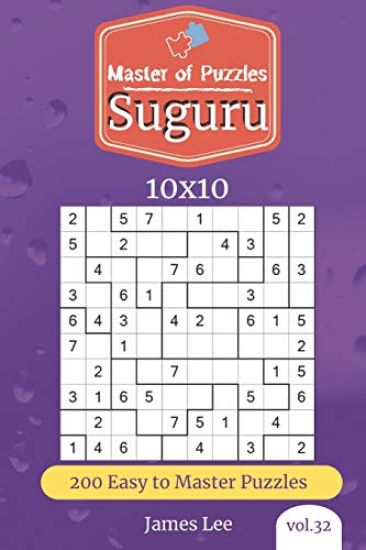
Master of Puzzles - Suguru 200 Easy to Master Puzzles 10x10 (vol. 32)
Suguru, also known as Tectonics or Number Blocks, is a Japanese puzzle invented by Naoki Inaba. The goal is to fill a given rectangular grid with numbers, so that every designated area contains a sequence of non-repeating, consecutive numbers, starting from 1 and going up. Also, adjacent (touching) cells should not contain the same number, even diagonally.
Master of Puzzles - Suguru 200 Easy to Master Puzzles 9x9 (vol. 31)
Suguru, also known as Tectonics or Number Blocks, is a Japanese puzzle invented by Naoki Inaba. The goal is to fill a given rectangular grid with numbers, so that every designated area contains a sequence of non-repeating, consecutive numbers, starting from 1 and going up. Also, adjacent (touching) cells should not contain the same number, even diagonally.
Master of Puzzles - Sudoku 12x12 200 Master Puzzles vol.4
The puzzle a 12 x 12 grid made up of 3 x 4 subgrids (called "regions"). Some cells already contain numbers, known as "givens". The goal is to fill in the empty cells, one number in each, so that each column, row, and region contains the numbers 1 through 12 exactly once. Each number in the solution therefore occurs only once in each of three "directions", hence the "single numbers" implied by the puzzle's name.
Master of Puzzles - Sudoku 12x12 200 Hard Puzzles vol.3
The puzzle a 12 x 12 grid made up of 3 x 4 subgrids (called "regions"). Some cells already contain numbers, known as "givens". The goal is to fill in the empty cells, one number in each, so that each column, row, and region contains the numbers 1 through 12 exactly once. Each number in the solution therefore occurs only once in each of three "directions", hence the "single numbers" implied by the puzzle's name.
Master of Puzzles - Sudoku 12x12 200 Easy Puzzles vol.1
The puzzle a 12 x 12 grid made up of 3 x 4 subgrids (called "regions"). Some cells already contain numbers, known as "givens". The goal is to fill in the empty cells, one number in each, so that each column, row, and region contains the numbers 1 through 12 exactly once. Each number in the solution therefore occurs only once in each of three "directions", hence the "single numbers" implied by the puzzle's name.
Hard Puzzles Book - Slitherlink, Hashi, Futoshiki, Numbricks - 200 Hard Puzzles vol.9
-Slitherlink is a logic puzzle is played on a rectangular lattice of dots. Some of the squares formed by the dots have numbers inside them. The objective is to connect horizontally and vertically adjacent dots so that the lines form a simple loop with no loose ends. In addition, the number inside a square represents how many of its four sides are segments in the loop.-(Hashi) Each puzzle is based on a rectangular arrangement of islands where the number in each island tells how many bridges are connected to it. The object is to connect all islands according to the number of bridges so: There are no more than two bridges in the same direction. Bridges can only be vertical or horizontal and are not allowed to cross islands or other bridges. When completed, all bridges are interconnected enabling passage from any island to another.-(Futoshiki) Place numbers of the given range in the grid 9x9 such that every row and column contains each number exactly once. Inequality constraints must be satisfied. The open end of the sign denotes the greater number.-Numbricks puzzles are similar to Hidato. The most important difference is that it is only possible to move 1 node left, right, up, or down. It is played on a rectangular grid of squares. Some of the cells have numbers in them. The object is to fill in the missing numbers, in sequential order, going horizontally and vertically only. Diagonal paths are not allowed.
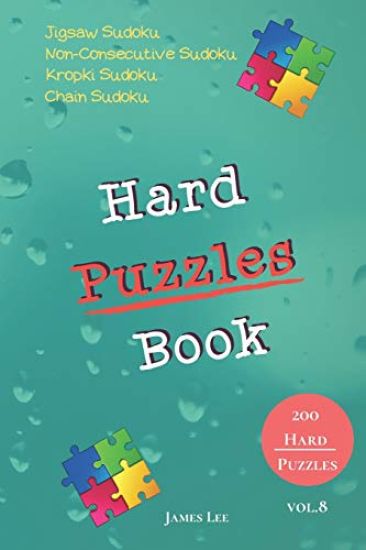
Hard Puzzles Book - Jigsaw Sudoku, Non-Consecutive Sudoku, Kropki Sudoku, Chain Sudoku - 200 Hard Puzzles vol.8
-The rules of Jigsaw Sudoku are similar to standard Sudoku, since you must place each of the numbers 1 to 9 (or 1 to whatever the size of the puzzle is) into each of the rows and columns. However whereas standard Sudoku also has rectangular boxes that must each contain every number, in Jigsaw Sudoku these boxes are replaced by different bold-lined shapes that must each contain every number instead.-In Non-Consecutive Sudoku no two adjacent cells have consecutive values. For example, if a cell contains 3, then any neighbouring square cannot contain either 2 or 4.Fill in the empty cells, one number in each, so that each column, row, and region contains the numbers 1 through 9 exactly once.-Kropki Sudoku puzzles add black (o) and white (o) circles to a regular Sudoku puzzle. All pairs of touching squares which contain consecutive values (such as 2 & 3 or 6 & 7) are marked with a white circle: o. Also, all pairs of touching squares which contain values where one number is exactly twice the value of the other (such as 2 & 4, or 4 & 8) are marked with a black circle: o. This applies to left/right, up/down touching only - there are no diagonal markers. All possible o and o are given, so if there is no circle between two touching squares then they are not consecutive and one is not double the value of the other.-The Sudoku Chain is similar to the Jigsaw Sudoku, each one have regions of irregular shapes.Consists of a group of circles arranged in a square grid and containing given clues in various places. The object is to fill all empty circles so that the digits appear exactly once in each row, column and chain.
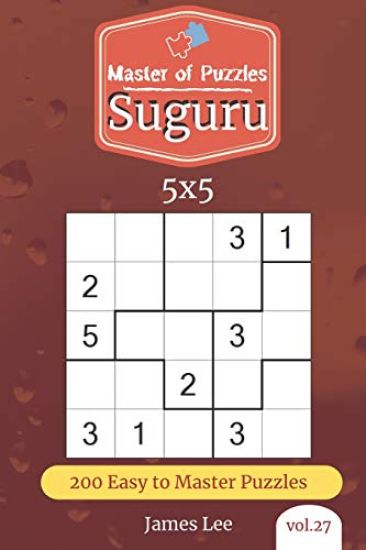
Master of Puzzles - Suguru 200 Easy to Master Puzzles 5x5 (vol. 27)
Suguru, also known as Tectonics or Number Blocks, is a Japanese puzzle invented by Naoki Inaba. The goal is to fill a given rectangular grid with numbers, so that every designated area contains a sequence of non-repeating, consecutive numbers, starting from 1 and going up. Also, adjacent (touching) cells should not contain the same number, even diagonally.
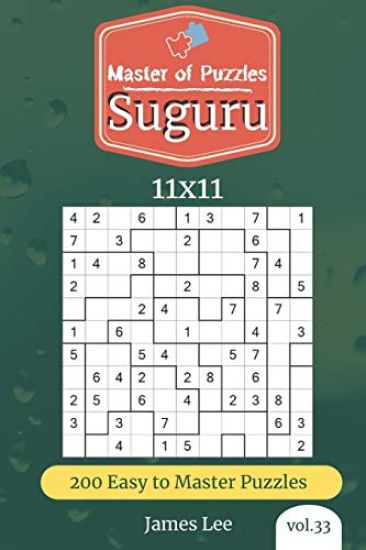
Master of Puzzles - Suguru 200 Easy to Master Puzzles 11x11 (vol. 33)
Suguru, also known as Tectonics or Number Blocks, is a Japanese puzzle invented by Naoki Inaba. The goal is to fill a given rectangular grid with numbers, so that every designated area contains a sequence of non-repeating, consecutive numbers, starting from 1 and going up. Also, adjacent (touching) cells should not contain the same number, even diagonally.