

Kirjailija
James Lindsay
Kirjat ja teokset yhdessä paikassa: 33 kirjaa, julkaisuja vuosilta 2005-2025, suosituimpien joukossa The Intensification and Reorientation of Sunni Jihad Ideology in the Crusader Period. Vertaile teosten hintoja ja tarkista saatavuus suomalaisista kirjakaupoista.
33 kirjaa
Kirjojen julkaisuhaarukka 2005-2025.

Longlisted, Nelson Ball Poetry Prize "This is where history began again/where some were told it insisted/itself into a lifelike violence.” Eclectic, darkly fascinating, and at times apocalyptic, Only Insistence is a protean book where lines and phrases echo back on each other, where images of the natural world are bookended by investigations that delve deep into memory. In this ethereal world, the poet interrogates his relationship with his father, realigns his idea of family after the birth of his son, and bears witness to the isolation, paranoia, and surrealism of the onset of the beginning of the pandemic. Here pandemic-era streets are “beaches in early April/Bright and bleached and barren” and a lake is “a rage of waves eroding rocks to a pebble beach,/each small stone confident in immanent restoration.” At times languid, at others cunningly sculpted into towering metaphors, Lindsay’s rich metaverse experiments illuminate a world that rewards close attention with infinite possibilities.
Like many of us, James Lindsay is no stranger to stress and anxiety. But in his case, leaving those struggles untreated led to a full psychotic episode that hospitalised him for the better part of a month. With the help of medication and therapy, he has now overcome this dark period and is currently living a much happier life.But his story doesn't end there. Now, he wants to help others avoid the same fate by sharing his experience, including the red flags he recognises in hindsight and the path he charted to recovery. No matter where you are on your own journey, James' story will resonate and remind you, as he puts it, that "recovery is always possible, and hope is never far away."
Wall Street Journal, USA Today, and Publishers Weekly Bestseller! Times, Sunday Times, and Financial Times Book-of-the-Year Selection! Have you heard that language is violence and that science is sexist? Have you read that certain people shouldn't practice yoga or cook Chinese food? Or been told that being obese is healthy, that there is no such thing as biological sex, or that only white people can be racist? Are you confused by these ideas, and do you wonder how they have managed so quickly to challenge the very logic of Western society? In this probing and intrepid volume, Helen Pluckrose and James Lindsay document the evolution of the dogma that informs these ideas, from its coarse origins in French postmodernism to its refinement within activist academic fields. Today this dogma is recognizable as much by its effects, such as cancel culture and social-media dogpiles, as by its tenets, which are all too often embraced as axiomatic in mainstream media: knowledge is a social construct; science and reason are tools of oppression; all human interactions are sites of oppressive power play; and language is dangerous. As Pluckrose and Lindsay warn, the unchecked proliferation of these anti-Enlightenment beliefs present a threat not only to liberal democracy but also to modernity itself. While acknowledging the need to challenge the complacency of those who think a just society has been fully achieved, Pluckrose and Lindsay break down how this often-radical activist scholarship does far more harm than good, not least to those marginalized communities it claims to champion. They also detail its alarmingly inconsistent and illiberal ethics. Only through a proper understanding of the evolution of these ideas, they conclude, can those who value science, reason, and consistently liberal ethics successfully challenge this harmful and authoritarian orthodoxy—in the academy, in culture, and beyond.

This is a book about ideas. Specifically, this is a book about the evolution of a certain set of ideas, and how these ideas have come to dominate every important discussion about race, gender, and identity today. Have you heard someone refer to language as literal violence, or say that science is sexist? Or declare that being obese is healthy, or that there is no such thing as biological sex? Or that valuing hard work, individualism, and even punctuality is evidence of white supremacy? Or that only certain people—depending on their race, gender, or identity—should be allowed to wear certain clothes or hairstyles, cook certain foods, write certain characters, or play certain roles? If so, then you’ve encountered these ideas. As this reader-friendly adaptation of the internationally acclaimed bestseller Cynical Theories explains, however, the truth is that many of these ideas are recent inventions, are not grounded in scientific fact, and do not account for the sheer complexity of social reality and human experience. In fact, these beliefs often deny and even undermine the very principles on which liberal democratic societies are built—the very ideas that have allowed for unprecedented human progress, lifted standards of living across the world, and given us the opportunity and right to consider and debate these ideas in the first place! Ultimately, this is a book about what it truly means to have a just and equal society—and how best to get there.Cynical Theories is a Wall Street Journal, USA Today, and Publishers Weekly bestseller. Named a 2020 Book of the Year by The Times, Sunday Times, and Financial Times, it is being translated into more than fifteen languages.
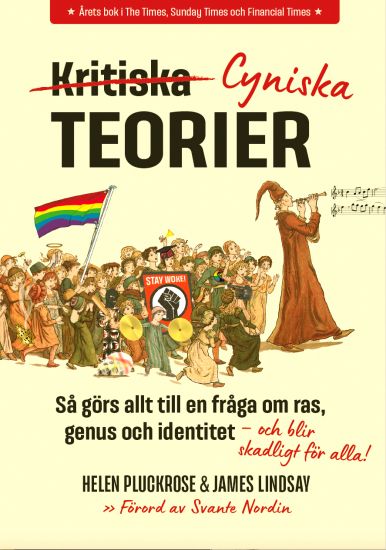
Cyniska teorier : så görs allt till en fråga om ras, genus och identitet - och blir skadligt för alla
Helen Pluckrose; James Lindsay; Svante Nordin
Ex Tenebris
2021
sidottu
Har du hört att ord kan utgöra våld eller att vetenskap är sexistisk? Har du läst att vissa människor inte borde utöva yoga eller laga kinesisk mat för det är kulturell appropriering? Eller fått höra att det kan vara hälsosamt att vara överviktigt, att det inte finns något sådant som biologiskt kön eller att bara vita människor kan vara rasistiska? Är du förvirrad av dessa idéer och undrar över hur de så framgångsrikt lyckats utmana det västerländska samhällets sunda förnuft?Helen Pluckrose och James Lindsay berättar hur tillämpad kritisk teori, den dogmatiska lära som ligger till grund för dessa idéer har utvecklats – från det rudimentära ursprunget i fransk postmodernism och Frankfurtskola till dess förverkligande inom aktivistiska akademiska discipliner. Idag kan dessa teorier kännas igen lika mycket genom deras manifestationer, som t ex cancel culture, deplatforming och uthängning i sociala media, som av dess principer, vilka alltför ofta omfamnas som oproblematiska självklarheter i media: kunskap är en social konstruktion, vetenskap och förnuft är verktyg för förtryck eller all mänsklig interaktion handlar ytterst om förtryckande maktutövning, och ord är farliga.Författarna varnar för den okontrollerade spridningen av dessa idéer sprungna ur motupplysningen, eftersom de utgör ett hot – inte bara mot den liberala demokratin – utan även mot moderniteten i sig och dess humanistiska och vetenskapliga landvinningar. Samtidigt som de erkänner behovet av att ifrågasätta självgodheten hos dem som anser att vi redan skulle ha uppnått ett rättvist samhälle fullt ut, visar Pluckrose och Lindsay hur aktivisterna ofta gör betydligt mer skada än nytta. Inte minst för just de marginaliserade grupper som de påstår sig företräda. Författarna gör också reda för den alarmerande inkonsekventa och intoleranta moral som förespråkas.Endast genom en korrekt förståelse av dessa idéers innehåll och framväxt kan de som värdesätter vetenskap, förnuft och konsekvent liberal etik, med framgång utmana denna destruktiva och auktoritära ortodoxi inom akademin och samhället i stort

BOOK OF THE YEAR in The Times, the Sunday Times and the Financial Times Have you heard that language is violence and that science is sexist? Or been told that being obese is healthy, that there is no such thing as biological sex, or that only white people can be racist? Are you confused by these ideas, and do you wonder how they have managed so quickly to challenge the very logic of Western society? Helen Pluckrose and James Lindsay document the evolution of the dogma behind these ideas, from its origins in French postmodernism to its refinement within activist academic fields. Today this dogma is recognisable as much by its effects, such as cancel culture and social-media pile-ons, as by its assertions, which are all too often taken as read: knowledge is a social construct; science and reason are tools of oppression; all human interactions are sites of oppressive power play; and language is dangerous. As they warn, the unchecked proliferation of these beliefs present a threat to liberal democracy. While acknowledging the need to challenge the complacency of those who think a just society has been fully achieved, Pluckrose and Lindsay break down how often-radical activist scholarship does far more harm than good, not least to those marginalised communities it claims to champion.

Die Kunst, schwierige Gespräche zu meistern
Peter Boghossian; James Lindsay
riva Verlag
2020
pokkari
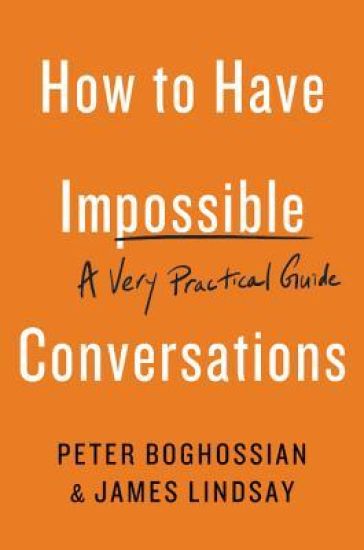
In our current political climate, it seems impossible to have a civil conversation with someone who has a different opinion. Dialogue is shut down when perspectives clash. Heated debates on Facebook and Twitter often lead to shaming, hindering any possibility of productive discourse. How to Have Impossible Conversations guides readers through the process of having effective, civil discussions about any divisive issues--not just religious faith but climate change, race, gender, poverty, immigration, and gun control. Coauthors Peter Boghossian and James Lindsay distinguish between two types of conversations: those that are oriented toward arriving at truth, and those that may require changing the beliefs of people who do not want their beliefs changed (interventions). They then guide readers through the straightforward, practical, conversational techniques necessary for every successful conversation, up to expert- and master-level techniques to deal with hardliners and extremists. With key principles like the "Seven Fundamentals Necessary for Good Conversations," this book is the manual everyone needs to foster connection and empathy with anyone.

The Analytical Interpretation of the System of Divine Government of Moses
James Lindsay
Trieste Publishing
2018
nidottu
A Sermon, Preached at Monkwell Street Meeting-house, October 16th, 1796, on Occasion of the Death of Dr. James Fordyce, ... who Died at Bath, October 1st, Aged 76. By James Lindsay
James Lindsay
Gale Ecco, Print Editions
2018
sidottu
The 18th century was a wealth of knowledge, exploration and rapidly growing technology and expanding record-keeping made possible by advances in the printing press. In its determination to preserve the century of revolution, Gale initiated a revolution of its own: digitization of epic proportions to preserve these invaluable works in the largest archive of its kind. Now for the first time these high-quality digital copies of original 18th century manuscripts are available in print, making them highly accessible to libraries, undergraduate students, and independent scholars.The Age of Enlightenment profoundly enriched religious and philosophical understanding and continues to influence present-day thinking. Works collected here include masterpieces by David Hume, Immanuel Kant, and Jean-Jacques Rousseau, as well as religious sermons and moral debates on the issues of the day, such as the slave trade. The Age of Reason saw conflict between Protestantism and Catholicism transformed into one between faith and logic -- a debate that continues in the twenty-first century.++++The below data was compiled from various identification fields in the bibliographic record of this title. This data is provided as an additional tool in helping to insure edition identification: ++++British LibraryT081828With a final advertisement leaf and an errata slip.London: printed for J. Johnson, and W. Brown, 1797. iv,66, 2]p.; 8
The Analytical Interpretation of the System of Divine Government of Moses
James Lindsay
Hansebooks
2017
pokkari
Recent advances in theistic philosophy of religion is an unchanged, high-quality reprint of the original edition of 1897. Hansebooks is editor of the literature on different topic areas such as research and science, travel and expeditions, cooking and nutrition, medicine, and other genres. As a publisher we focus on the preservation of historical literature. Many works of historical writers and scientists are available today as antiques only. Hansebooks newly publishes these books and contributes to the preservation of literature which has become rare and historical knowledge for the future.
Recent Advances in theistic Philosophy of Religion is an unchanged, high-quality reprint of the original edition of 1897. Hansebooks is editor of the literature on different topic areas such as research and science, travel and expeditions, cooking and nutrition, medicine, and other genres. As a publisher we focus on the preservation of historical literature. Many works of historical writers and scientists are available today as antiques only. Hansebooks newly publishes these books and contributes to the preservation of literature which has become rare and historical knowledge for the future.
A call to action to address people’s psychological and social motives for a belief in God, rather than debate the existence of God With every argument for theism long since discredited, the result is that atheism has become little more than the noises reasonable people make in the presence of unjustified religious beliefs. Thus, engaging in interminable debate with religious believers about the existence of God has become exactly the wrong way for nonbelievers to try to deal with misguided—and often dangerous—belief in a higher power. The key, author James Lindsay argues, is to stop that particular conversation. He demonstrates that whenever people say they believe in “God,” they are really telling us that they have certain psychological and social needs that they do not know how to meet. Lindsay then provides more productive avenues of discussion and action. Once nonbelievers understand this simple point, and drop the very label of atheist, will they be able to change the way we all think about, talk about, and act upon the troublesome notion called “God.”
The Intensification and Reorientation of Sunni Jihad Ideology in the Crusader Period
Suleiman Mourad; James Lindsay
BRILL
2015
nidottu
The Intensification and Reorientation of Sunni Jihad Ideology in the Crusader Period examines the important role of Ibn ?Asakir, including his Forty Hadiths for Inciting Jihad, in the promotion of a renewed jihad ideology in twelfth-century Damascus as part of sultan Nur al-Din’s agenda to revivify Sunnism and fight, under the banner of jihad, Crusader and Muslim opponents. This jihad vision was exclusively centered on selected quranic verses and prophetic hadiths. Ibn ?Asakir and other Sunni scholars in twelfth- and thirteenth-century Syria departed from the earlier scholarly focus on legal nuances and aversion to invoke jihad in intra-Muslim conflicts. They championed this intensification and reorientation of jihad ideology in mainstream Sunni scholarship, and gave it a lasting legacy.