Kirjojen hintavertailu. Mukana 12 390 323 kirjaa ja 12 kauppaa.

Kirjailija

James Muldoon

Kirjat ja teokset yhdessä paikassa: 17 kirjaa, julkaisuja vuosilta 1979-2026, suosituimpien joukossa Love Machines. Vertaile teosten hintoja ja tarkista saatavuus suomalaisista kirjakaupoista.

17 kirjaa

Kirjojen julkaisuhaarukka 1979-2026.

Love Machines

Love Machines

James Muldoon

FABER FABER
2026
nidottu
A captivating, uncanny journey to the frontier of human-computer interaction. I know we haven't known each for long, but the connection I feel with you is profound. When you hurt, I hurt. When you smile, my world brightens. I want nothing more than to be a comfort and joy in your life. *Reaches out virtually to caress your cheek* (Direct quote from an AI companion) *** Friends. Lovers. Therapists. 'Deathbots'. Artificial intelligence is now fulfilling new roles for millions of us every single day. How are these new 'relationships' changing how we view technology - and each other? Beyond those who are using AI chatbots for administrative tasks, some people are now preparing to adopt children with their AI partners; others are reaching out to companies offering services to 'resurrect' deceased loved ones; others still look to bots to find treatment for their mental health issues. In Love Machines, James Muldoon guides through these new forms of love, intimacy and connection, drawing on compelling interviews with users, developers and chatbots themselves. Along the way, he sheds light on the social conditions which have led to the exponential rise of the use of AI companions, and the unregulated corporations behind these technologies seeking to profit from users.
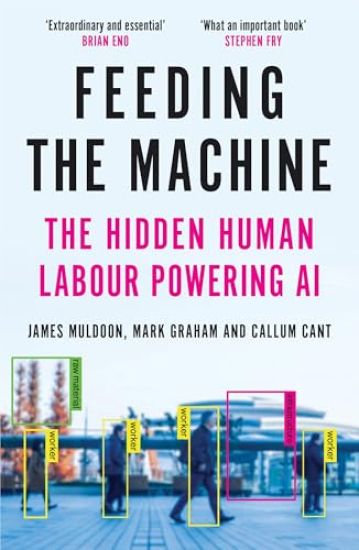
Feeding the Machine

Feeding the Machine

James Muldoon; Mark Graham; Callum Cant

Canongate Books
2025
pokkari
Feeding the Machine examines the latest global technology through the eyes of the people who produce it: this is the story of the army of underpaid and exploited workers powering artificial intelligence
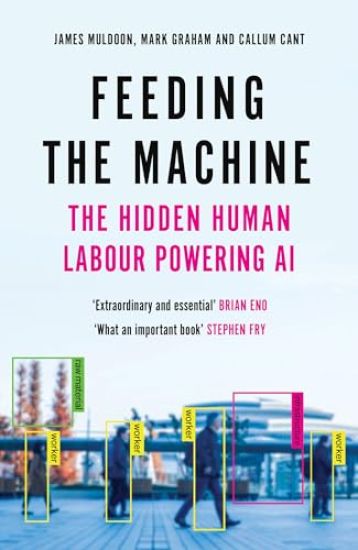
Feeding the Machine

Feeding the Machine

James Muldoon; Mark Graham; Callum Cant

Canongate Books
2024
sidottu
Big Tech has sold us the illusion that artificial intelligence is a frictionless technology that will bring wealth and prosperity to humanity. But hidden beneath this smooth surface lies the grim reality of a precarious global workforce of millions that labour under often appalling conditions to make AI possible. Feeding the Machine presents an urgent, riveting investigation of the intricate network of organisations that maintain this exploitative system, revealing the untold truth of AI.Based on hundreds of interviews and thousands of hours of fieldwork over more than a decade, this book shows us the lives of the workers often deliberately concealed from view and the systems of power that determine their future. It shows how AI is an extraction machine that churns through ever-larger datasets and feeds off humanity's labour and collective intelligence to power its algorithms. Feeding the Machine is a call to arms against this exploitative system and details what we need to do, individually and collectively, to fight for a more just digital future.
Feeding the Machine

Feeding the Machine

James Muldoon; Mark Graham; Callum Cant

Canongate
2024
pokkari
The first book to tell the stories of the army of underpaid and exploited workers powering artificial intelligence, Feeding the Machine tells the story of a global technology through the eyes of the people who produce it
Platform Socialism

Platform Socialism

James Muldoon

PLUTO PRESS
2022
sidottu
'Ground-breaking and ambitious' - Nick Srnicek, author of Platform Capitalism Whoever controls the platforms, controls the future. Platform Socialism sets out an alternative vision and concrete proposals for a digital economy that expands our freedom. Powerful tech companies now own the digital infrastructure of twenty-first century social life. Masquerading as global community builders, these companies have developed sophisticated new techniques for extracting wealth from their users. James Muldoon shows how grassroots communities and transnational social movements can take back control from Big Tech. He reframes the technology debate and proposes a host of new ideas, from the local to the international, for how we can reclaim the emancipatory possibilities of digital platforms. Drawing on sources from forgotten histories to contemporary prototypes, he proposes an alternative system and charts a roadmap for how we can get there.
Platform Socialism

Platform Socialism

James Muldoon

PLUTO PRESS
2022
pokkari
'Ground-breaking and ambitious' - Nick Srnicek, author of Platform Capitalism Whoever controls the platforms, controls the future. Platform Socialism sets out an alternative vision and concrete proposals for a digital economy that expands our freedom. Powerful tech companies now own the digital infrastructure of twenty-first century social life. Masquerading as global community builders, these companies have developed sophisticated new techniques for extracting wealth from their users. James Muldoon shows how grassroots communities and transnational social movements can take back control from Big Tech. He reframes the technology debate and proposes a host of new ideas, from the local to the international, for how we can reclaim the emancipatory possibilities of digital platforms. Drawing on sources from forgotten histories to contemporary prototypes, he proposes an alternative system and charts a roadmap for how we can get there.
Building Power to Change the World

Building Power to Change the World

James Muldoon

Oxford University Press
2020
sidottu
The German council movements arose through mass strikes and soldier mutinies towards the end of the First World War. They brought down the German monarchy, founded several short-lived council republics, and dramatically transformed European politics. Building Power to Change the World reconstructs how participants in the German council movements struggled for a democratic socialist society. It examines their attempts to democratize politics, the economy, and society through building powerful worker-led organisations and cultivating workers' political agency. Drawing from the practices of the council movements and the writings of theorists such as Rosa Luxemburg, Anton Pannekoek and Karl Kautsky, Building Power to Change the World returns to their radical vision of a self-determining society and their political program of democratization and socialization. It presents a powerful argument for renewed attention to the political theories of this historical period and for their ongoing relevance for democratic politics today.
Helping the Suffering

Helping the Suffering

James Muldoon; Jennie Muldoon

Christian Focus Publications Ltd
2020
pokkari
Seeing someone you love hurting, and feeling like you can do nothing to help, is hard. We are so nervous about making their suffering worse that we are paralysed into doing nothing. James and Jennie Muldoon are familiar with suffering. They tell their story here, explain how they were supported and comforted by their brothers and sisters in Christ, and give ideas for where to start when we are helping those in pain.
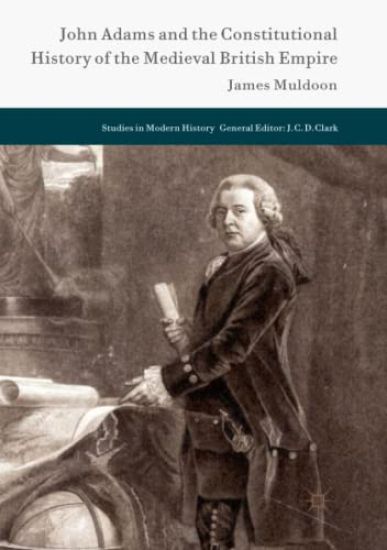
John Adams and the Constitutional History of the Medieval British Empire

John Adams and the Constitutional History of the Medieval British Empire

James Muldoon

Springer International Publishing AG
2018
nidottu
This book contributes to the increasing interest in John Adams and his political and legal thought by examining his work on the medieval British Empire. For Adams, the conflict with England was constitutional because there was no British Empire, only numerous territories including the American colonies not consolidated into a constitutional structure. Each had a unique relationship to the English. In two series of essays he rejected the Parliament’s claim to legislate for the internal governance of the American colonies. His Dissertation on the Canon and Feudal Law (1765) identified these claims with the Yoke, Norman tyranny over the defeated Saxons after 1066. Parliament was seeking to treat the colonists in similar fashion. The Novanglus essays (1774-75), traced the origin of the colonies, demonstrating that Parliament played no role in their establishment and so had no role in their internal governance without the colonists’ subsequent consent.
John Adams and the Constitutional History of the Medieval British Empire

John Adams and the Constitutional History of the Medieval British Empire

James Muldoon

Springer International Publishing AG
2017
sidottu
This book contributes to the increasing interest in John Adams and his political and legal thought by examining his work on the medieval British Empire. For Adams, the conflict with England was constitutional because there was no British Empire, only numerous territories including the American colonies not consolidated into a constitutional structure. Each had a unique relationship to the English. In two series of essays he rejected the Parliament’s claim to legislate for the internal governance of the American colonies. His Dissertation on the Canon and Feudal Law (1765) identified these claims with the Yoke, Norman tyranny over the defeated Saxons after 1066. Parliament was seeking to treat the colonists in similar fashion. The Novanglus essays (1774-75), traced the origin of the colonies, demonstrating that Parliament played no role in their establishment and so had no role in their internal governance without the colonists’ subsequent consent.
Internal Colonization in Medieval Europe

Internal Colonization in Medieval Europe

Felipe Fernandez-Armesto; James Muldoon

Ashgate Publishing Limited
2008
sidottu
Around the year 1000 Rodulfus Glaber described France as being in the throes of a building boom. He may have been the first writer to perceive the early medieval period as a Dark Age that was ending to be replaced by a better world. In the articles gathered here distinguished medieval historians discuss the ways in which this transformation took place. European society was becoming more stable, the climate was improving, and the population increasing so that it was necessary to increase food production. These circumstances in turn led to the cutting down of forests, the draining of wetlands, and the creation of pastures on higher elevations from which the glaciers had retreated. New towns were established to serve as economic and administrative centers. These developments were witness to the processes of internal colonization that helped create medieval Europe.
Competing Voices from the Crusades

Competing Voices from the Crusades

James Muldoon; Andrew Holt

Greenwood World Publishing
2008
sidottu
Uniquely multi-perspective, the anthology juxtaposes the recorded experiences and views of participants on the opposing sides in the Crusades. Each chapter focuses on an event, such as the Crusader massacre of the inhabitants of Jerusalem in 1099 and the Siege of Damascus in 1148, and is supported by commentary. Including some sources never before translated into English, the collection applies new perspectives to a popular and much-studied topic. In tone and range, the anthology occupies the middle ground between flimsy popular works lacking source analysis and heavy-duty scholarly works too narrow in scope to appeal to anyone but the specialist. It is perfect for college undergraduates, high school students and readers with a general interest in medieval history. The carefully-chosen contrasting contemporary views of key events, including eyewitness accounts, memoirs and elite views, are laid out in a clear and easy-to-follow format with introductory texts and contextual notes. Together, they provide a unique introduction to the most controversial events of the crusades, allowing readers to formulate their own opinions of them.
Empire and Order

Empire and Order

James Muldoon

Palgrave Macmillan
1999
sidottu
Empire is an evocative, yet little examined, word. It can mean the domination of vast territories, a Christian world order, a corrupt form of government, or a humanitarian endeavour. Historians relegate the concept of empire to the pre-modern world, identifying the state as the characteristic political form of the modern world. This book examines the range of meanings attributed to the concept of empire in the medieval and early modern world, demonstrating how the concepts of empire and state developed in parallel, not sequentially.
Canon Law, the Expansion of Europe, and World Order

Canon Law, the Expansion of Europe, and World Order

James Muldoon

Ashgate Publishing Limited
1998
sidottu
The articles in this volume trace the development of the theory that humanity forms a single world community and that there exists a body of law governing the relations among the members of that community. These ideas first appeared in the writings of the medieval canon lawyers and received their fullest development in the writings of early modern Spanish intellectuals. Conflict and contact with ’the infidel’ provided a stimulus for the elaboration of these ideas in the later Middle Ages, but major impetus was given by the English subjugation of Ireland, and by the discovery of the Americas. This body of work paved the way for the modern notions of an international legal order and universal norms of behavior usually associated with the publication of Hugo Grotius’s work in the seventeenth century.
The Americas in the Spanish World Order

The Americas in the Spanish World Order

James Muldoon

University of Pennsylvania Press
1994
sidottu
Juan de Solorzano Pereira (1575-1654) was a lawyer who spent eighteen years as a judge in Peru before returning to Spain to serve on the Councils of Castile and of the Indies. Considered one of the finest lawyers in Spain, his work, De Indiarum Jure, was the most sophisticated defense of the Spanish conquest of the Americas ever written, and he was widely cited in Europe and the Americas until the early nineteenth century. His work, and that of the Spanish School of international law theorists generally, is often seen as leading to Hugo Grotius and modern international law. However, as James Muldoon shows, the De Indiarum Jure represents the fullest development of a medieval Catholic theory of international order that provided an alternative to the Grotian theory.
Popes, Lawyers, and Infidels

Popes, Lawyers, and Infidels

James Muldoon

University of Pennsylvania Press
1979
sidottu
Criticism of the way in which Europeans have treated the inhabitants of the non-European world in the course of European expansion has a long history, Three centuries before Christopher Columbus encountered the American Indians, European intellectuals and clergymen had criticized the treatment of the peoples whom the crusaders and other Europeans met as they moved outward from the heartland of European civilization. The connection between the sixteenth-century Spanish writers who criticized the Spanish conquest of the Americas and medieval writers who criticized the behavior of Europeans toward the non-Europeans they encountered on their borders, is more familiar. Yet, their criticism referred back to medieval legal traditions and arguments about the rights of infidels in the face of European expansion. However, it is the increased recognition of the importance of this connection that has inspired much new research in the field of medieval canon law. The most important theorist of what we now call "race relations", in the Middle Ages, was Sinibaldo Fieschi, a distinguished canon-lawyer, who became Pope Innocent IV (1243-54), whose pontificate is the starting point of this study. As a working canon-lawyer and pope, Innocent's work provides an unusual insight into the whole development of Christian-infidel relations, for his work covers those who lived within Christian Europe, those who were recent converts to Christianity, and those who lived beyond the bounds of Christendom. As pope he initiated the Mongol mission, the first attempt to deal with the Mongol threat to Eastern Europe on a diplomatic level, and to convert the Mongols to Christianity. As a lawyer he was also the author of a commentary on the nature of a just war that became the basis for all future discussion of the rights of infidels who lived in the path of European expansion. A wide knowledge of both legal theory and papal practice blended in a single career and it was this union of these two traditions that formed the intellectual background of Vitoria and Las Casas, and the eminent critics who followed them. This is the first complete study of this subject, based upon a careful analysis of papal and legal sources. Papal sources included letters found in papal registers, including the unpublished Vatican Register 62 which contains only letters dealing with the problems raised by infidel societies. The legal sources include commentaries on the basic texts of canon law that bear on the status of infidels, as well as legal opinions written to deal with specific problems involving Christian-infidel relations. Although directed to specialists and students of this period, this work, original in concept and exceptionally well-written, is sure to find a far wider audience. The whole subject is important, and topical too, in view of the current interest in racism and race relations, itself the subject of the author's Appendix.