Kirjojen hintavertailu. Mukana 12 595 353 kirjaa ja 12 kauppaa.

Kirjailija

James Q. Wilson

Kirjat ja teokset yhdessä paikassa: 9 kirjaa, julkaisuja vuosilta 1978-2013, suosituimpien joukossa Varieties of Police Behavior. Vertaile teosten hintoja ja tarkista saatavuus suomalaisista kirjakaupoista.

9 kirjaa

Kirjojen julkaisuhaarukka 1978-2013.

The Moral Sense

The Moral Sense

James Q. Wilson

Blackstone Audiobooks
2013
cd
Virtue has acquired a bad name, says Wilson, but it is nevertheless what we are referring to when we discuss a person's character, such as whether someone is kind, friendly, or loyal. Although we may disguise the language of morality as a language of personality, it is still, in Wilson's words, "the language of virtue and vice." Says the author, "This book is not an effort to state or justify moral rules; that is, it is not a book of philosophy. Rather, it is an effort to clarify what ordinary people mean when they speak of their moral feelings and to explain, insofar as one can, the origins of those feelings."
Understanding and Controlling Crime

Understanding and Controlling Crime

David P. Farrington; Lloyd E. Ohlin; James Q. Wilson

Springer-Verlag New York Inc.
2011
nidottu
In 1982 the John D. and Catherine T. MacArthur Foundation created a small committee-the Justice Program Study Group (whose membership is listed at the end ofthis preface)-and posed to it what can hardly be regarded as an easy ques­ tion: "What ideas, what concepts, what basic intellectual frameworks are lack­ ing" to understand and to more effectively deal with crime in our society? Those who are acquainted with the work of the members of the Study Group will appreciate how many divergent views were expressed-divergent to the degree that some of us came to the conclusion that we were not a Study Group at all but rather a group being studied, an odd collection of ancient experimental animals serving some dark purpose of the Foundation. Eventually, however, a surprisingly strong concurrence emerged. We found we were impressed by the extent to which in our discussions we placed heavy reliance on the products of two types of research: first, those few longitudinal studies related to juvenile delinquency and crime that had been pursued in this country and, second, a few experimental studies that had sought to measure the consequences of different official interventions in criminal careers. These two research strategies had taught us much about crime and its control. Other strategies-case studies, cross-sectional surveys, participant observations, and similar techniques-had indeed been productive, but it was the longitudinal and experimental designs that firmed up the knowledge that the others helped to discover.
Crime Human Nature

Crime Human Nature

Richard J. Herrnstein; James Q. Wilson

The Free Press
1998
sidottu
From Simon & Schuster, Crime & Human Nature is the definitive study of the causes of crime.Assembling the latest evidence from the fields of sociology, criminology, economics, medicine, biology, and psychology and exploring the effects of such factors as gender, age, race, and family, two eminent social scientists frame a groundbreaking theory of criminal behavior.
Two Nations

Two Nations

James Q. Wilson; Christopher DeMuth

AEI Press
1998
pokkari
While many Americans live in conditions of prosperity, a second nationwhere illegitimacy, child and drug abuse, violence, criminality, and other social ills proliferateis growing within.
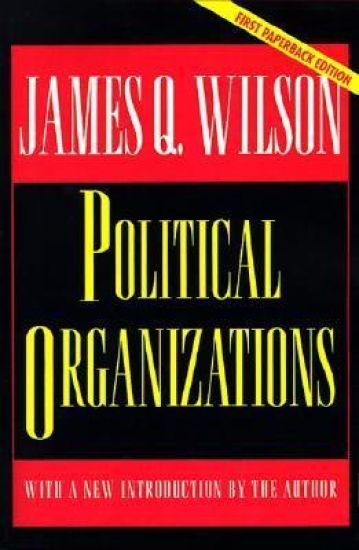
Political Organizations

Political Organizations

James Q. Wilson

Princeton University Press
1995
pokkari
A major work by one of America's eminent political scientists, Political Organizations has had a profound impact on how we view the influence of interest groups on policymaking. James Wilson wrote this book to counter two ideas: that popular interests will automatically generate political organizations and that such organizations will faithfully mirror the opinions and interests of their members. Moreover, he demonstrated that the way in which political organizations (including parties, business groups, labor unions, and civil rights associations) are created and maintained has a profound impact on the opinions they represent and the tactics they use. Now available for the first time in paperback, this book has broadened its scope to include recently developed organizations as it addresses many of today's concerns over the power of such groups as special-interest lobbies. In 1973, when this book was first published, the press and public were fascinated by the social movements of the 1960s, thinking that the antiwar and civil rights movements might sweep aside old-fashioned interest-group lobbies. Wilson argued, however, that such movements would inevitably be supplanted by new organizations, ones with goals and tactics that might direct the course of action away from some of the movements' founding principles. In light of the current popular distress with special-interest groups and their supposed death-grip on Congress, Wilson again attempts to modify a widely held view. He shows that although lobbies have multiplied in number and kind, they remain considerably constrained by the difficulty they have in maintaining themselves.
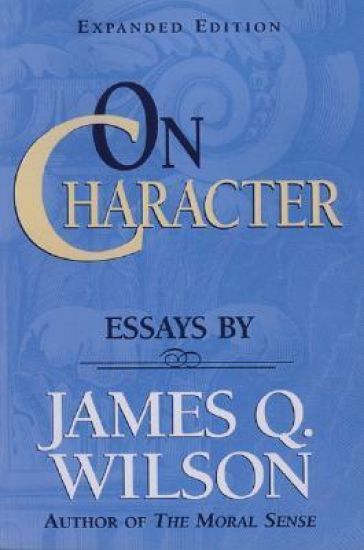
On Character

On Character

James Q. Wilson

AEI Press
1995
pokkari
James Q. Wilson is the former president of the American Political Science Association and adviser to four presidents on issues related to crime, drug abuse, education, and other crises of American cutlure. In this book, he has produced a provocative series of essays related to character development and character policy that sets this important area in perspective. He brings his argument into clear focus by negating that public discussion of character is a conservative pasttime. Rather, the development of character is our collective responsibility. The public interest depends on private virtue. Wilson argues throughout these essays that to have good character one needs to have at least developed a sense of empathy and self control. In various chapters he writes about crime, families, communities and schooling with those two traitsempathy and self-controlas a basis. He presents the current crises of our community in clear perspective: how much can society tolerate? what is the role of the police? the family? what is a moral virtue? Wilson concludes with an argument that all humans have an inborn "moral sense". We are, after all, social beings, dependent on each other and we have an obligation to each other to develop that moral sense if we care about each other. This is a well written, reasoned book by a wise and experienced expert.
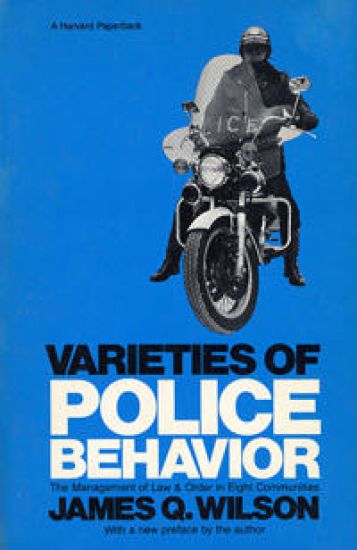
Varieties of Police Behavior

Varieties of Police Behavior

James Q. Wilson

Harvard University Press
1978
nidottu
The patrolman has the most difficult, complex, and least understood task in the police department. Much less is known of him than of his better publicized colleague, the detective. In this important and timely book, James Q. Wilson describes the patrolman and the problems he faces that arise out of constraints imposed by law, politics, public opinion, and the expectations of superiors.The study considers how the uniformed officer in eight communities deals with such common offenses as assault, theft, drunkenness, vice, traffic, and disorderly conduct. Six of the communities are in New York State: Albany, Amsterdam, Brighton, Nassau County, Newburgh, and Syracuse. The others are Highland Park, Illinois, and Oakland, California.Enforcing laws dealing with common offenses is especially difficult because it raises the question of administrative discretion. Murder, in the eyes of the police, is unambiguously wrong, and murderers are accordingly arrested; but in cases such as street-corner scuffles or speeding motorists, the patrolman must decide whether to intervene (should the scuffle be stopped? should the motorist be pulled over?) and, if he does, just how to intervene (by arrest? a warning? an interrogation?). In most large organizations, the lowest-ranking members perform the more routinized tasks and the means of accomplishing these tasks are decided by superiors, but in a police department the lowest-ranking officer—the patrolman—is almost solely responsible for enforcing those laws which are the least precise, the most ambiguous. Three ways or “styles” of policing—the watchman, the legalistic, and the service styles—are analyzed and their relation to local politics is explored.In the final chapter, Mr. Wilson discusses if and how the patrolman’s behavior can be changed and examines some current proposals for reorganizing police departments. He observes that the ability of the patrolman to do his job well may determine our success in managing social conflict and our prospects for maintaining a proper balance between liberty and order.