Kirjojen hintavertailu. Mukana 12 595 353 kirjaa ja 12 kauppaa.

Kirjailija

James R. Taylor

Kirjat ja teokset yhdessä paikassa: 13 kirjaa, julkaisuja vuosilta 1993-2021, suosituimpien joukossa Needs-Based Market Segmentation Strategies. Vertaile teosten hintoja ja tarkista saatavuus suomalaisista kirjakaupoista.

Mukana myös kirjoitusasut: James R Taylor

13 kirjaa

Kirjojen julkaisuhaarukka 1993-2021.

Needs-Based Market Segmentation Strategies

Needs-Based Market Segmentation Strategies

James R Taylor

Van Rye Publishing, LLC
2021
pokkari
Wouldn't it be great if you had a tool for accurately predicting businesses' future successes or failures and winners or losers based on something other than historical facts and figures about those businesses?...Written by a leading business school professor, this book presents business executives, investors, students, educators, and others with that tool "Market Segmentation" is the division of businesses' potential customers into groups based on a wide range of characteristics, including demographics, income and education levels, interests, and more. And "Needs-Based Market Segmentation," as presented in this book, is an innovative form of market segmentation that allows accurate forecasts of businesses' future competitive performance (successes and failures, winners and losers) by measuring today's consumer and business needs.This book is the result of requests from students and business executives to have a document that summarizes material the author, Professor James R. Taylor, presented in MBA classes and executive education programs during his over forty-year teaching and research career at the University of Michigan's famed Ross School of Business. The book is cleverly written as a recounting of the real-life progression of a business school student named Bob as he learned about the Needs-Based Market Segmentation process in school and then used that process to make millions in the stock market and retire early. Are you the next Bob? Read and find out.

When Organization Fails

When Organization Fails

James R. Taylor; Elizabeth J. Van Every

Routledge
2014
sidottu
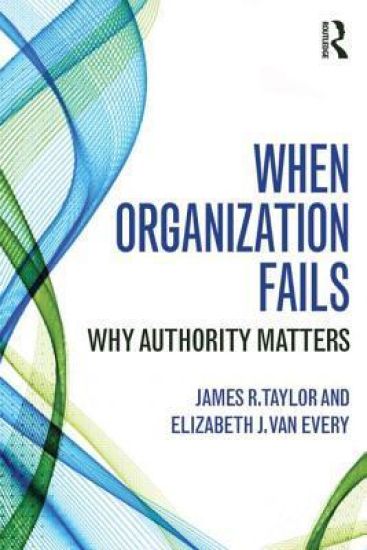
When Organization Fails: Why Authority Matters develops the study of authority as an area of investigation in organizational communication and management. As a research topic, authority has rarely been addressed in depth in the management and organizational communication literature. It is critical, however, to maintaining unity of purpose and action of the organization, and it is frequently cited by organizational members themselves.Utilizing two case studies, examined in depth and based on the accounts of the individuals involved, authors James R. Taylor and Elizabeth J. van Every explore the pathology of authority when it fails. They develop a theoretical foundation that aims to illuminate authority by positioning it in communication theory. This volume sets the stage for a new generation of scholars who can make their reputations as experts on authority, and is intended for scholars and graduate students in organizational communication, leadership, and discourse analysis. It also offers practical insights to consultants and management experts worldwide.
When Organization Fails

When Organization Fails

James R. Taylor; Elizabeth J. Van Every

Routledge
2014
nidottu
When Organization Fails: Why Authority Matters develops the study of authority as an area of investigation in organizational communication and management. As a research topic, authority has rarely been addressed in depth in the management and organizational communication literature. It is critical, however, to maintaining unity of purpose and action of the organization, and it is frequently cited by organizational members themselves.Utilizing two case studies, examined in depth and based on the accounts of the individuals involved, authors James R. Taylor and Elizabeth J. van Every explore the pathology of authority when it fails. They develop a theoretical foundation that aims to illuminate authority by positioning it in communication theory. This volume sets the stage for a new generation of scholars who can make their reputations as experts on authority, and is intended for scholars and graduate students in organizational communication, leadership, and discourse analysis. It also offers practical insights to consultants and management experts worldwide.
The Situated Organization

The Situated Organization

James R. Taylor; Elizabeth J. Van Every

Routledge
2010
sidottu
The Situated Organization explores recent research in organizational communication, emphasizing the organization as constructed in and emerging out of communication practices. Working from the tradition of the Montreal School in its approach, it focuses not only on how an organization’s members understand the purposes of the organization through communication, but also on how they realize and recognize the organization itself as they work within it. The text breaks through with an alternative viewpoint to the currently popular idea of 'organization-as-network,' viewing organization instead as a configuration of agencies, and their fields of practice. It serves as an original, comprehensive, and well-written text, elaborated by case studies that make the theory come to life. The substantial ideas and insights are presented in a deep and meaningful way while remaining comprehensible for student readers.This text has been developed for students at all levels of study in organizational communication, who need a systematic introduction to conducting empirical field research. It will serve as an invaluable sourcebook in planning and conducting research.
The Situated Organization

The Situated Organization

James R. Taylor; Elizabeth J. Van Every

Routledge
2010
nidottu
The Situated Organization explores recent research in organizational communication, emphasizing the organization as constructed in and emerging out of communication practices. Working from the tradition of the Montreal School in its approach, it focuses not only on how an organization’s members understand the purposes of the organization through communication, but also on how they realize and recognize the organization itself as they work within it. The text breaks through with an alternative viewpoint to the currently popular idea of 'organization-as-network,' viewing organization instead as a configuration of agencies, and their fields of practice. It serves as an original, comprehensive, and well-written text, elaborated by case studies that make the theory come to life. The substantial ideas and insights are presented in a deep and meaningful way while remaining comprehensible for student readers.This text has been developed for students at all levels of study in organizational communication, who need a systematic introduction to conducting empirical field research. It will serve as an invaluable sourcebook in planning and conducting research.
The Computerization of Work

The Computerization of Work

James R. Taylor; Carole Groleau; Lorna Heaton; Elizabeth Van Every-Taylor

SAGE Publications Inc
2000
sidottu
The computerization of the workplace confronts us with a paradox. While almost everyone agrees that the fusion of new information and communication technologies (I/CT) is radically transforming the way society works, some individuals argue that the implementation of any single I/CT is disappointing. Studies report that these individual experiences in computerization often fail to measure up to expectation. The Computerization of Work offers an explanation for the gap between the expectations and the often less-than-satisfactory results. Written by renowned professionals in the fields of information and communication technologies, this volume explores the subject matter through the discussion of theory and field studies as well as insights from other research. Students and researchers alike will appreciate this rare look into the world of technology and society.
The Computerization of Work

The Computerization of Work

James R. Taylor; Carole Groleau; Lorna Heaton; Elizabeth Van Every-Taylor

SAGE Publications Inc
2000
nidottu
The computerization of the workplace confronts us with a paradox. While almost everyone agrees that the fusion of new information and communication technologies (I/CT) is radically transforming the way society works, some individuals argue that the implementation of any single I/CT is disappointing. Studies report that these individual experiences in computerization often fail to measure up to expectation. The Computerization of Work offers an explanation for the gap between the expectations and the often less-than-satisfactory results. Written by renowned professionals in the fields of information and communication technologies, this volume explores the subject matter through the discussion of theory and field studies as well as insights from other research. Students and researchers alike will appreciate this rare look into the world of technology and society.
The Emergent Organization

The Emergent Organization

James R. Taylor; Elizabeth J. Van Every

Routledge Member of the Taylor and Francis Group
1999
nidottu
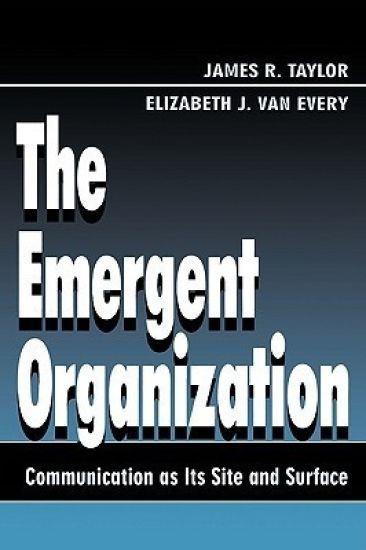
Today's organizations face a wide variety of challenges, including such contradictions as maintaining unity of action while becoming increasingly diverse. Even the definition of organization is changing and evolving. In this monograph, the authors apply their academic and professional experience to address the notion of "organization," setting forth communication as the essential modality for the constitution of organization--explaining how an organization can at the same time be both local and global, and how these properties which give organization continuity over time and across geographically dispersed situations also come to be manifested in the day-to-day of human interpersonal exchange. As a radical rethinking of the traditional discourse approaches in communication theory, this book develops a conceptual framework based on the idea that "organization" emerges in the mix of conversational and textual communicative activities that together construct organizational identity. Applying concepts from the philosophy of language, linguistics, semiotics, system design, sociology and management theory, the authors put forth a convincing argument demonstrating the materiality of language and its constructive role in organization and society.
The Emergent Organization

The Emergent Organization

James R. Taylor; Elizabeth J. Van Every

Routledge Member of the Taylor and Francis Group
1999
sidottu
Today's organizations face a wide variety of challenges, including such contradictions as maintaining unity of action while becoming increasingly diverse. Even the definition of organization is changing and evolving. In this monograph, the authors apply their academic and professional experience to address the notion of "organization," setting forth communication as the essential modality for the constitution of organization--explaining how an organization can at the same time be both local and global, and how these properties which give organization continuity over time and across geographically dispersed situations also come to be manifested in the day-to-day of human interpersonal exchange. As a radical rethinking of the traditional discourse approaches in communication theory, this book develops a conceptual framework based on the idea that "organization" emerges in the mix of conversational and textual communicative activities that together construct organizational identity. Applying concepts from the philosophy of language, linguistics, semiotics, system design, sociology and management theory, the authors put forth a convincing argument demonstrating the materiality of language and its constructive role in organization and society.
Rethinking the Theory of Organizational Communication

Rethinking the Theory of Organizational Communication

James R. Taylor

Praeger Publishers Inc
1993
sidottu
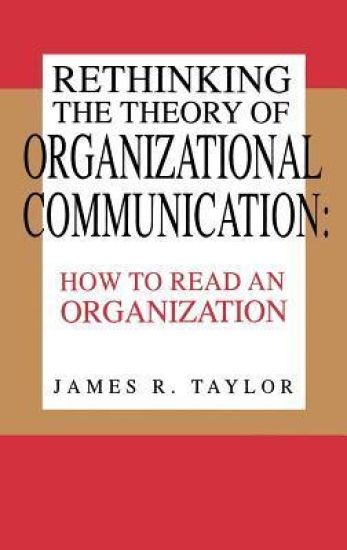
The first part of this new book concentrates on the office automation phenomenon. Chapter 1 sketches some of its disappointments and sets the stage for the chapters to follow. In Chapter 2, the author argues that images of organization incorporate what has been called a worldview and are thus inevitably relativistic in their orientation. This allows the author to criticize some common assumptions about the nature of organization, but it equally introduces a theme that is central to his theory, and that will be picked up again in a later chapter. Chapter 3 gets to the heart of his criticism of conventional theories of communication process, and in doing so allows the author to demonstrate the feet of clay of one of the sacred cows of our time: the concept of office work as information processing. The second part is concerned with theory and its implications. Chapter 4 describes the event of communication, in microcosm. Chapter 5 is an attempt to give this perception a more systematic presentation. Chapter 6 tries to understand the problem of operationalizing the theory, as a means to understanding, and studying the dynamics of conversation and of communication mediated through texts. Chapter 7 explores one implication of the theory, namely, the maintenance of requisite variety, within a conversational system. Chapter 8 concludes the presentation by a consideration of some of the implications of the theory for the conduct of research.
Rethinking the Theory of Organizational Communication

Rethinking the Theory of Organizational Communication

James R. Taylor

Praeger Publishers Inc
1993
nidottu
The first part of this new book concentrates on the office automation phenomenon. Chapter 1 sketches some of its disappointments and sets the stage for the chapters to follow. In Chapter 2, the author argues that images of organization incorporate what has been called a worldview and are thus inevitably relativistic in their orientation. This allows the author to criticize some common assumptions about the nature of organization, but it equally introduces a theme that is central to his theory, and that will be picked up again in a later chapter. Chapter 3 gets to the heart of his criticism of conventional theories of communication process, and in doing so allows the author to demonstrate the feet of clay of one of the sacred cows of our time: the concept of office work as information processing. The second part is concerned with theory and its implications. Chapter 4 describes the event of communication, in microcosm. Chapter 5 is an attempt to give this perception a more systematic presentation. Chapter 6 tries to understand the problem of operationalizing the theory, as a means to understanding, and studying the dynamics of conversation and of communication mediated through texts. Chapter 7 explores one implication of the theory, namely, the maintenance of requisite variety, within a conversational system. Chapter 8 concludes the presentation by a consideration of some of the implications of the theory for the conduct of research.