Kirjojen hintavertailu. Mukana 12 262 843 kirjaa ja 12 kauppaa.

Kirjailija

James T. Streib

Kirjat ja teokset yhdessä paikassa: 4 kirjaa, julkaisuja vuosilta 2014-2023, suosituimpien joukossa Guide to Data Structures. Vertaile teosten hintoja ja tarkista saatavuus suomalaisista kirjakaupoista.

4 kirjaa

Kirjojen julkaisuhaarukka 2014-2023.

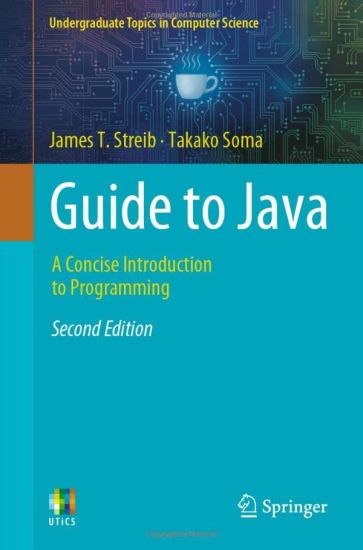
Guide to Java

Guide to Java

James T. Streib; Takako Soma

Springer International Publishing AG
2023
nidottu
This textbook presents a focused and accessible primer on the fundamentals of Java programming, with extensive use of illustrative examples and hands-on exercises.Addressing the need to acquire a good working model of objects in order to avoid possible misconceptions, the text introduces the core concepts of object-oriented programming at any stage, supported by the use of contour diagrams. Each chapter has one or more complete programs to illustrate the various ideas presented, and to help readers learn how to write programs on their own. Chapter summaries and practical exercises also are included to help the reader to review their progress and practice their skills.This substantially updated second edition has been expanded with additional exercises, and includes new material on bit manipulation and parallel processing. Topics and features: Introduces computing concepts in Chapter 0 for new programmersAdds new chapters on bit-manipulation and parallel processingContains exercises at the end of each chapter with selected answersSupports both text-based and GUI-based Input/OutputObjects can be introduced first, last, or intermixed with other materialUses contour diagrams to illustrate objects and recursionDiscusses OOP concepts such as overloading, class methods, and inheritanceIntroduces string variables and illustrates arrays and array processingDiscusses files, elementary exception processing, and the basics of Javadoc This concise and easy-to-follow textbook/guide is ideal for students in an introductory programming course. It is also suitable as a self-study guide for both practitioners and academics.
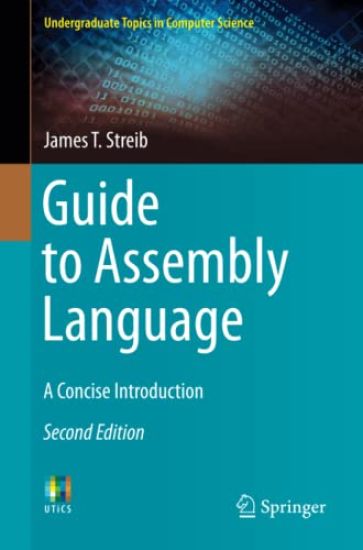
Guide to Assembly Language

Guide to Assembly Language

James T. Streib

Springer Nature Switzerland AG
2020
nidottu
This concise guide is designed to enable the reader to learn how to program in assembly language as quickly as possible. Through a hands-on programming approach, readers will also learn about the architecture of the Intel processor, and the relationship between high-level and low-level languages.This updated second edition has been expanded with additional exercises, and enhanced with new material on floating-point numbers and 64-bit processing.Topics and features: provides guidance on simpli?ed register usage, simpli?ed input/output using C-like statements, and the use of high-level control structures; describes the implementation of control structures, without the use of high-level structures, and often with related C program code; illustrates concepts with one or more complete program; presents review summaries in each chapter, together with a variety of exercises, from short-answer questions to programming assignments; covers selection and iteration structures, logic,shift, arithmetic shift, rotate, and stack instructions, procedures and macros, arrays, and strings; includes an introduction to floating-point instructions and 64-bit processing; examines machine language from a discovery perspective, introducing the principles of computer organization.A must-have resource for undergraduate students seeking to learn the fundamentals necessary to begin writing logically correct programs in a minimal amount of time, this work will serve as an ideal textbook for an assembly language course, or as a supplementary text for courses on computer organization and architecture. The presentation assumes prior knowledge of the basics of programming in a high-level language such as C, C++, or Java.
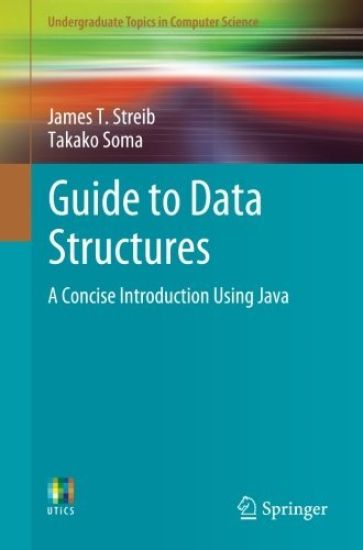
Guide to Data Structures

Guide to Data Structures

James T. Streib; Takako Soma

Springer International Publishing AG
2018
nidottu
This accessible and engaging textbook/guide provides a concise introduction to data structures and associated algorithms. Emphasis is placed on the fundamentals of data structures, enabling the reader to quickly learn the key concepts, and providing a strong foundation for later studies of more complex topics. The coverage includes discussions on stacks, queues, lists, (using both arrays and links), sorting, and elementary binary trees, heaps, and hashing. This content is also a natural continuation from the material provided in the separate Springer title Guide to Java by the same authors.Topics and features: reviews the preliminary concepts, and introduces stacks and queues using arrays, along with a discussion of array-based lists; examines linked lists, the implementation of stacks and queues using references, binary trees, a range of varied sorting techniques, heaps, and hashing; presents both primitive and generic data types in each chapter, and makes use of contour diagrams to illustrate object-oriented concepts; includes chapter summaries, and asks the reader questions to help them interact with the material; contains numerous examples and illustrations, and one or more complete program in every chapter; provides exercises at the end of each chapter, as well as solutions to selected exercises, and a glossary of important terms.This clearly-written work is an ideal classroom text for a second semester course in programming using the Java programming language, in preparation for a subsequent advanced course in data structures and algorithms. The book is also eminently suitable as a self-study guide in either academe or industry.
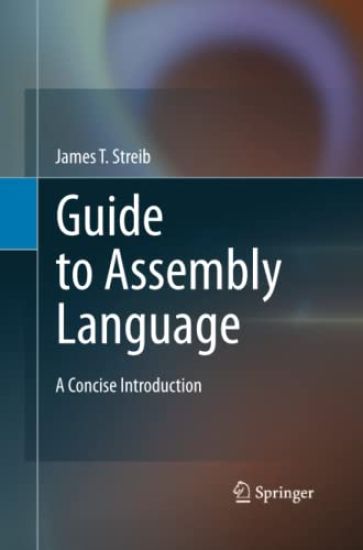
Guide to Assembly Language

Guide to Assembly Language

James T. Streib

Springer London Ltd
2014
nidottu
This book will enable the reader to very quickly begin programming in assembly language. Through this hands-on programming, readers will also learn more about the computer architecture of the Intel 32-bit processor, as well as the relationship between high-level and low-level languages. Topics: presents an overview of assembly language, and an introduction to general purpose registers; illustrates the key concepts of each chapter with complete programs, chapter summaries, and exercises; covers input/output, basic arithmetic instructions, selection structures, and iteration structures; introduces logic, shift, arithmetic shift, rotate, and stack instructions; discusses procedures and macros, and examines arrays and strings; investigates machine language from a discovery perspective. This textbook is an ideal introduction to programming in assembly language for undergraduate students, and a concise guide for professionals wishing to learn how to write logically correct programs in a minimal amount of time.