Kirjojen hintavertailu. Mukana 12 390 323 kirjaa ja 12 kauppaa.

Kirjailija

James V. Schall

Kirjat ja teokset yhdessä paikassa: 30 kirjaa, julkaisuja vuosilta 1986-2022, suosituimpien joukossa On Islam: A Chronological Record, 2002-2018. Vertaile teosten hintoja ja tarkista saatavuus suomalaisista kirjakaupoista.

30 kirjaa

Kirjojen julkaisuhaarukka 1986-2022.

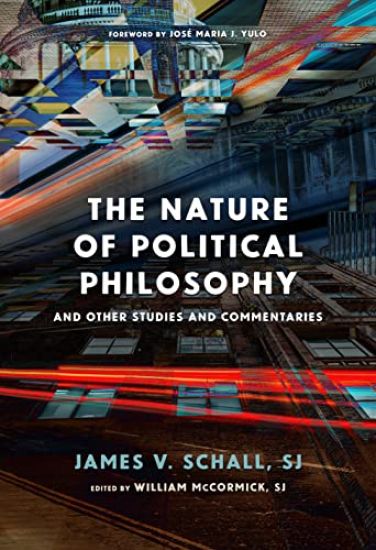
The Nature of Political Philosophy

The Nature of Political Philosophy

James V. Schall; Jose Maria J. Yulo

THE CATHOLIC UNIVERSITY OF AMERICA PRESS
2022
nidottu
In his final collection of essays, Father Schall explores the life of faith across a dazzling array of subjects, from Martin Luther to bioethics. With his characteristic patience, brilliance, and careful tenacity, Father Schall interrogates profoundly what it means to try to be a citizen of the Kingdom of God in the city of Man. Never shying away from controversy, across 14 articles and 4 book reviews Father Schall investigates the critical themes of his life and scholarship: reason and revelation; the nature of modernity; literature and salvation; metaphysics and politics; and much more.Whether the reader is new to Father Schall or a longtime student, this posthumously-published collection of essays offers a profound meditation on the nature of political philosophy, and particularly what it would mean for Catholicism to offer a political philosophy. From such fundamental considerations, Schall explores ethical, literary and legal themes, displaying his typical breadth and depth of engagement with all that is real.Ultimately, Father Schall leads one on a Socratic enterprise, an education whereby one comes to question for oneself basic assumptions, and to dig deeper into the first principles as they are recalled in the orders of knowledge and being. While Father Schall has passed on to his reward, this collection of essays helps ensure that his lessons continue to guide, challenge and enrich students for generations to come.
At a Breezy Time of Day – Selected Schall Interviews on Just about Everything
We have books that contain collected essays, verse, and humor. What we see less often are books that contain collected interviews on various topics. Interviews have a certain outside discipline about them. The one interviewed responds to a question someone else asks of him. Often the questions are unexpected, sometimes annoying. Answers have a freshness to them. They can be more personal, frank. The responses in At a Breezy Time of Day are occasioned when someone writes or phones with a request for an interview. There may be a common theme but often side questions come up. We are curious about what someone has to say – about sports, about God, about Plato, about education, about books, about just about anything. Usually central questions occur. The same question can be answered in different ways. We often have more to say on a given topic than we do say on our first being asked about it. These interviews appeared in various on-line and printed sources. Having them collected in one text makes the interview form itself seem more substantial. Interviews too often seem to be passing, ephemeral things, but often we want to hold on to them. There is something more existential about them. Yet there is also something more lightsome about them also. The truth of things seems more bearable when it is spoken, when it has a human voice. So, as the title of this collection intimates, we begin with the very first interview in the Garden of Eden. We touch many places and issues. The interview always has somewhere even in its written form the touch of the human voice. The one who interviews invites us to speak, to tell us what we hold, why we hold it. Interviews are themselves part of that engagement in conversation that defines our kind in its search for a full knowledge of what is. We know that when we have said the last word, much remains to be said. We can rejoice both in what we know, and in what we know that we do not know. I believe it was Socrates who, in an earlier form of interview at the end of The Apology, alerted us to be aware of what we know and to await the many other interviews that we hope to carry on with so many others of our kind in the Isles of the Blessed.
On the Principles of Taxing Beer – and Other Brief Philosophical Essays
What is real and what is noble, as well as what is deranged and wrong, can often be stated briefly. Nietzsche was famous for his succinct aphorisms and epigrams. Aquinas in one of his responses could manage to state clearly what he held to be true. Ultimately, all of our thought needs to be so refined and concentrated that we can see the point. So these are “brief” essays and they are largely of a philosophical “hue.” They touch on things worth thinking about. Indeed, often they consider things we really need to think about if our lives are to make sense. The advantage of a collection of essays is that it is free to talk about many things. It can speak of them in a learned way or in an amused and humorous way. As Chesterton said, there is no necessary conflict between what is true and what is funny. Oftentimes, the greatest things we learn are through laughter, even laughter at ourselves and our own foibles and faults. So these essays are “brief.” And they are largely of philosophical import. At first sight, taxing beer may seem to have no serious principle, except perhaps for the brewer and the consumer. But wherever there is reality, we can find something to learn. Each of these essays begins with the proposition “on”—this is a classical form of essay in the English language. Belloc, one the essay’s greatest masters, wrote a book simply entitled “ON”—and several other books with that introductory “ON” to begin it. The word has the advantage of focusing our attention on some idea, place, book, person, or reality that we happen to come across and notice, then notice again, then wonder about. These essays are relatively short, often lightsome, hopefully always with a consideration that illumines the world through the mind of the reader. These essays are written in the spirit that the things we encounter provoke us, our minds. We need to come to terms, to understand what we come across in our pathways through this world. Often the best way to know what we observe or confront is to write about it, preferably briefly and with some philosophical insight. This is what we do here.
Run That by Me Again: Selected Essays from Absolutes to the Things That Can Be Otherwise
Over a span of six decades, Fr. James Schall has been one of our foremost thinkers and cultural commenters. A distinguished professor, the author of more than thirty books, and writer of countless essays - his favorite literary form - Fr. Schall has made a life of pondering the most important questions of this world and beyond. Now, in Run That By be Again, Fr. Schall himself has selected more than fifty of his essays on the most intriguing, urgent, and sometimes difficult topics. These are things we want to - need to- think about again and again, and Schall, with his concise, readable style and teacher's heart, has a knack for explaining lofty ideas to all. Here, Schall ruminates on: Language, Wodehouse, cooking, music, and putting Jesuit donkeys out to pasture (you'll just have to read it); Abortion, marriage, Christian persecution, and other issues that continue to gnaw away at our Christian culture; Christ and his nature, what it means to be human, sin and its origins and consequences; And the Cosmos, the South, English departments, and other mysterious places.The Common threads are a love of God, a thirst for wisdom, and a desire for a life well-lived. Whether this is your first time considering the questions posed and answered in these pages or if you are revisiting them with fresh eyes and a renewed spirit, it is well worth the time to sit with Fr. Schall - one of the greatest thinkers and teachers of the past century - and ponder the great mysteries and truths of life.
On Islam: A Chronological Record, 2002-2018

On Islam: A Chronological Record, 2002-2018

James V. Schall

IGNATIUS PRESS
2018
nidottu
From Paris to San Bernardino, from Orlando to Manchester the Western world has been rocked by shocking mass murders done in the name of Islam since the attack on the World Trade Center and the Pentagon in 2001. This chronology of these and other key events, from 2002 to 2018, offers an opportunity to analyze the ongoing conflict between Islamism and the West. Author Fr. James V. Schall, S.J., a renowned political philosopher, discusses the difficulty that Europeans and Americans have in recognizing that resurgent Islamic militancy is not just caused by "terrorists", as if terrorism were some kind of independent movement or mind-set. Violence has a source. No one undertakes it without a cause that is worth, in his mind, the risk of death. Islam is unique in its description of the world within itself, which is to live peacefully by the law of Allah, and the world outside this sphere, which is at war with Islam. The main concern of the author is the abiding existence of Islam over time and its constancy in attempting to achieve the goal of worldwide submission to Allah as a political and cultural fact.
The Universe We Think in

The Universe We Think in

James V. Schall

The Catholic University of America Press
2018
nidottu
The Universe We Think In arises from a tradition of realism, both philosophical and political, a universe in which the common sense understanding of things is included in our judgement about them. The scope is both vast and narrow – vast because it is aware of the reality of things, narrow because it is the individual person who can and wants to know them. The abiding undercurrent of this book is that the cosmos, the universe, does not look at us human beings, but we look at it, seek to understand it, and do understand much of it. Why is this so? The book seeks to begin with the basic question that we each ought to pose to ourselves; namely: “Why do I exist?” Nothing is more immediate than the relation of what is not ourselves to ourselves.We have the strange experience that we cannot even ‘know ourselves’ unless we know something that is not ourselves. In a sense, we have two related worlds, the one that exists, a universe, as it were, that includes each of us, and the same world that we think about. What is so striking about our personal existence is that we can know what is not ourselves. Indeed, we not only want to know what is not ourselves, but this knowledge of what is not ourselves is also, in part, the reason for our existence in the first place. Our thinking about the world is not unrelated to the world that is. Yet, once we understand what is in the world, both systematically and casually, we find ourselves free in a world of others who also think and communicate with one another. Thus, to know ourselves includes knowing what is not ourselves in its own diversity. Ultimately, we seek to know why it all is rather than is not, why it all belongs together in the same universe.
The Quotable Augustine

The Quotable Augustine

James V. Schall

The Catholic University of America Press
2016
nidottu
Augustine of Hippo is one of the most well-loved and most thoughtprovoking writers of the early church. He is also one of the most quotable. In this slim volume, some of the saint’s memorable, pithy, controversial, and oŸen feisty sayings are gathered in topics that range from war to peace; grief to happiness; vice to virtue; and from heaven to hell. He speaks—and speaks out—on things theological, such as sin and salvation, but also on the life of the mind—on books, education, teaching, and knowledge. This book is ideal for those who wish to read some of the wisest and most wonderful sayings of Augustine. It will help all those who wish to pepper a speech, or a sermon, or an essay with the wisdom of Saint Augustine. The book is a valuable resource, too, for anyone who wants tofind out “Did Augustine really say that?” and, if he did, in which of his voluminous writings it appeared. Drawn from the internationally acclaimed and successful series, the ‘Fathers of the Church,’ The Quotable Augustine presents a wide-ranging sample of the writings of a towering figure of the early church.
Political Philosophy and Revelation

Political Philosophy and Revelation

James V. Schall

The Catholic University of America Press
2013
nidottu
A collection of Fr. James Schall’s recent essays, Political Philosophy and Revelation offers a learned, erudite, and coherent statement on the relationship between reason and revelation in the modern world. It addresses political philosophy in the context of an awareness of other humane and practical sciences, including history, literature, economics, theology, ethics and metaphysics.Today, revelation and reason are often thought to be in opposition to each other. This book looks at arguments and evidence for a more consistent reading of our experience and thought, one that would include the revelational contributions and the philosophy and politics it inspires. This is done in accord with “the Catholic understanding of freedom and reason”. To see these connections, Schall looks to the readings of Plato to illustrate how revelation addresses itself to reason.Political Philosophy and Revelation will prove to be an indispensable guide to the thinking and writing of Fr. Schall in the second decade of the twenty first century.
On Unseriousness Of Human Affairs

On Unseriousness Of Human Affairs

James V. Schall

ISI Books
2012
nidottu
To the ears of ceaselessly busy and ambitious modern Westerners, it will come as a shock, and perhaps as an insult, to be told that human affairs are ?unserious.? But this fundamental truth is exactly what James Schall, following Plato, has to teach us in this wise and witty book.Schall cites Charlie Brown, Aristotle, and Samuel Johnson with the same sobriety?the sobriety that sees the truth in what is delightful and even amusing. Singing, dancing, playing, contemplating, and other ?useless? human activities are not merely forms of escape from more important things?politics, work, social activism, etc.?but an indication of the very nature of the highest things themselves.On the Unseriousness of Human Affairs is an instructive volume whose countercultural message is of vital importance.
The Mind That is Catholic

The Mind That is Catholic

James V. Schall

The Catholic University of America Press
2008
nidottu
James V. Schall is a treasure of the Catholic intellectual tradition. A prolific author and essayist, Schall readily connects with his readers on sundry topics from war to friendship, philosophy, politics, and to ordinary everyday living. In his newest work, ""The Mind That Is Catholic"", he presents a retrospective collection of his academic and literary essays written in the past fifty years. In each essay, he exemplifies the Catholic mind at its best - seeing the whole, leaving nothing out.The 'Catholic mind' seeks to recognize a consistent and coherent relation between the solid things of reason and the definite facts of revelation. Its thought aims to understand how they belong together in a fruitful manner, each profiting from the other; each being what it is. The Catholic mind is not a confusion of disparate sources. It respects and makes distinctions. It sees where things separate. It is in fact delighted by what is.This delightful book is not polemical, but contemplative in mood. Schall shares with readers a mind that is constantly struck by how things fit together when seen in full light. He brings to his work a lifetime of study in political philosophy, a wide-ranging discipline that, in many ways, is the most immediate context in which reason and revelation meet. ""The Mind That Is Catholic"" respects what can be known by faith alone. But it also considers what is known by faith to be itself intelligible to a mind actively thinking on political and philosophical things. The whole, at the risk of its own contradiction, does not exclude the intelligibility of what is revealed.