Kirjojen hintavertailu. Mukana 12 595 353 kirjaa ja 12 kauppaa.

Kirjailija

James W. Hardin

Kirjat ja teokset yhdessä paikassa: 4 kirjaa, julkaisuja vuosilta 2010-2018, suosituimpien joukossa Common Errors in Statistics (and How to Avoid Them). Vertaile teosten hintoja ja tarkista saatavuus suomalaisista kirjakaupoista.

4 kirjaa

Kirjojen julkaisuhaarukka 2010-2018.

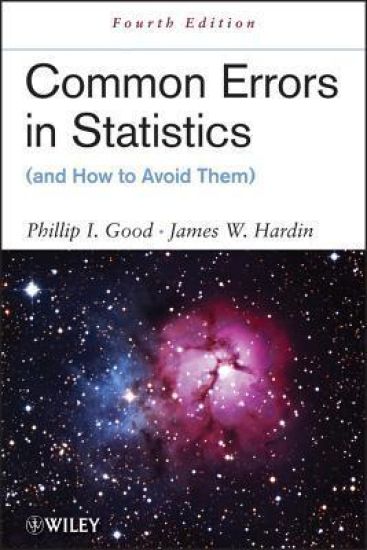
Common Errors in Statistics (and How to Avoid Them)

Common Errors in Statistics (and How to Avoid Them)

Phillip I. Good; James W. Hardin

John Wiley Sons Inc
2012
nidottu
Praise for Common Errors in Statistics (and How to Avoid Them) "A very engaging and valuable book for all who use statistics in any setting." ?CHOICE "Addresses popular mistakes often made in data collection and provides an indispensable guide to accurate statistical analysis and reporting. The authors' emphasis on careful practice, combined with a focus on the development of solutions, reveals the true value of statistics when applied correctly in any area of research." ?MAA Reviews Common Errors in Statistics (and How to Avoid Them), Fourth Edition provides a mathematically rigorous, yet readily accessible foundation in statistics for experienced readers as well as students learning to design and complete experiments, surveys, and clinical trials. Providing a consistent level of coherency throughout, the highly readable Fourth Edition focuses on debunking popular myths, analyzing common mistakes, and instructing readers on how to choose the appropriate statistical technique to address their specific task. The authors begin with an introduction to the main sources of error and provide techniques for avoiding them. Subsequent chapters outline key methods and practices for accurate analysis, reporting, and model building. The Fourth Edition features newly added topics, including: Baseline dataDetecting fraudLinear regression versus linear behaviorCase control studiesMinimum reporting requirementsNon-random samples The book concludes with a glossary that outlines key terms, and an extensive bibliography with several hundred citations directing readers to resources for further study. Presented in an easy-to-follow style, Common Errors in Statistics, Fourth Edition is an excellent book for students and professionals in industry, government, medicine, and the social sciences.
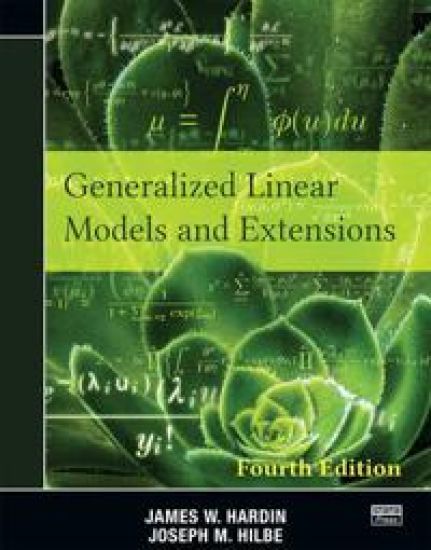
Generalized Linear Models and Extensions

Generalized Linear Models and Extensions

James W. Hardin; Joseph M. Hilbe

Stata Press
2018
nidottu
Generalized linear models (GLMs) extend linear regression to models with a non-Gaussian, or even discrete, response. GLM theory is predicated on the exponential family of distributions—a class so rich that it includes the commonly used logit, probit, and Poisson models. Although one can fit these models in Stata by using specialized commands (for example, logit for logit models), fitting them as GLMs with Stata’s glm command offers some advantages. For example, model diagnostics may be calculated and interpreted similarly regardless of the assumed distribution.This text thoroughly covers GLMs, both theoretically and computationally, with an emphasis on Stata. The theory consists of showing how the various GLMs are special cases of the exponential family, showing general properties of this family of distributions, and showing the derivation of maximum likelihood (ML) estimators and standard errors. Hardin and Hilbe show how iteratively reweighted least squares, another method of parameter estimation, are a consequence of ML estimation using Fisher scoring.
Generalized Estimating Equations

Generalized Estimating Equations

James W. Hardin; Joseph M. Hilbe

Taylor Francis Inc
2012
sidottu
Generalized Estimating Equations, Second Edition updates the best-selling previous edition, which has been the standard text on the subject since it was published a decade ago. Combining theory and application, the text provides readers with a comprehensive discussion of GEE and related models. Numerous examples are employed throughout the text, along with the software code used to create, run, and evaluate the models being examined. Stata is used as the primary software for running and displaying modeling output; associated R code is also given to allow R users to replicate Stata examples. Specific examples of SAS usage are provided in the final chapter as well as on the book’s website.This second edition incorporates comments and suggestions from a variety of sources, including the Statistics.com course on longitudinal and panel models taught by the authors. Other enhancements include an examination of GEE marginal effects; a more thorough presentation of hypothesis testing and diagnostics, covering competing hierarchical models; and a more detailed examination of previously discussed subjects. Along with doubling the number of end-of-chapter exercises, this edition expands discussion of various models associated with GEE, such as penalized GEE, cumulative and multinomial GEE, survey GEE, and quasi-least squares regression. It also offers a thoroughly new presentation of model selection procedures, including the introduction of an extension to the QIC measure that is applicable for choosing among working correlation structures. See Professor Hilbe discuss the book.
Lahav II: Households and the Use of Domestic Space at Iron II Tell Halif
This volume focuses on the reconstruction of household organization during the Iron II period at Tell Halif. It centers in particular on one four-room, pillared-type building located in Area F7 of Field IV and on its remains, which were sealed in a massive destruction that eclipsed the site in the late eighth century B.C.E. This study was first prepared as a Ph.D. dissertation for the Department of Near Eastern Studies at the University of Arizona (Hardin 2001) and has since been amplified and embellished by further research. Published here are the results of research deliberately designed by the author to provide for more complete recovery and detailed recording in the field of all artifacts and other remains within a special refined three-dimensional grid matrix. These data in turn established a framework for studying the formation processes active on the materials and for conducting a spatial analysis of the assemblages in the building. Along with developing ethnographic and ethnoarchaeological inferences, these techniques are used to identify activities, activity areas, and social organization related to the building, ultimately defining an “archaeological household” consisting of the pillared dwelling and its occupants. Finally, these conclusions are also related to reconstructions of the Iron II-period household suggested by Hebrew Bible sources.