Kirjojen hintavertailu. Mukana 12 595 353 kirjaa ja 12 kauppaa.
Kirjailija
James W. Heisig
Kirjat ja teokset yhdessä paikassa: 29 kirjaa, julkaisuja vuosilta 2003-2023, suosituimpien joukossa La filosofía japonesa en sus textos. Vertaile teosten hintoja ja tarkista saatavuus suomalaisista kirjakaupoista.
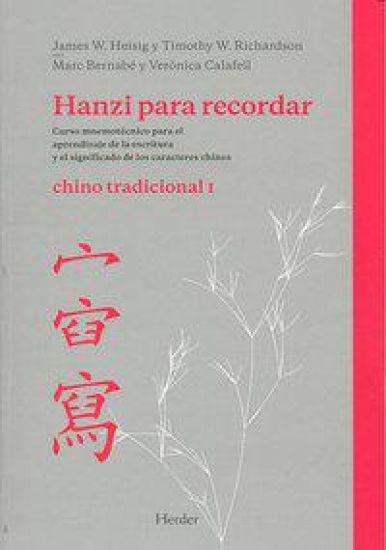
This book is the second of two volumes designed to help students learn the meaning and writing of the 3,000 most frequently used traditional Chinese characters. (A parallel set of volumes has been prepared for simplified characters.) The 1,500 characters introduced in Book 1 include the top 1,000 by frequency, plus another 500 best learned at an early stage. Book 2 adds the remaining 1,500 characters to complete the set.The lessons of Book 2 have been arranged in such a way that they may be studied either after those of Book 1 or simultaneously with them. Students who wish to focus initially on the 1,000 most frequently used characters in the language can do so by studying Book 1 before moving on to Book 2. Many, if not most, learners will find this preferable. Students who wish to apply the logical ordering found in these pages to the entire list of 3,000 characters from the very beginning can take the more exacting, but also more rationally satisfying, approach of studying the parallel lessons of the two volumes together.The lessons in this book are followed by two short, additional sections, one that introduces a number of “compounds,” or characters that are best learned in pairs, and another that adds two “postscripts.” The book also includes a number of comprehensive indexes that are designed to facilitate work with both volumes. Of central importance to the approach found in these pages is the systematic arranging of characters in an order best suited to memory. In the Chinese writing system, strokes and simple components are nested within relatively simple characters. These characters, in turn, can serve as parts of more complicated characters, and so on. Taking advantage of this allows a logical ordering, making it possible for students to approach most new characters with prior knowledge that can greatly facilitate the learning process.Guidance and detailed instructions are provided all along the way. Students are taught to employ “imaginative memory” to associate each character’s component parts or “primitive elements” with one another and with a key word that has been carefully selected to represent an important meaning of the character. This is accomplished through creation of a “story” that engagingly ties the primitive elements and key word together. In this way, the collections of dots, strokes and components that make up the characters are associated in memorable ways, dramatically shortening the time required for learning and helping prevent characters from slipping out of memory.
The aim of this book is to provide the student of Japanese with a simple method for correlating the writing and the meaning of Japanese characters in such a way as to make them both easy to remember. It is intended not only for the beginner, but also for the more advanced student looking for some relief from the constant frustration of forgetting how to write the kanji, or for a way to systematize what he or she already knows.The author begins with writing the kanji because—contrary to first impressions—it is in fact simpler than learning how to the pronounce them. By ordering the kanji according to their component parts or “primitive elements,” and then assigning each of these parts a distinct meaning with its own distinct image, the student is led to harness the powers of “imaginative memory” to learn the various combinations that make up the kanji. In addition, each kanji is given its own key word to represent the meaning, or one of the principal meanings, of that character. These key words provide the setting for a particular kanji’s “story,” whose protagonists are the primitive elements.In this way, one is able to complete in a few short months a task that would otherwise take years. Armed with the same skills as Chinese or Korean students, who know the meaning and writing of the kanji but not their Japanese pronunciations, one is then in a much better position to learn the readings (which are treated in a separate volume).Remembering the Kanji has helped tens of thousands of students advance towards literacy at their own pace, and to acquire a facility that traditional methods have long since given up on as all but impossible for those not raised with the kanji from childhood. The 6th edition has been updated to include the 196 new kanji approved by the government in 2010 as “general-use” kanji.
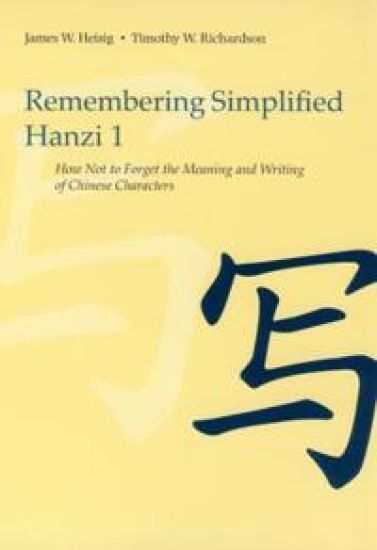
At long last the approach that has helped thousands of learners memorize Japanese kanji has been adapted to help students with Chinese characters. ""Book 1 of Remembering Simplified Hanzi"" covers the writing and meaning of the 1,000 most commonly used characters in the simplified Chinese writing system, plus another 500 that are best learned at an early stage. (Book 2 adds another 1,500 characters for a total of 3,000.) Of critical importance to the approach found in these pages is the systematic arranging of characters in an order best suited to memorization. In the Chinese writing system, strokes and simple components are nested within relatively simple characters, which can, in turn, serve as parts of more complicated characters and so on. Taking advantage of this allows a logical ordering, making it possible for students to approach most new characters with prior knowledge that can greatly facilitate the learning process.Guidance and detailed instructions are provided along the way. Students are taught to employ 'imaginative memory' to associate each character's component parts, or 'primitive elements', with one another and with a key word that has been carefully selected to represent an important meaning of the character. This is accomplished through the creation of a 'story' that engagingly ties the primitive elements and key word together. In this way, the collections of dots, strokes, and components that make up the characters are associated in memorable fashion, dramatically shortening the time required for learning and helping to prevent characters from slipping out of memory.
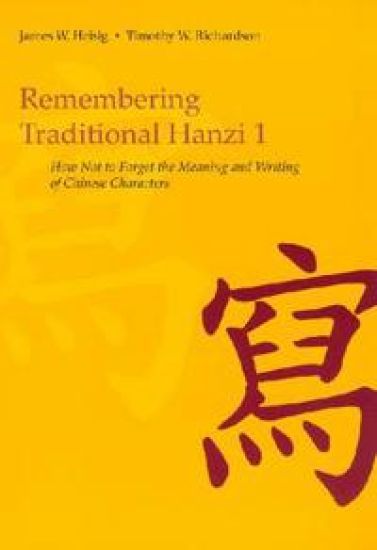
At long last the approach that has helped thousands of learners memorize Japanese kanji has been adapted to help students with Chinese characters. Book 1 of ""Remembering Simplified Hanzi"" and ""Remembering Traditional Hanzi"" covers the writing and meaning of the 1,000 most commonly used characters in the Chinese writing system, plus another 500 that are best learned at an early stage. (Book 2 adds another 1,500 characters for a total of 3,000.) Of critical importance to the approach found in these pages is the systematic arranging of characters in an order best suited to memorization. In the Chinese writing system, strokes and simple components are nested within relatively simple characters, which can, in turn, serve as parts of more complicated characters and so on. Taking advantage of this allows a logical ordering, making it possible for students to approach most new characters with prior knowledge that can greatly facilitate the learning process. Guidance and detailed instructions are provided along the way. Students are taught to employ 'imaginative memory' to associate each character's component parts, or 'primitive elements', with one another and with a key word that has been carefully selected to represent an important meaning of the character. This is accomplished through the creation of a 'story' that engagingly ties the primitive elements and key word together. In this way, the collections of dots, strokes, and components that make up the characters are associated in memorable fashion, dramatically shortening the time required for learning and helping to prevent characters from slipping out of memory.
Die Kana, also die Silbenschriften Hiragana und Katakana, sind die erste Herausforderung und auch das erste Abenteuer für alle, die Japanisch lesen und schreiben möchten. Für viele Lernende beginnt der Weg zu fließendem Japanisch jedoch mit hartem Drill, die fremd und abstrakt anmutenden Zeichen werden traditionell durch wochenlange Wiederholung erlernt. Die Kana lernen und behalten zeigt einen anderen Weg: Kleine Geschichten helfen, sich die Zeichen schnell und doch dauerhaft zu merken. Diese von James W. Heisig entwickelte Methode ist seit Jahrzehnten bewährt und gerade für erwachsene Lernende viel effektiver als pures Auswendiglernen abstrakter Strichfolgen. Sie greift auf Erinnerungen und individuelle Assoziationen zurück - diese müssen nicht mehr auswendig gelernt, sondern nur neu verknüpft werden. Daher entfallen die ermüdenden Wiederholungen und Schreibübungen, das Lerntempo steigert sich spürbar: Die Hiragana und Katakana können in je drei Stunden erlernt werden. Beginnen Sie den ersten Schritt auf Ihrem Weg zur japanischen Sprache nicht mit sturem Pauken, sondern mit lustvollem Imaginieren - und lassen Sie sich verzaubern von der Schönheit der japanischen Schrift.
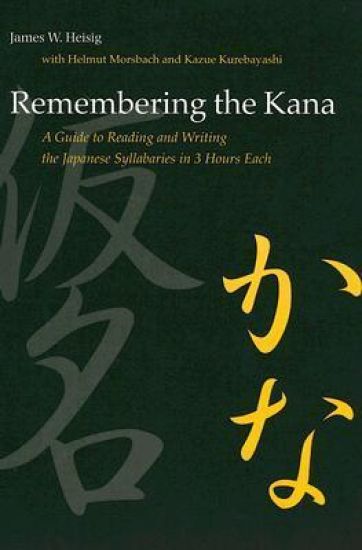
Following on the phenomenal success of ""Remembering the Kanji"", the author has prepared a companion volume for learning the Hiragana and Katakana syllabaries of modern Japanese. In six short lessons of about twenty minutes, each of the two systems of ""kana"" writing are introduced in such a way that the absolute beginner can acquire fluency in writing in a fraction of the time normally devoted to the task. Using the same basic self-taught method devised for learning the kanji, and in collaboration with Helmut Morsbach and Kazue Kurebayashi, the author breaks the shapes of the two syllabaries into their component parts and draws on what he calls ""imaginative memory"" to aid the student in reassembling them into images that fix the sound of each particular kana to its writing. Now in its third edition, ""Remembering the Kana"" has helped tens of thousands of students of Japanese master the Hiragana and Katakana in a short amount of time...and have fun in the process.
James Heisig has spent his life traveling along many roads—living in Japan, Spain, England, and the United States, and listening to other religious traditions while remaining a Roman Catholic. In this book, Heisig draws from this worldly insight, and presents an invaluable dialogue between Christianity and Buddhism.