Kirjojen hintavertailu. Mukana 12 390 323 kirjaa ja 12 kauppaa.

Kirjailija

James W. Kolari

Kirjat ja teokset yhdessä paikassa: 9 kirjaa, julkaisuja vuosilta 2009-2025, suosituimpien joukossa Asset Pricing Models and Market Efficiency. Vertaile teosten hintoja ja tarkista saatavuus suomalaisista kirjakaupoista.

9 kirjaa

Kirjojen julkaisuhaarukka 2009-2025.

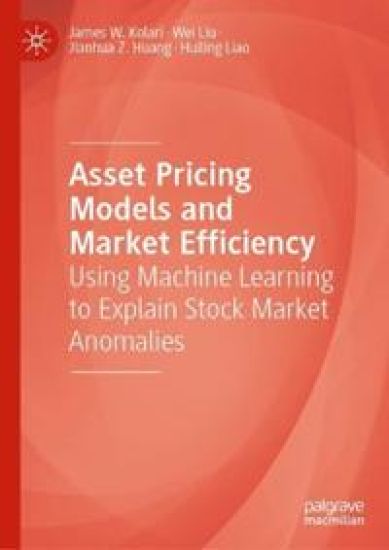
Asset Pricing Models and Market Efficiency

Asset Pricing Models and Market Efficiency

James W. Kolari; Wei Liu; Jianhua Z. Huang; Huiling Liao

Springer International Publishing AG
2025
sidottu
This book shows that the stock market returns of hundreds of anomaly portfolios discovered by researchers in finance over the past three decades can be explained by a recent asset pricing model dubbed the ZCAPM. Anomaly portfolios are long/short portfolio returns on stocks that cannot be explained by asset pricing models, and their number has been steadily increasing into the hundreds. Since asset pricing models cannot explain them, behavioral theories have become popular to account for anomalies. Unlike the efficient market hypothesis that assumes rational investors, these human psychology-based theories emphasize irrational investor behavior. This book collects and analyzes a large database of U.S. stock returns for anomaly portfolios over a long sample period spanning approximately 60 years. The authors overview different asset pricing models that have attempted to explain anomalous portfolio returns in the stock market. They then provide a theoretical and empirical discussion of a new asset pricing model dubbed the ZCAPM and report compelling empirical evidence that reveals the ZCAPM can explain hundreds of anomalies. Implications to the efficient-markets/behavioral-finance controversy are discussed. The book will be of particular interest to researchers, students, and professors of capital markets, asset management, and financial economics alongside professionals.
A New Model of Capital Asset Prices

A New Model of Capital Asset Prices

James W. Kolari; Wei Liu; Jianhua Z. Huang

Springer Nature Switzerland AG
2021
sidottu
This book proposes a new capital asset pricing model dubbed the ZCAPM that outperforms other popular models in empirical tests using US stock returns. The ZCAPM is derived from Fischer Black’s well-known zero-beta CAPM, itself a more general form of the famous capital asset pricing model (CAPM) by 1990 Nobel Laureate William Sharpe and others. It is widely accepted that the CAPM has failed in its theoretical relation between market beta risk and average stock returns, as numerous studies have shown that it does not work in the real world with empirical stock return data. The upshot of the CAPM’s failure is that many new factors have been proposed by researchers. However, the number of factors proposed by authors has steadily increased into the hundreds over the past three decades. This new ZCAPM is a path-breaking asset pricing model that is shown to outperform popular models currently in practice in finance across different test assets and time periods.Since asset pricing is central to the field of finance, it can be broadly employed across many areas, including investment analysis, cost of equity analyses, valuation, corporate decision making, pension portfolio management, etc. The ZCAPM represents a revolution in finance that proves the CAPM as conceived by Sharpe and others is alive and well in a new form, and will certainly be of interest to academics, researchers, students, and professionals of finance, investing, and economics.
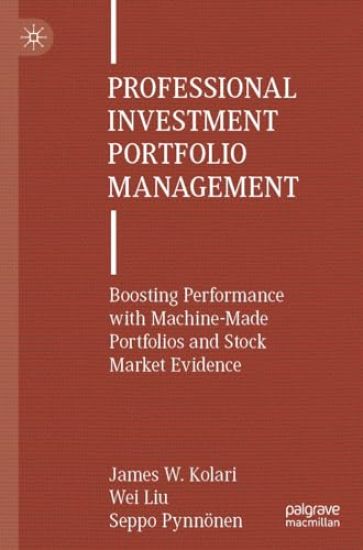
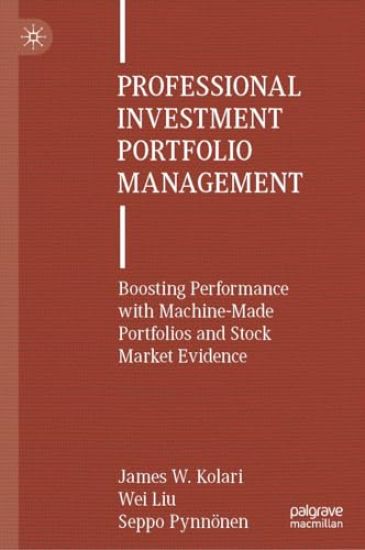
Professional Investment Portfolio Management

Professional Investment Portfolio Management

James W. Kolari; Wei Liu; Seppo Pynnönen

Springer International Publishing AG
2024
sidottu
Professional investment portfolio management is increasingly utilizing sophisticated statistical and computer techniques to better control risks and improve performance. This book provides new quantitative tools and technology for securities professionals to help boost the performance of their investment portfolios offered to clients. Unlike other books in this area, the authors utilize revolutionary asset pricing methods and models to analyze data for U.S. stocks and show how to apply them to the problem of creating highly diversified portfolios that are efficient in terms of returns per unit risk.
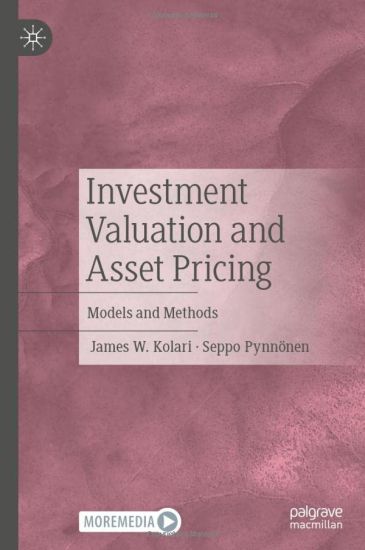
Investment Valuation and Asset Pricing

Investment Valuation and Asset Pricing

James W. Kolari; Seppo Pynnönen

Springer International Publishing AG
2024
nidottu
This textbook is intended to fill a gap in undergraduate finance curriculums by providing an asset pricing text that is accessible for undergraduate finance students. It offers an overview of original works on foundational asset pricing studies that follows their historical publication chronologically throughout the text. Each chapter stays close to the original works of these major authors, including quotations, examples, graphical exhibits, and empirical results. Additionally, it includes statistical concepts and methods as applied to finance. These statistical materials are crucial to learning asset pricing, which often applies statistical tests to evaluate different asset pricing models. It offers practical examples, questions, and problems to help students check their learning and better understand the fundamentals of asset pricing., alongside including PowerPoint slides and an instructor’s manual for professors.
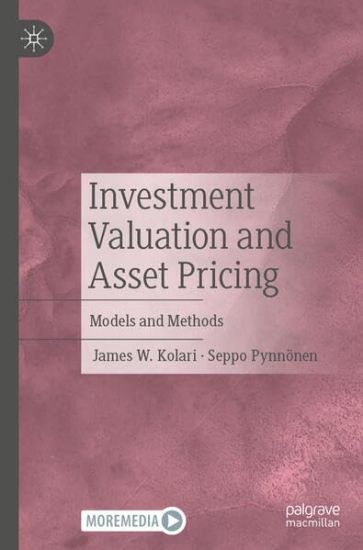
Investment Valuation and Asset Pricing

Investment Valuation and Asset Pricing

James W. Kolari; Seppo Pynnönen

Springer International Publishing AG
2023
sidottu
This textbook is intended to fill a gap in undergraduate finance curriculums by providing an asset pricing text that is accessible for undergraduate finance students. It offers an overview of original works on foundational asset pricing studies that follows their historical publication chronologically throughout the text. Each chapter stays close to the original works of these major authors, including quotations, examples, graphical exhibits, and empirical results. Additionally, it includes statistical concepts and methods as applied to finance. These statistical materials are crucial to learning asset pricing, which often applies statistical tests to evaluate different asset pricing models. It offers practical examples, questions, and problems to help students check their learning and better understand the fundamentals of asset pricing., alongside including PowerPoint slides and an instructor’s manual for professors.
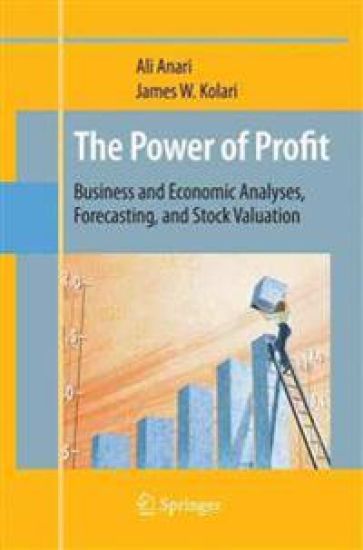
The Power of Profit

The Power of Profit

Ali Anari; James W. Kolari

Springer-Verlag New York Inc.
2014
nidottu
How can business leaders make better production and capital investment decisions? How can Wall Street analysts improve their predictions of future stock market values? How can government improve macroeconomic forecasts and policies? In The Power of Profit, Anari and Kolari demonstrate how profit measures can be applied as the basis for these and many other applications of economic, policy, financial, and business analysis. The underlying theme of the book is that profitability is the driving force in free market economies. Firms invest in capital, produce goods and services, and generate sales in an effort to reap profits. Firms that are unprofitable exit the marketplace and are replaced by profitable firms. Despite the crucial importance of profits, however, there is no formal model that directly relates profits to capital formation and output. Previous studies over the past 100 years on profit and the economy are mainly descriptive in nature, without any well-specified model grounded in microeconomic theory. Filling this gap, the authors present a profit system model of the firm grounded in basic accounting relationships in addition to the well-known Cobb-Douglas production function, which can be applied to individual firms, industries, and the business sector as a whole. Through rigorous data analysis, the authors show how the profit system modelcan be applied to: modeling the U.S. business sector and national economy forecasting output, capital stock, total profit, profit rates, and profit margins examining the relationships among profitability, economic growth, and the business cycle simulating the effects of potential monetary policy changes on the business sector and national economy valuing the Standard & Poor’s stock market index as well as individual firms. The result is a model thatintegrates microeconomic and macroeconomic factors and that can be widely applied in business and economic decisions, policymaking, research, and teaching.
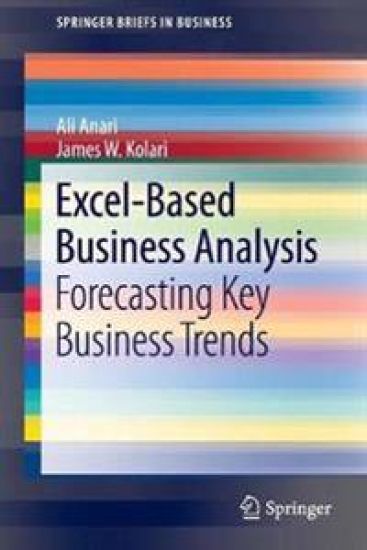
Excel-Based Business Analysis

Excel-Based Business Analysis

Ali Anari; James W. Kolari

Springer-Verlag New York Inc.
2011
nidottu
?“The trend is your friend”is a practical principle often used by business managers, who seek to forecast future sales, expenditures, and profitability in order to make production and other operational decisions. The problem is how best to identify and discover business trends and utilize trend information for attaining objectives of firms.This book contains an Excel-based solution to this problem, applying principles of the authors’ “profit system model” of the firm that enables forecasts of trends in sales, expenditures, profits and other business variables. The program, called FIRM, which runs on Windows with Microsoft Excel 2010, useshistorical time series of total sales, total costs, and total assets of the firm from its financial statements (income statements and balance sheets), estimates relationships among these variables, and then employs the estimated relationships to forecasts trends in these vital business variables. Featuring step-by-step case examples, the goalis to equip business managers and students with easy-to-use tools for understanding and forecasting trends in important business variables, thereby empowering them to make better business decisions.
The Power of Profit

The Power of Profit

Ali Anari; James W. Kolari

Springer-Verlag New York Inc.
2009
sidottu
How can business leaders make better production and capital investment decisions? How can Wall Street analysts improve their predictions of future stock market values? How can government improve macroeconomic forecasts and policies? In The Power of Profit, Anari and Kolari demonstrate how profit measures can be applied as the basis for these and many other applications of economic, policy, financial, and business analysis. The underlying theme of the book is that profitability is the driving force in free market economies. Firms invest in capital, produce goods and services, and generate sales in an effort to reap profits. Firms that are unprofitable exit the marketplace and are replaced by profitable firms. Despite the crucial importance of profits, however, there is no formal model that directly relates profits to capital formation and output. Previous studies over the past 100 years on profit and the economy are mainly descriptive in nature, without any well-specified model grounded in microeconomic theory. Filling this gap, the authors present a profit system model of the firm grounded in basic accounting relationships in addition to the well-known Cobb-Douglas production function, which can be applied to individual firms, industries, and the business sector as a whole. Through rigorous data analysis, the authors show how the profit system modelcan be applied to: modeling the U.S. business sector and national economy forecasting output, capital stock, total profit, profit rates, and profit margins examining the relationships among profitability, economic growth, and the business cycle simulating the effects of potential monetary policy changes on the business sector and national economy valuing the Standard & Poor’s stock market index as well as individual firms. The result is a model thatintegrates microeconomic and macroeconomic factors and that can be widely applied in business and economic decisions, policymaking, research, and teaching.