Kirjojen hintavertailu. Mukana 12 595 353 kirjaa ja 12 kauppaa.

Kirjailija

Jamie Pitts

Kirjat ja teokset yhdessä paikassa: 10 kirjaa, julkaisuja vuosilta 2013-2025, suosituimpien joukossa Principalities and Powers. Vertaile teosten hintoja ja tarkista saatavuus suomalaisista kirjakaupoista.

10 kirjaa

Kirjojen julkaisuhaarukka 2013-2025.

Organizing Spirit

Organizing Spirit

Jamie Pitts

BLOOMSBURY PUBLISHING PLC
2025
sidottu
Contemporary theologians tend to associate the Holy Spirit with the formation of local communities, social movements, and fluid relational networks—and not with institutions such as denominations or global church bodies. In this work, Jamie Pitts argues that this pneumatological-sociological picture misses important aspects of the Spirit’s work. Pitts draws on a wide range of theological and theoretical resources to depict the Spirit as organizing the complex, dynamic, and relationally entangled structures that constitute creation. Human organizing that seeks to participate in the Spirit can take a variety of analogous structural forms, including formal organizations or institutions. Organizational participation in the Spirit is not a function of an organization’s scale, mobility, or relative informality, but rather of its practical orientation toward the Spirit’s goals of life, solidarity, healing, and inclusive justice. A series of case studies clarifies and extends the implications of the argument in connection to organizing for environmental, gender, sexual, and racial justice. In the final chapter, Pitts addresses the role of a political theology of the organizing Spirit in imagining organizational alternatives to the global neoliberal order.
Organizing Spirit

Organizing Spirit

Jamie Pitts

BLOOMSBURY PUBLISHING PLC
2025
nidottu
Contemporary theologians tend to associate the Holy Spirit with the formation of local communities, social movements, and fluid relational networks—and not with institutions such as denominations or global church bodies. In this work, Jamie Pitts argues that this pneumatological-sociological picture misses important aspects of the Spirit’s work. Pitts draws on a wide range of theological and theoretical resources to depict the Spirit as organizing the complex, dynamic, and relationally entangled structures that constitute creation. Human organizing that seeks to participate in the Spirit can take a variety of analogous structural forms, including formal organizations or institutions. Organizational participation in the Spirit is not a function of an organization’s scale, mobility, or relative informality, but rather of its practical orientation toward the Spirit’s goals of life, solidarity, healing, and inclusive justice. A series of case studies clarifies and extends the implications of the argument in connection to organizing for environmental, gender, sexual, and racial justice. In the final chapter, Pitts addresses the role of a political theology of the organizing Spirit in imagining organizational alternatives to the global neoliberal order.
What Is God's Mission in the World and How Do We Join It?

What Is God's Mission in the World and How Do We Join It?

Juan Francisco Martinez; Jamie Pitts

Herald Press (VA)
2021
pokkari
What does God's mission look like? Who is supposed to carry it out--and how?Juan F. Mart nez leads us on an inquiry into God's mission in the world: what it is, what it is not, and who is invited to be part of it. If Jesus is truly God's mission incarnate, we need to look at what Jesus did and how he did it. Mart nez helps readers understand what mission means, why Christians in the past have made missteps, and how we can learn from Christian communities that are spreading the good news of Jesus today. Doing mission in the way of Jesus may look different from what many assume, but it is a call that the church cannot afford to miss. The Jesus Way: Small Books of Radical Faith delve into big questions about God's work in the world. These concise, practical books are deeply rooted in Anabaptist theology. Crafted by a diverse community of internationally renowned scholars, pastors, and practitioners, The Jesus Way series helps readers deepen their faith in Christ and enliven their witness.Accessible Jesus-centered theology from an Anabaptist perspectiveDesigned for use by individual readers, small groups, and Christian education classesGlossary of terms, illustrations, and discussion and reflection questions in each volume Books in series: What Is the Bible and How Do We Understand It? Dennis R. Edwards Fall 2019]Why Did Jesus Die and What Difference Does It Make? Michele Hershberger Fall 2019]What Is God's Mission in the World and How Do We Join It? Juan F. Mart nez Spring 2020]Why Do We Suffer and Where Is God When We Do? Valerie G. Rempel Spring 2020]What Is the Trinity and Why Does It Matter? Steve Dancause Summer 2020]Who Are Our Enemies and How Do We Love Them? Hyung Jin Kim Sun Summer 2020]What Is the Church and Why Does It Exist? David Fitch Fall 2020]What Does Justice Look Like and Why Does God Care about It? Judith and Colin McCartney Fall 2020]What Is God's Kingdom and What Does Citizenship Look Like? C sar Garc a Spring 2021]Who Was Jesus and What Does It Mean to Follow Him? Nancy Elizabeth Bedford Spring 2021]
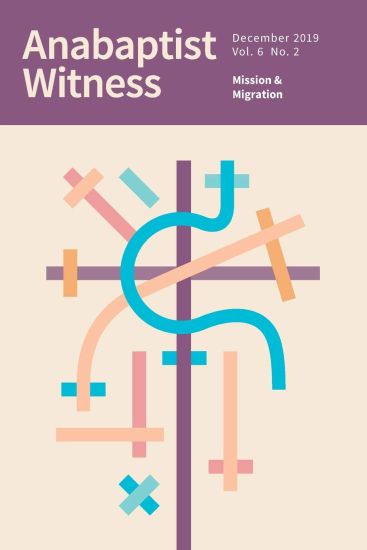
Anabaptist Witness 6.2: Mission and Migration

Anabaptist Witness 6.2: Mission and Migration

Jamie Pitts

Independently Published
2019
nidottu
To talk about migration is to talk about identity, both individual identity and the collective identities of communities of faith. Forced migration characterized and shaped the early Anabaptist movement-a movement created, in part to ensure religious freedom and the ability to practice faith as separate communities. This pattern of movement, originally meant to support a closed community, has resulted in a migration of theology, growing missions movements, and the spread of Anabaptism across the world.In this issue of Anabaptist Witness, authors explore ways in which migration has shaped identity as well as how identity has shaped migration and ways of being and belief, both in the past and the present. They also offer reflections on, and understandings from different perspectives around the world of, who we are as faith communities of migrants and people on the move.
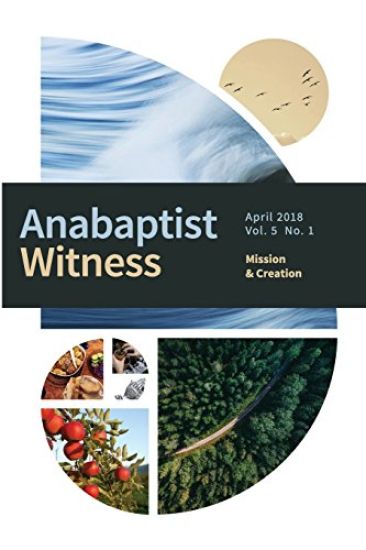
Anabaptist Witness 5.1: Mission and Creation

Anabaptist Witness 5.1: Mission and Creation

Jamie Pitts

Createspace Independent Publishing Platform
2018
nidottu
In the midst of the ominous message that we are careening toward destruction, there are signs of hope everywhere in acts large and small that people are taking to mitigate the effects of climate change and restore damaged lands. Essays in this issue of Anabaptist Witness explore and propose some of these hopeful acts: community gardens in the Netherlands and Syria, environmental activism in the UK, the carbon impact of mission agency travel, and imaginative speech about God and the environment shaped by dialogue with indigenous communities and embracing "wildness" in one's soul.
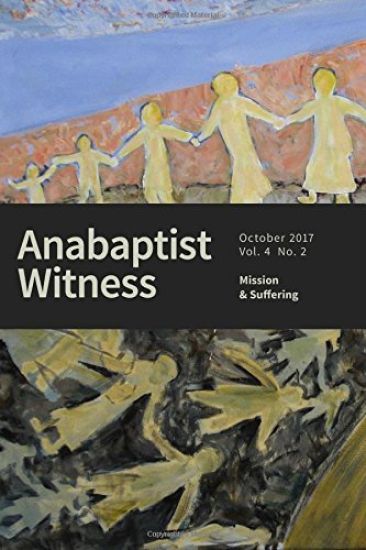
Anabaptist Witness 4.2: Mission and Suffering

Anabaptist Witness 4.2: Mission and Suffering

Jamie Pitts

Createspace Independent Publishing Platform
2017
nidottu
The contributors to this issue of Anabaptist Witness have strained to see God amid experiences of suffering in mission, and in doing so they point to the hope of resurrection life. Articles, poems, and artwork address missionary suffering, mission that responds to suffering, and mission that causes suffering. Specific topics treated include Ausbund hymns, Sufi Islam, health crisis during ministry, marginalized indigenous communities in southern Mexico, and Mennonite participation in the Canadian Residential Schools program for indigenous children.