Kirjojen hintavertailu. Mukana 12 298 144 kirjaa ja 12 kauppaa.
Kirjailija
Jan Emblemsvåg
Kirjat ja teokset yhdessä paikassa: 5 kirjaa, julkaisuja vuosilta 2000-2016, suosituimpien joukossa Reengineering Capitalism. Vertaile teosten hintoja ja tarkista saatavuus suomalaisista kirjakaupoista.
This book provides an innovative approach to sustainable development, one based on insights gleaned from the Industrial Revolution to the present, and which highlights the importance of aligning economic interests with sustainable development considerations. It investigates how a broad-based systematic approach can be used to develop societies sustainably by integrating environmental issues into the capitalist system without value-laden approaches, which produce little more than politics and inaction as we are witnessing today. The proposed approach focuses on realigning the financial markets to providing capital at reasonable cost to fuel innovation towards sustainable development across the entire economy. This requires government policies that level the playing field and also intervene strategically in cases where the playing field is weak or missing . Intended for researchers, policy-makers and graduate students, the book will also benefit non-governmental organizations, economists and the general public.
This book provides an innovative approach to sustainable development, one based on insights gleaned from the Industrial Revolution to the present, and which highlights the importance of aligning economic interests with sustainable development considerations. It investigates how a broad-based systematic approach can be used to develop societies sustainably by integrating environmental issues into the capitalist system without value-laden approaches, which produce little more than politics and inaction as we are witnessing today. The proposed approach focuses on realigning the financial markets to providing capital at reasonable cost to fuel innovation towards sustainable development across the entire economy. This requires government policies that level the playing field and also intervene strategically in cases where the playing field is weak or missing . Intended for researchers, policy-makers and graduate students, the book will also benefit non-governmental organizations, economists and the general public.
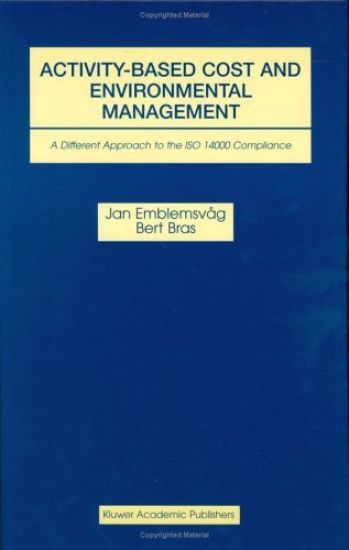
It is clear that our environment is changing, and not for the better. Companies cannot ignore environmental issues anymore. Public awareness is growing, legislation is tightening, and demand for ISO 14000 compliance is rising. For many, however, the field of environmental management (including ISO 14000) is full of unfamiliar terms, high learning curves, unproductive approaches, much frustration, and often little action. If environmental management is to become widely accepted and self-motivated in industry, it must connect to the basic motivators for business: increased competitiveness and profitability. Activity-Based Cost And Environmental Management: A Different Approach to the ISO 14000 Compliance demonstrates how environmental assessment and management can be performed based upon familiar principles: cost accounting and cost management. Specifically, this book describes how the well-established Activity-Based Costing and Management principles can be extended with non-monetary environmental dimensions. The result is a single, integrated framework called Activity-Based Cost and Environmental Management that provides the tools and abilities to do both environmental management and cost management in an integrated manner and according to modern management principles. This integration of economic and environmental dimensions based upon familiar cost accounting and management principles makes it easier for decision-makers to not only include the environment in their decision-making, but also to identify, rank and prioritize opportunities for win-win situations where competitiveness is increased and environmental impact reduced at the same time. In this book, the basic concepts of Activity-Based Cost and Environmental Management are described, as well as how to make your own integrated Activity-Based Cost and Environmental Management implementations and how to get the most out of them using uncertainty distributions, Monte Carlo simulations, and sensitivity charts. Among others, the book includes chapters on environmental management and Activity-Based Costing, as well as several real-life case studies from companies for which the authors implemented Activity-Based Cost and Environmental Management systems.
Manage costs before they occur "Traditional cost cutting has always had a backward focus and created lots of negative reactionsboth rational and irrational. In his new book, Jan Emblemsvag introduces a new forward looking life-cycle approach to cost management. Employing foresight instead of hindsight puts the focus on processes, uncertainty and risks, and future value creation. "The authors strong sidebesides having a good holistic conceptis the ability to express himself accurately and clearly on very complicated and sophisticated theory. Managers, consultants, and others with interest in cost management will be enlightened and inspired by the bookand no doubt find it of great help in applying the methods and processes that are presented. "The idea of turning uncertainty into an asset for managers is quite unique. Making budgeting less data-oriented and more risk-oriented is another good idea. The next step now is to make operative approaches and apply the theory in practical situations!" John-Erik Stenberg Considium Consulting Group AS "This book skillfully combines the ideas of life-cycle costing and activity-based costing to come up with an approach to effectively manage costs in an uncertain environment." Dr. Arnold Schneider Professor of Accounting Georgia Institute of Technology Life-Cycle Costing (LCC), a cost projection method typically associated with engineering, allows for the accurate prediction of the total costs a product will incur throughout its life-cycle. Meshing this technique with activity-based costing, risk management, and Monte Carlo analytical methods, Jan Emblemsvåg offers a broad range of businesses a new, more effective approach to cost management in Life-Cycle Costing. By introducing uncertainty into its models, "Activity-Based LCC" offers managers the clarity of hindsight before costs are actually incurred. Among other features, Life-Cycle Costing includes: *Three case studies that demonstrate how Activity-Based LCC affords superior cost management *A step-by-step guide to LCC methodology *Definitions of key terms *A discussion of activity-based costing and risk management fundamentals *An appendix with examples of Monte Carlo methods Life-Cycle Costing provides controllers and cost managers an insiders look at the next generation of cost management techniques.
It is clear that our environment is changing, and not for the better. Companies cannot ignore environmental issues anymore. Public awareness is growing, legislation is tightening, and demand for ISO 14000 compliance is rising. For many, however, the field of environmental management (including ISO 14000) is full of unfamiliar terms, high learning curves, unproductive approaches, much frustration, and often little action. If environmental management is to become widely accepted and self-motivated in industry, it must connect to the basic motivators for business: increased competitiveness and profitability. Activity-Based Cost And Environmental Management: A Different Approach to the ISO 14000 Compliance demonstrates how environmental assessment and management can be performed based upon familiar principles: cost accounting and cost management. Specifically, this book describes how the well-established Activity-Based Costing and Management principles can be extended with non-monetary environmental dimensions. The result is a single, integrated framework called Activity-Based Cost and Environmental Management that provides the tools and abilities to do both environmental management and cost management in an integrated manner and according to modern management principles. This integration of economic and environmental dimensions based upon familiar cost accounting and management principles makes it easier for decision-makers to not only include the environment in their decision-making, but also to identify, rank and prioritize opportunities for win-win situations where competitiveness is increased and environmental impact reduced at the same time. In this book, the basic concepts of Activity-Based Cost and Environmental Management are described, as well as how to make your own integrated Activity-Based Cost and Environmental Management implementations and how to get the most out of them using uncertainty distributions, Monte Carlo simulations, and sensitivity charts. Among others, the book includes chapters on environmental management and Activity-Based Costing, as well as several real-life case studies from companies for which the authors implemented Activity-Based Cost and Environmental Management systems.