Kirjojen hintavertailu. Mukana 12 595 353 kirjaa ja 12 kauppaa.

Kirjailija

Jan Jagodzinski

Kirjat ja teokset yhdessä paikassa: 14 kirjaa, julkaisuja vuosilta 1997-2025, suosituimpien joukossa Arts-Based Research. Vertaile teosten hintoja ja tarkista saatavuus suomalaisista kirjakaupoista.

14 kirjaa

Kirjojen julkaisuhaarukka 1997-2025.

Pedagogical Encounters in the Post-Anthropocene, Volume 2

Pedagogical Encounters in the Post-Anthropocene, Volume 2

jan jagodzinski

Springer International Publishing AG
2025
nidottu
As a follow up to Pedagogical Encounters in the Post-Anthropocene, Volume I, this book addresses three major areas in response to the post-Anthropocene: Technology, Neurology, Quantum. Each of these areas is broadly addressed in relation to the concerns that have arisen both theoretically and educationally. As in Volume I, the author terms these to be encounters as each area presents a particular problematic when addressing the phase change that the planet is undergoing where the anthropogenic labour of global humanity is contributing to climate change, endangering our very existence. Technology in education has been a significant development. There is a concerted effort to review this development placing stress on the rise of learning machines and algorithms. In the second encounter the vast literature on neurology is addressed, especially neurodiversity and the various symptoms that have emerged in the post-Anthropocene era. The last section reviews issues related to quantum theory as this is fundamental to tensions between physics and metaphysics. The volume concludes with the author’s own pedagogical proposal for the future.
Pedagogical Encounters in the Post-Anthropocene, Volume 1

Pedagogical Encounters in the Post-Anthropocene, Volume 1

jan jagodzinski

Springer International Publishing AG
2025
nidottu
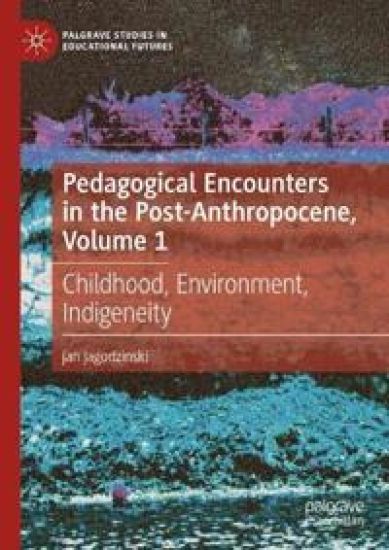
This volume, the first of a two volume set, addresses three major areas in response to the post-Anthropocene: childhood, environment and indigeneity. Each of these areas is broadly addressed in relation to the concerns that have arisen both theoretically and educationally. The author terms these to be encounters as each area presents a particular problematic when addressing the phase change that the planet is undergoing where the anthropogenic labour of global humanity is contributing to climate change, endangering our very existence. There has been a concerted effort to overcome the nature-culture divide in education. The author reviews this development in the first section where there has been a particular emphasis placed on childhood education. In the second section he turns to the pedagogical theories that are attempting to overcome this same divide in environmental and science education. The last section attempts to bring into the conversation the vast literature on Indigeneity and their attempts to revise traditional education to meet these extraordinary times.
Pedagogical Encounters in the Post-Anthropocene, Volume 1

Pedagogical Encounters in the Post-Anthropocene, Volume 1

jan jagodzinski

Springer International Publishing AG
2024
sidottu
This volume, the first of a two volume set, addresses three major areas in response to the post-Anthropocene: childhood, environment and indigeneity. Each of these areas is broadly addressed in relation to the concerns that have arisen both theoretically and educationally. The author terms these to be encounters as each area presents a particular problematic when addressing the phase change that the planet is undergoing where the anthropogenic labour of global humanity is contributing to climate change, endangering our very existence. There has been a concerted effort to overcome the nature-culture divide in education. The author reviews this development in the first section where there has been a particular emphasis placed on childhood education. In the second section he turns to the pedagogical theories that are attempting to overcome this same divide in environmental and science education. The last section attempts to bring into the conversation the vast literature on Indigeneity and their attempts to revise traditional education to meet these extraordinary times.
Pedagogical Encounters in the Post-Anthropocene, Volume 2

Pedagogical Encounters in the Post-Anthropocene, Volume 2

jan jagodzinski

Springer International Publishing AG
2024
sidottu
As a follow up to Pedagogical Encounters in the Post-Anthropocene, Volume I, this book addresses three major areas in response to the post-Anthropocene: Technology, Neurology, Quantum. Each of these areas is broadly addressed in relation to the concerns that have arisen both theoretically and educationally. As in Volume I, the author terms these to be encounters as each area presents a particular problematic when addressing the phase change that the planet is undergoing where the anthropogenic labour of global humanity is contributing to climate change, endangering our very existence. Technology in education has been a significant development. There is a concerted effort to review this development placing stress on the rise of learning machines and algorithms. In the second encounter the vast literature on neurology is addressed, especially neurodiversity and the various symptoms that have emerged in the post-Anthropocene era. The last section reviews issues related to quantum theory as this is fundamental to tensions between physics and metaphysics. The volume concludes with the author’s own pedagogical proposal for the future.
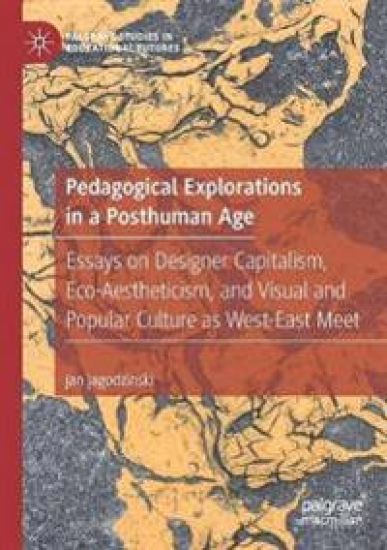
Pedagogical Explorations in a Posthuman Age

Pedagogical Explorations in a Posthuman Age

jan jagodzinski

Springer Nature Switzerland AG
2021
nidottu
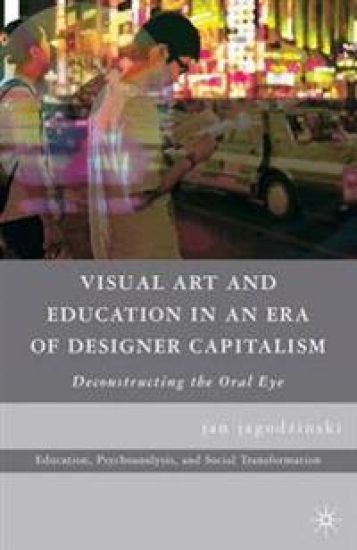
This book problematizes the role of education in an increasingly mediatized world through the lenses of creativity, new media, and consumerism. At the core of the issue, the author argues, creativity in art education is being co-opted to serve the purposes of current economic trends towards designer capitalism. Using an East meets West approach, jagodzinski draws on Deleuze and Guattarian philosophy to explore visual and popular culture in Korean society, addressing the tensions that exist between designer education and art that explores the human condition. In doing so, he challenges art educators to envision a new paradigm for education which questions established media ontologies and incorporates new ways to confront the crisis of the Anthropocene.
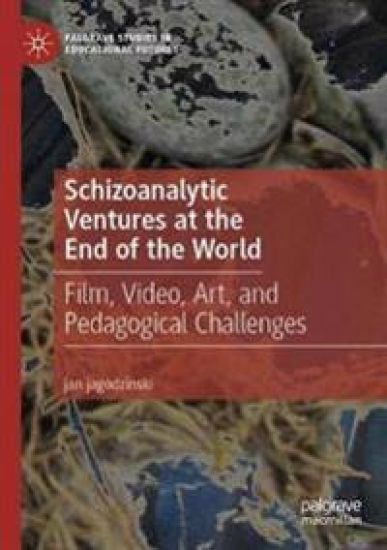
Schizoanalytic Ventures at the End of the World

Schizoanalytic Ventures at the End of the World

jan jagodzinski

Springer Nature Switzerland AG
2020
nidottu
This book provides a thorough application of theoretical ideas from Deleuze and Guattari to a series of examples drawn from contemporary film and new media arts. Chapters demonstrate examples of how to do schizoanalysis in philosophically informed cinema studies, new media, and arts based education. Schizoanalysis, as proposed by Deleuze and Guattari in distinction to Lacanian psychoanalysis, provides an imaginary basis to address the precarity of the contemporary world order: from the growing populism with its authoritarian fascist tendencies to the growing concerns regarding climate change within the Anthropocene. Part I of this book initiates this understanding through cinematic examples. Part II calls for a schizoanalytic pedagogical imagination, which is needed to provide insight into the structures of desire as they circulate in media, especially videogames, and the tensions between analogue and digital technological manifestations. Such pedagogy enables an understanding of the ‘new materialism’ where nonhuman and inhuman (AI) agencies are taken into account. To this end schizoanalytic pedagogy calls for a ‘new earth’ of transformed values and relationships.
Pedagogical Explorations in a Posthuman Age

Pedagogical Explorations in a Posthuman Age

Jan Jagodzinski

Springer Nature Switzerland AG
2020
sidottu
This book problematizes the role of education in an increasingly mediatized world through the lenses of creativity, new media, and consumerism. At the core of the issue, the author argues, creativity in art education is being co-opted to serve the purposes of current economic trends towards designer capitalism. Using an East meets West approach, jagodzinski draws on Deleuze and Guattarian philosophy to explore visual and popular culture in Korean society, addressing the tensions that exist between designer education and art that explores the human condition. In doing so, he challenges art educators to envision a new paradigm for education which questions established media ontologies and incorporates new ways to confront the crisis of the Anthropocene.
Schizoanalytic Ventures at the End of the World

Schizoanalytic Ventures at the End of the World

Jan Jagodzinski

Springer Nature Switzerland AG
2019
sidottu
This book provides a thorough application of theoretical ideas from Deleuze and Guattari to a series of examples drawn from contemporary film and new media arts. Chapters demonstrate examples of how to do schizoanalysis in philosophically informed cinema studies, new media, and arts based education. Schizoanalysis, as proposed by Deleuze and Guattari in distinction to Lacanian psychoanalysis, provides an imaginary basis to address the precarity of the contemporary world order: from the growing populism with its authoritarian fascist tendencies to the growing concerns regarding climate change within the Anthropocene. Part I of this book initiates this understanding through cinematic examples. Part II calls for a schizoanalytic pedagogical imagination, which is needed to provide insight into the structures of desire as they circulate in media, especially videogames, and the tensions between analogue and digital technological manifestations. Such pedagogy enables an understanding of the ‘new materialism’ where nonhuman and inhuman (AI) agencies are taken into account. To this end schizoanalytic pedagogy calls for a ‘new earth’ of transformed values and relationships.
Misreading Postmodern Antigone

Misreading Postmodern Antigone

Jan Jagodzinski

Intellect Books
2011
nidottu
In the mid-1980s, film director Marco Bellocchio and renegade psychoanalyst Massimo Fagioli cowrote The Devil in the Flesh, a politically and sexually charged film illustrating some of Fagioli's controversial theories. Echoing the anti-Lacanian sentiment popularized by Gilles Deleuze, the film is perhaps best remembered for a scene in which the character Andrea misreads a section of the famous Greek tragedy Antigone. But this scene has itself been frequently misread, opening up the text to questions of feminism, politics, and the representation of Antigone—a figure frequently used and abused in feminist politics. Displaying considerable analytic depth, Misreading Postmodern Antigone considers these divergent readings and what they have to tell us about contemporary society.
Pedagogical Desire

Pedagogical Desire

Jan Jagodzinski

Praeger Publishers Inc
2002
sidottu
What is the right pedagogical distance for learning to take place? What should be the teacher's role concerning a student's desire? Ethically speaking, how are we to understand the dialectic between desire and the drive? Are we obligated to help students mourn the knowledge that they must let go? Can ignorance (which sounds pejorative) be pedagogically useful as that which is unsaid and repressed? When the pedagogical distance collapses and seduction takes place, can such behavior be excused? These are just some of the questions that are raised throughout this collection by the authors. Lacanian psychoanalysis presents a challenge to our usual understanding of the subject as formulated by ego psychology, as well as the discursive subject of postmodernism. Can Lacan's tripartite psychic registers of the Real, Imaginary, and the Symbolic present the subject in unending intrapsychic conflict? Can pedagogy address this struggle? How do we, as educators, take the notion of the unconscious seriously into account? The authors of this collection engage themselves in such questioning, in some cases examining their own practices and in other cases developing possible strategies with a view of understanding the psychic life of teaching.
Postmodern Dilemmas

Postmodern Dilemmas

Jan Jagodzinski

Routledge Member of the Taylor and Francis Group
1997
sidottu
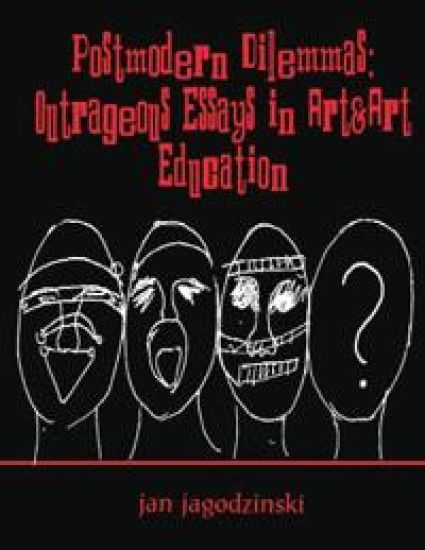
In Postmodern Dilemmas: Outrageous Essays in Art&Art Education and Pun(k) Deconstruction: Experimental Writings in Art&Art Education, jan jagodzinski presents a series of essays covering a timespan of approximately ten years. These essays chart the theory and practice of art&art education as it relates to issues of postmodernity and poststructuralism concerning representation, identity politics, consumerism, postmodern architecture, ecology, phallocentrism of the artistic canon, pluriculturalism, media and technology, and AIDS. As a former editor of The Journal of Social Theory in Art Education and a founding member for the Caucus on Social Theory in Art Education, the author attempts to deconstruct the current art education paradigm, which is largely based on modernist tenets, and to reorient art education practice to social issues as developed in both media education and cultural studies. Part of the intent in these two volumes is to undertake a sustained critique of the 1982 Art in the Mainstream (A.I.M.) statement, which continues to be considered as the core value for art education. The distinct intention of this critique is to put forward a new value base for art&art education in these postmodern times.Many of the essays raise the need to be attentive to sex/gender issues in art&art education and the need to read the artistic discourse "otherwise." There is a sustained critique of the art programs developed by the Getty Center for the Arts, whose arts curriculum presents the paradigm case of late modernist thinking. Some essays are written in a provocative form that tries to accommodate such content. This is particularly the case in Pun(k) Deconstruction, where architectural discourse is deconstructed, and which includes an "artistic performance" given by the author in 1987. This singular set of volumes combines scholarship in the areas of gender studies, aesthetics, art history, art education, poststructuralism, and cultural studies in a unique blend of theory and practice for rethinking the field of art education.
Pun(k) Deconstruction

Pun(k) Deconstruction

jan jagodzinski

Routledge Member of the Taylor and Francis Group
1997
sidottu
In Postmodern Dilemmas: Outrageous Essays in Art&Art Education and Pun(k) Deconstruction: Experifigural Writings in Art&Art Education, jan jagodzinski presents a series of essays covering a timespan of approximately ten years. These essays chart the theory and practice of art&art education as it relates to issues of postmodernity and poststructuralism concerning representation, identity politics, consumerism, postmodern architecture, ecology, phallocentrism of the artistic canon, pluriculturalism, media and technology, and AIDS. As a former editor of The Journal of Social Theory in Art Education and a founding member for the Caucus on Social Theory in Art Education, the author attempts to deconstruct the current art education paradigm, which is largely based on modernist tenets, and to reorient art education practice to social issues as developed in both media education and cultural studies. Part of the intent in these two volumes is to undertake a sustained critique of the 1982 Art in the Mainstream (A.I.M.) statement, which continues to be considered as the core value for art education. The distinct intention of this critique is to put forward a new value base for art&art education in these postmodern times. Many of the essays raise the need to be attentive to sex/gender issues in art&art education and the need to read the artistic discourse "otherwise." There is a sustained critique of the art programs developed by the Getty Center for the Arts, whose arts curriculum presents the paradigm case of late modernist thinking. Some essays are written in a provocative form that tries to accommodate such content. This is particularly the case in Pun(k) Deconstruction, where architectural discourse is deconstructed, and which includes an "artistic performance" given by the author in 1987. This singular set of volumes combines scholarship in the areas of gender studies, aesthetics, art history, art education, poststructuralism, and cultural studies in a unique blend of theory and practice for rethinking the field of art education.